Clara’s Verdict
There are very few audiobooks about astrophysics that I would recommend without reservation to a general listener, but Matthew Bothwell’s The Invisible Universe is one of them. It takes a genuinely surprising approach – not the universe we can see, the stars and galaxies that have been the subject of human wonder since before recorded history, but the 99 per cent we cannot see with any kind of conventional optical instrument – and pursues that approach with rigour, wit, and an infectious delight in the sheer strangeness of the cosmos. Bothwell narrates his own work, and the combination of his evident expertise and his evident pleasure in communicating it produces something that feels more like a conversation with a brilliant and enthusiastic friend than a formal lecture.
I have reviewed a great deal of popular science in audio form, and the most consistent failure mode is a book that substitutes enthusiasm for explanation – that conveys excitement without building understanding. Bothwell avoids this entirely. His explanations are structured with real pedagogical intelligence: each new concept is introduced when the reader is ready for it, grounded in concrete examples, and linked back to what has come before. This is a model of the form.
About the Audiobook
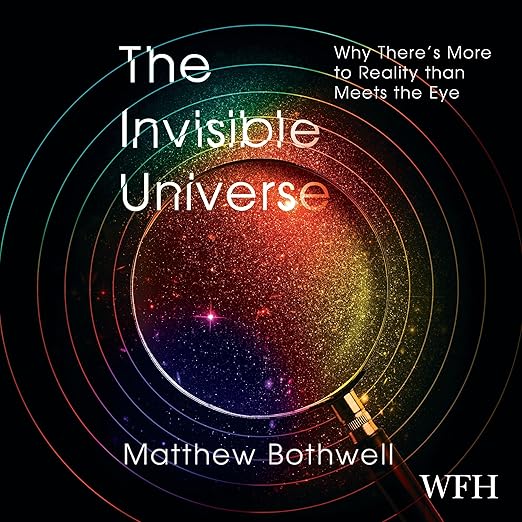
Since the dawn of our species, people all over the world have gazed in awe at the night sky. But for all the beauty and wonder of the stars, when we look with just our eyes we are seeing and appreciating only a tiny fraction of the universe. What does the cosmos have in store for us beyond the phenomena we can see – from black holes to supernovas? How different does the invisible universe look from the home we thought we knew? Dr Matt Bothwell takes us on a journey through the full spectrum of light and beyond, revealing what we have learned about the mysteries of the universe.
This book is a guide to the 99 per cent of cosmic reality we cannot see – the universe that is hidden, right in front of our eyes. It is also the endpoint of a scientific detective story thousands of years in the telling, beginning with the ancient recognition that there was more to the sky than the eye could discern, and progressing through radio astronomy, infrared, X-ray and gamma-ray observations to the gravitational wave detections of recent years. Bothwell covers black holes, neutron stars, the cosmic microwave background radiation, dark matter, dark energy, and the large-scale structure of the universe – all without losing the thread of narrative or the sense of cumulative revelation. Published by W. F. Howes Ltd. The audiobook runs to 10 hours and 6 minutes.
The Narration
Matthew Bothwell narrates The Invisible Universe himself, which proves to be an excellent decision. He has a clear, unhurried voice with a quality of genuine excitement that never tips into the breathless enthusiasm that can feel performative. When he describes the first detection of gravitational waves, or the discovery of the cosmic microwave background, you hear the pleasure of someone who finds these events as extraordinary as you are about to find them. His pacing is well-judged for the material – he gives the more complex passages room to breathe without letting the narrative stall. For a ten-hour scientific audiobook, sustaining the listener’s engagement throughout is no small achievement, and Bothwell manages it with apparent ease.
What Readers Say
The listener response has been consistently enthusiastic, with 381 ratings averaging 4.6 out of 5 on Audible – among the stronger scores for popular science titles in this category. One reviewer wrote: “An incredible book that has really made me value what scientists have been able to tell us about the cosmos. The entire universe is so strange and much of it we can’t see, but things like infrared and sound wavelengths have helped us discover things about black holes that are bizarre and wonderful.” Another described it as “well written, explaining the hidden Universe in easy language, with occasional asides of wit.” A third noted that “from about halfway through, every fact was new to me” – high praise from a reader who came in with some prior knowledge of the subject. The consensus is that Bothwell has achieved the popular science ideal: genuinely accessible without being dumbed down.
Who Should Listen?
Curious non-specialists – the kind of listener who has enjoyed television series by Brian Cox or Neil deGrasse Tyson but wants more depth and sustained argument than a television hour can provide. Bothwell is careful never to assume prior knowledge, but equally careful never to be condescending, which is a harder balance to strike than it appears. Those with a physics or astronomy background will likely find it too introductory, but as an onramp to the subject for an interested general reader, it is excellent. Also available via Kobo and Scribd.