Clara’s Verdict
The Science of Discworld series represents one of the more unlikely successes in popular science publishing: using the anarchic, magic-saturated universe of Terry Pratchett’s Discworld as a vehicle for explaining how the actual universe works. Darwin’s Watch is the third instalment, and it tackles evolutionary theory — specifically, the question of how different history might look if Charles Darwin had never written On the Origin of Species. It is a wonderfully strange book, part Pratchett comedy, part rigorous science communication, and entirely sui generis.
Whether you come to this as a Pratchett devotee or as someone with a genuine interest in evolutionary science, there is something here for you. The two modes coexist with more grace than you might expect, and the result is a book that makes you think while making you laugh — a combination that is rarer and more valuable than it sounds.
About the Audiobook
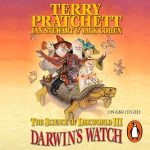
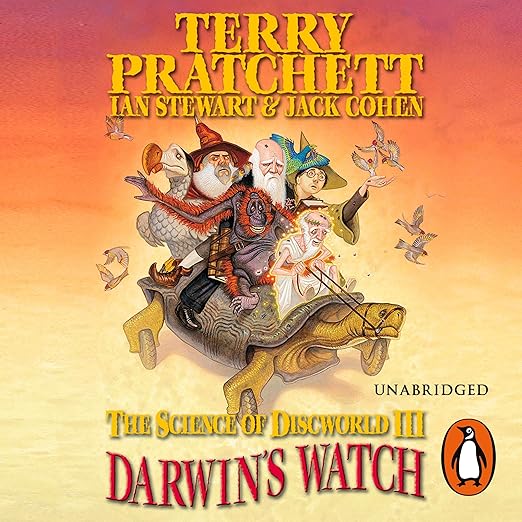
Science of Discworld III: Darwin’s Watch is the third entry in the Science of Discworld Series, written by Terry Pratchett, Ian Stewart and Jack Cohen and published by RH AudioGo in 2012. The audiobook runs to 11 hours and 26 minutes. The premise builds on the previous volumes: the wizards of Unseen University have accidentally created Roundworld — our universe, a place without magic where physics actually works — and are now obliged to monitor its progress from afar.
In this instalment, something has gone badly wrong with Victorian England. History has stagnated: a theologian named Sir Arthur Nightingale has published a dismal book about natural selection, and in response, an obscure country vicar called Charles Darwin has written a bestselling work called Theology of Species, making it essentially impossible for evolutionary theory to gain traction. Unless the wizards intervene, humanity will never develop space travel, will never escape Earth’s eventual fate, and will effectively cease to exist. The novel chapters alternate with substantial non-fiction passages written by Stewart and Cohen that explain the real science of evolution — natural selection, the fossil record, genetic drift, and the philosophical implications of a godless universe. It is an unusual structure, but it works, and the Pratchett sections give the science an emotional and comedic context that makes it stick.
The Narration
Michael Fenton Stevens provides the narration, and his performance is a significant part of what makes this audiobook work. Stevens has the rare ability to shift between the mock-pompous register of the Discworld sections — the wizards of Unseen University demand a certain theatrical self-importance — and the clearer, more measured tone required for the scientific passages without the transitions feeling jarring. He handles Pratchett’s comedy timing with evident affection, and gives the science the authority it deserves without making it feel like a lecture. At nearly 11 and a half hours, this is a substantial commitment, but Stevens sustains it throughout.
What Readers Say
Rated 4.5 out of 5 from 889 listeners on Audible UK, this is a well-loved entry in a well-loved series. Reviewer Susan Barber praised “all the references to Disc World versus round world” and noted it was “a very good explanation of evolutionary theories.” Victor offered the most thorough assessment, describing it as “another highly readable book from Pratchett, Stewart and Cohen that uses the interaction between the Discworld and the Wizards’ accidental Roundworld universe to teach some interesting ideas about evolution.” Several reviewers simply noted “typical Pratchett” as sufficient commendation — which, for fans of the series, says everything.
Who Should Listen?
This is essential listening for Pratchett fans who have not yet explored the Science of Discworld spin-off series — it is not quite like anything else he wrote, and that is part of its value. It will also suit anyone who wants a genuinely engaging introduction to evolutionary theory presented without condescension or academic dryness. Science enthusiasts who bounced off Pratchett’s fantasy in the past may find this more accessible than they expect — the science chapters stand on their own. For best results, start with the first two volumes, though each book is largely self-contained.
The counterfactual premise — what if Darwin had written a book defending divine design rather than natural selection? — is executed with the kind of intellectual seriousness that Pratchett always brought to his philosophical premises. The novel does not simply use evolution as a backdrop; it engages with the actual history and philosophy of science in ways that will give readers a richer understanding of why Darwin’s work was so culturally explosive. Stewart and Cohen’s non-fiction chapters are not padding — they are the point, and the Discworld story exists to make them more memorable rather than the other way around.
Listen to Science of Discworld III: Darwin’s Watch on Audible UK and let Terry Pratchett make evolutionary biology feel like the most urgent comedy you’ve ever encountered.