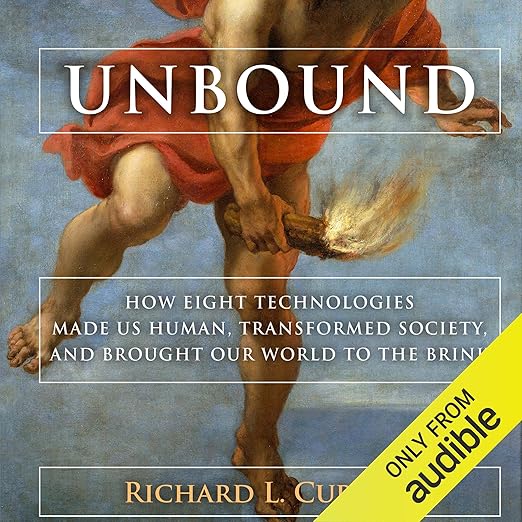
Clara’s Verdict
The grand narrative of human history – from prehistoric tools to digital civilisation – is a subject that invites either breathless triumphalism or paralysing doom, and Richard L. Currier manages to avoid both. Unbound, his account of the eight key technologies that have successively freed humanity from its biological limitations, is measured, intellectually serious, and surprisingly readable given the scale of its ambition. Noah Michael Levine’s narration keeps the long game in view over a ten-and-a-half-hour listen. This is the kind of popular science and history that justifies the category’s existence.
About the Audiobook
Currier’s central argument is elegant: that technology is not a recent phenomenon but an ancient one, beginning with the fabrication of weapons millions of years ago, and that each major technological development has literally transformed the human body and human society in ways we rarely acknowledge. The fabrication of weapons reshaped our bodies; mastery of fire enabled the migration out of Africa; clothing and shelter restructured our relationship with the environment; symbolic communication shifted human evolution from the biological to the cultural; agriculture changed our relationship with the natural world; precision machinery created the industrial nation-state.
Each of these transformations is treated with proper historical and anthropological depth. Currier draws on primatology, paleontology, archaeology, history, and anthropology to build an account that is genuinely synthetic rather than merely additive. He is particularly good on the early chapters – the periods of human prehistory that most popular accounts handle superficially because the evidence is fragmentary and the temptation to speculate is great. Currier’s training as a scientist disciplines his speculation while not eliminating it.
The book’s final sections, addressing the digital age and its implications for a sustainable human future, are necessarily more tentative – we are living inside the process rather than observing it at a distance – but Currier’s framing of the digital revolution as a potential ninth transformation, one that might either unite humanity or accelerate its self-destruction, is genuinely thought-provoking.
The Narration
Noah Michael Levine has the kind of clean, clear delivery that serves intellectual non-fiction well – authoritative without being academic, engaged without being excitable. He navigates Currier’s deliberately precise prose – the book opens with a formal definition of “technology” that sets the analytical tone – without making it feel arid. The pacing is measured, which gives the listener space to process arguments that are sometimes genuinely complex. This is a narrator who trusts the content to do the work rather than trying to dramatise it.
What Readers Say
A 4.2 rating from 731 listeners reflects solid, consistent appreciation from a broad audience. UK responses have been thoughtful: one noted that “it’s worth persevering” through the occasional side-track, finding the discursiveness stimulating rather than frustrating. An American reader provided an extended appreciation, praising the way Currier had written what could easily have been “a myriad of technical terms” in “an educational as well as entertaining manner.” Australian readers have also responded warmly, with one recommending it to “anyone with even a passing interest in anthropology.” The consistent note across reviews is that this is a book that leaves you feeling as if you understand something important that you didn’t quite grasp before.
Who Should Listen?
Unbound is for listeners who enjoy big-picture intellectual history – the kind of book that takes a very long view and draws connections across millennia. If you have enjoyed Yuval Noah Harari’s Sapiens, this is a more academic but equally ambitious treatment of overlapping territory, with a more specific focus on technology as the driving force of human transformation. It will also appeal to anyone interested in sustainability and the long-term consequences of industrial civilisation, since Currier’s final chapters engage seriously with questions that feel increasingly urgent. The accompanying reference material is available in the Audible library alongside the audio.
Listen to Unbound on Audible UK.