Clara’s Verdict
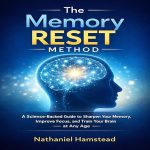
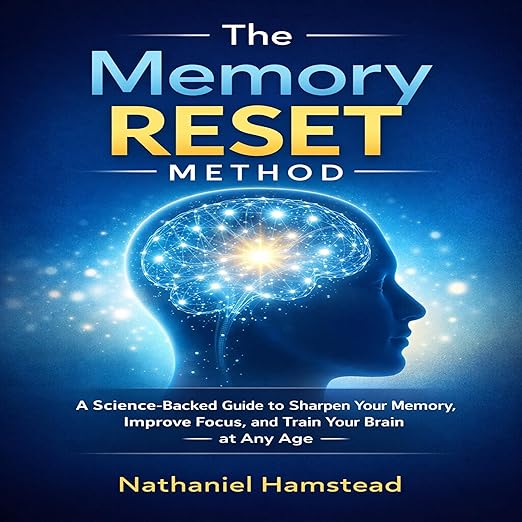
The memory self-help category is crowded, and much of it is driven by anxiety rather than genuine insight – books that tell you your memory is failing and then sell you a rigorous programme of drills and mnemonics to panic your way back to competence. The Memory Reset Method by Nathaniel Hamstead takes a refreshingly different approach. The opening reframe is worth the price of admission on its own: most everyday memory failures aren’t signs of decline. They’re signs of stress, distraction, overload, and exhaustion. Fix those, and the memory often fixes itself.
This is a short listen – just over an hour – which means it can’t go deep on any single idea. But as an introduction to a kinder, more evidence-based way of thinking about cognitive function, it’s well-structured and genuinely calming. Sometimes a book doesn’t need to be long to do its job.
About the Audiobook
Hamstead’s central argument challenges the dominant narrative around memory and ageing. Rather than treating forgetfulness as a problem to be drilled away, he frames it as the brain’s response to an overloaded, high-pressure environment. The book covers the basics of how memory actually works, why multitasking and self-criticism are among its biggest enemies, and how qualities like focus, adequate rest, and emotional safety create the conditions for recall to improve naturally.
The practical sections offer gentle, realistic techniques for remembering names, conversations, and daily details – not through forced repetition, but through changing the conditions under which you encounter and process information. There’s also a section specifically on rebuilding confidence in your own memory, which addresses something the flashcard-and-quiz approach entirely misses: the anxiety feedback loop, where fear of forgetting creates the conditions for further forgetting.
It’s a short book, clocking in at just over an hour, so this isn’t a comprehensive neuroscience course. It’s more of a thoughtful reset – a way of approaching memory with less hostility and more intelligence.
The Narration
B Fike narrates, delivering the material in a calm, clear style that suits the book’s therapeutic register. There’s no urgency or alarm in the delivery – which is, of course, exactly right for a book whose central message is that you need to stop panicking about your memory. The short runtime means the listen doesn’t test your attention in any demanding way, and the structure is clear enough that key ideas land cleanly without needing repetition.
What Readers Say
This is a recently released title with no published listener reviews yet, which means we’re working without the usual social proof. That’s not necessarily a mark against it – new releases from independent authors often take time to accumulate feedback. The book’s synopsis is transparent about what it offers, and the author’s positioning (pressure-free, science-backed, designed for “clarity, calm, and real life”) is consistent with what the material actually delivers.
If you’ve read widely in the cognitive health category, you’ll recognise the approach from work like Lisa Feldman Barrett’s research on emotion and performance, or the growing literature on psychological safety and cognitive function. Hamstead synthesises these ideas accessibly without oversimplifying them.
Who Should Listen?
Anyone who has spent the past few years blaming themselves for an increasingly unreliable memory. If you routinely walk into rooms and immediately forget why, lose names seconds after hearing them, or feel a low-grade anxiety about cognitive decline – and you’d rather be reassured than panicked – this is a useful starting point. It’s particularly well-suited to people in high-demand professional or caregiving roles who aren’t getting enough sleep and are running on constant stress.
At just over an hour, it’s also genuinely manageable. You can listen to it on a single commute and come away with a different, kinder framework for understanding your own mind.
Listen on Audible UK: Get The Memory Reset Method on Audible. Also available on Kobo, Scribd, and Storytel.