Clara’s Verdict
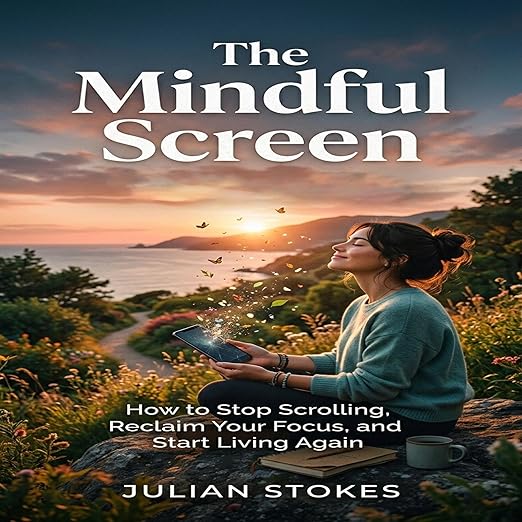
I have a complicated relationship with books about screen addiction, not least because I tend to read them on a screen while simultaneously checking my email. Julian Stokes’s The Mindful Screen is not the most substantial entry in this crowded genre — and I say that as someone who has listened to most of the substantial entries — but at just over an hour it earns its modest runtime by being realistic about what it is asking you to do rather than demanding wholesale technological renunciation. There is a particular kind of digital-wellness book that leaves you feeling guilty and exhausted; this is not one of them. Narrated by Robyn Green for an independent publisher, it is practical and non-preachy, and that combination is rarer than you might expect in this genre.
About the Audiobook
Stokes’s framing is psychological rather than moralising, which is the right approach for a subject that can easily tip into self-righteousness. He begins with the dopamine-driven mechanics of habit loops and the myth of multitasking: ground covered by Cal Newport, Johann Hari, and others, but competently summarised here for listeners who have not yet encountered that literature. The argument is accessible and does not assume prior familiarity with attention science.
The middle section offers practical strategies, including auditing screen time, silencing notifications, and designing environments that make distraction harder to fall into. These are not novel ideas, but Stokes presents them with clarity and without the hectoring tone that can make self-help feel like a lecture. The emphasis throughout is on deliberate choice rather than prohibition, which is the correct emphasis for something as embedded in modern life as digital technology.
The final third extends to social territory: social media overwhelm, email anxiety, and what it means to raise children in a household where screens are everywhere. This section is the most interesting and the most underserved in the literature, particularly the material on children — where the question is not whether to expose them to screens but how to model a healthy relationship with technology in front of them. Stokes does not resolve this question fully, but he raises it usefully.
The book’s most useful quality is its stated refusal to demand total abstinence. Stokes is not asking you to become a digital hermit. He is asking you to be deliberate rather than automatic, and that distinction is the entire argument. This is an independent production released in March 2026 with no listener ratings yet recorded.
The Narration
Robyn Green delivers the text with a clear, pleasantly neutral voice that suits instructional nonfiction. The pace is measured without being soporific, and the clarity of the delivery makes it easy to follow the argument without re-winding. For a self-help audiobook of this length, Green’s performance is entirely functional and occasionally a little more than that: there are moments where the warmth in her delivery makes the advice feel like it comes from a person rather than a listicle, and those moments are the best parts of the recording.
What Readers Say
No ratings are available at the time of writing. This is a new release from an independent publisher, and the absence of a review record is simply a reflection of that newness rather than any evidence of quality. The synopsis and the author’s framing are the best guide to whether this title will suit you. One measure of a book about intentional technology use is whether it survives the audio format well — whether the argument can be followed without notes or diagrams — and this one does. It works as background listening and as a focused listen, which is a minor but genuine recommendation.
Who Should Listen?
At just over an hour, this is a low-risk listen for anyone who has been meaning to think more carefully about their relationship with technology but does not want to commit to a full-length book on the subject. It functions well as an introduction to the ideas — a gateway into the broader literature of attention and distraction — and may serve as a useful companion to more substantial works like Hari’s Stolen Focus or Newport’s Digital Minimalism. Those already familiar with that literature will find little here that is new, but may appreciate the compression. Those with young children will find the final section the most directly applicable part of the book to their current situation and daily life.