Clara’s Verdict
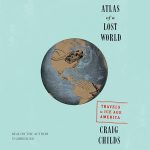
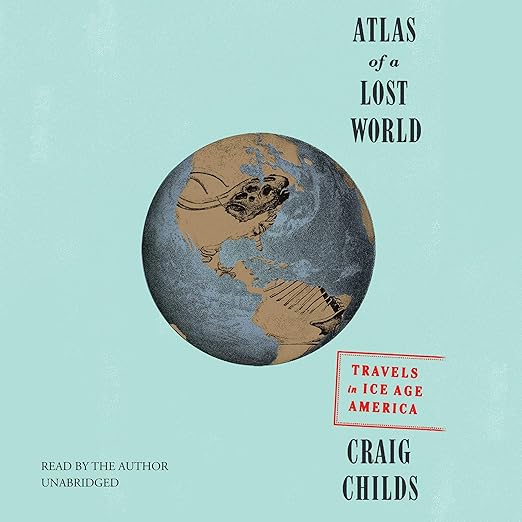
Craig Childs is the kind of writer who will spend three days crossing a Utah desert trying to locate the exact spot where a Palaeolithic hunter made camp twelve thousand years ago – not for academic credentials, but because he needs to stand there, to feel the rock and the heat and the silence, before he can write about it. Atlas of a Lost World is an unusual and sometimes genuinely awkward book, but at its best it does something that very few works of popular archaeology manage: it makes the deep past feel physically present, not as data or narrative reconstruction, but as a place you could almost reach. Childs narrates his own text across nine hours and ten minutes, and that voice – unhurried, attentive, carrying the particular quality of someone who spends a great deal of time in difficult terrain – is essential to how the book works.
About the Audiobook
The subject is the first humans in North America: who they were, where they came from, when they arrived, and what they encountered when they got there. Scientists disagree, sometimes vehemently, about the dates – somewhere between 20,000 and 40,000 years ago is the current working range – and about the routes: the Bering land bridge, the Pacific coastline, or both. Childs moves between backcountry expeditions in the landscapes these first arrivals would have traversed and the accumulated archaeological evidence – Palaeolithic spear points still bearing the protein residue of their prey, ancient hearths, handprints, and the preserved tracks of megafauna that both sustained and threatened these early humans.
The resulting structure is part travelogue, part popular archaeology, and part speculative imaginative reconstruction. Childs is frank about the limits of the evidence and the speculative nature of some of his inferences, which is both intellectually honest and, for readers wanting authoritative answers, occasionally frustrating. This is not a textbook; it is a sustained act of imaginative attention to a subject that is genuinely uncertain.
The megafauna deserve particular mention. The North American Ice Age landscape Childs describes – mastodons, woolly mammoths, giant ground sloths, sabre-toothed cats, American lions, short-faced bears – is genuinely staggering to contemplate, and the evidence that these first humans were simultaneously hunting these creatures and being hunted by them gives the arrival story a dramatic scale that no subsequent chapter of American history quite matches. Childs makes you feel the scale of what it meant to arrive in a continent full of enormous animals that had never seen a human being before.
The Narration
Childs reads his own work, and his voice carries the unhurried quality of someone who is not in a hurry to reach the conclusion because the landscape itself is the point. The prose is literary – closer to Barry Lopez or Robert Macfarlane than to standard popular science – and the narration matches that register, treating the material with seriousness and taking the contemplative passages at the pace they require. This is not background listening; it demands and rewards full attention. Those who prefer their non-fiction at a brisk informational pace will find it slow; those who read for the quality of the thinking and the writing will find it precisely right.
What Readers Say
With a rating of 4.4 from 655 reviews, response is instructively mixed rather than uniformly enthusiastic. “Perfect book for adventurers and those interested in palaeontology – some of his travels are hair-raising, and you can only imagine how much more was at stake 30,000 years ago,” wrote an appreciative Canadian reader who grasped exactly what the book is trying to do. A UK reviewer was more measured: “Very heavy on the ‘travels’ part and pretty light on the Ice Age America bit – the comparisons feel a bit awkward and forced.” Both assessments are accurate, and the question of which element you came for will determine whether this works for you. A third reviewer wanted a textbook and didn’t get one – which is fair but not quite what Childs was offering.
The divergence in the reviews – some finding it transcendent, some finding it frustrating – reflects a genuine division in what readers come to popular archaeology expecting. Those who want the adventure writing and the imaginative reconstruction will find it here in full. Those who want the scientific narrative presented with academic rigour will need to supplement Childs with more formal texts. The book is what it is, and what it is is a very specific and genuinely valuable thing.
Who Should Listen?
For readers who enjoy nature and adventure writing with genuine intellectual substance – fans of Robert Macfarlane, Barry Lopez, or Nan Shepherd who also have an active interest in deep prehistory and human origins. If you want a rigorous scientific account of Palaeolithic migration theory, this is a companion text rather than a primary source; Childs is a writer-adventurer, not an academic, and the book benefits enormously from being read alongside more formal literature on the subject. The audio format suits the book’s meditative pacing particularly well – this is a listen for long journeys, quiet evenings, or any moment when you want to be taken somewhere very far back in time by a voice that clearly finds the distance worth travelling.
Listen to Atlas of a Lost World on Audible UK – also available on Kobo, Scribd, and Storytel.