Clara’s Verdict
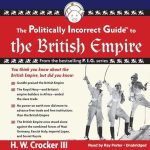
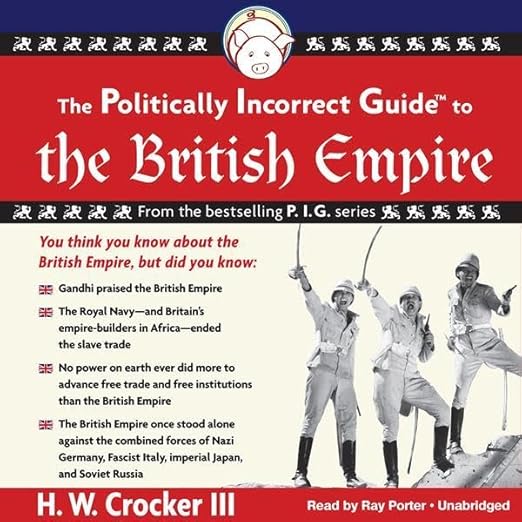
There is a particular kind of book that announces its position in the title and then dares you to object. H. W. Crocker III’s The Politically Incorrect Guide to the British Empire is exactly that – a provocation dressed up as a history survey, wearing its contrarianism like a pith helmet. I came to it with some scepticism, which is the appropriate starting point. I also came to it curious, because the revisionist case for empire has become one of those pub-argument positions that gets asserted far more often than it is actually examined. Crocker does examine it, albeit selectively, and the result is a more interesting listen than the title might suggest – and a more frustrating one too.
Crocker is a skilled populariser. He writes – and Ray Porter reads – with momentum and confidence, and across eleven hours the book never becomes a chore. What it does become, fairly consistently, is a curated highlight reel: the administrators who were genuinely dedicated to their charges, the explorers who mapped unknown worlds, the military campaigns that ended slavery or held back worse alternatives. The darker chapters of imperial history are either briefly acknowledged or quietly omitted. This is not dishonesty, exactly. It is selective emphasis, and the book is explicit enough about its own position that the listener at least knows what framework they are operating within.
About the Audiobook
The structure moves geographically and chronologically, covering roughly four centuries of British imperial reach from the early Caribbean colonies through to twentieth-century decolonisation. Crocker organises it by region and by key figures – Clive, Rhodes, Kitchener, the architects of the Indian Civil Service – rather than attempting a strict chronological spine. This works well for a popular audience: each section reads like a self-contained essay, making it possible to dip in and out without losing the thread.
The book is part of the Politically Incorrect Guides series from Regnery, an American conservative publishing house, and that context is worth keeping in mind. Crocker’s reference points are explicitly American-conservative, and his framing of empire as a defender of freedom carries a great deal of ideological freight. Readers expecting even-handed historiography in the tradition of Niall Ferguson or John Darwin will find this closer to advocacy. Those who read Ferguson’s Empire and felt it was insufficiently admiring of the imperial project will likely find Crocker more congenial company.
The book was first published in 2011 and the Audible edition – released by Blackstone Audio in October of that year – remains the version in circulation. It is worth noting that the historiographical conversation around empire has shifted considerably since then, and several of Crocker’s more breezy dismissals of criticism look more strained in 2026 than they did fifteen years ago.
The Narration
Ray Porter is one of the most reliable voices in non-fiction audiobooks, and he does not disappoint here. His delivery is authoritative without being pompous, and he handles the book’s considerable cast of Victorian names and colonial placenames with assurance. Porter is well-suited to Crocker’s brawling, punchy prose style – he gives the rhetorical flourishes their due without tipping into parody. At eleven hours the performance stays engaged throughout; you never feel as though he has lost interest in the material. For a book that is essentially an argument dressed as a history, you need a narrator who sounds convinced, and Porter sounds convinced.
What Readers Say
The audiobook holds a rating of 4.5 stars from 223 listeners, which is a healthy signal for a niche political history. UK reviewers split fairly neatly along the lines you would expect. Nathan Rees praised it as engaging and informative, appreciating its accessible style and the richness of its historical portraits. Benny Goodman found it a sound potted history, though noted with some frustration that the specifically contrarian framing was almost incidental to the narrative – he had expected a sharper engagement with contemporary misconceptions. A reviewer going by Pickhandle offered perhaps the most balanced verdict: appreciating the energy and the alternative frame, while acknowledging the selectiveness of the approach. The three-star reviewer Arioch put it most precisely: this is a useful corrective to one kind of distortion, but it overcorrects into a different one, and the history that would include both sides honestly has yet to be written.
Who Should Listen?
This works well for listeners who are already broadly familiar with British imperial history and want to spend time with the proudly revisionist case – not to accept it uncritically, but to understand the strongest version of the argument. It also functions reasonably well as a survey for complete beginners who want an entertaining introduction before seeking out more measured accounts. It is not the right choice for anyone who needs scholarly balance, or for listeners who are likely to be angered by confident elisions of atrocity. Read alongside something like Shashi Tharoor’s Inglorious Empire or John Darwin’s Unfinished Empire, it becomes genuinely illuminating as a piece of intellectual history – a record of how a certain generation wanted the story to be told.