Clara’s Verdict
Most personal finance audiobooks want to tell you what to do. This one wants to tell you why you will not do it, which is a considerably more useful conversation and a much rarer one. Morgan Housel puts the premise flatly in the opening copy: “Doing well with money isn’t necessarily about what you know. It’s about how you behave.” Five hours and fifty-four minutes later you have not been sold a system, and I count that as a virtue, not an omission.
The structure is why this works so well in audio. It is nineteen short stories instead of one continuous argument, which works out at roughly eighteen or nineteen minutes each. That is a commute, a dog walk, or the washing-up. Very few books in this category are so naturally suited to being taken in fragments.
One reservation, and it is the one a British listener should hear first. This is an American book, and a British listener will feel it. The most useful review here makes exactly that point, and I will come to it.
About the Audiobook
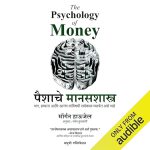
Housel’s argument is that money gets taught as a mathematical subject, where data and formulas are supposed to tell us precisely what to do, while actual financial decisions are made “at the dinner table, or in a meeting room”, tangled up with personal history, ego, pride, marketing and odd incentives. Rather than resolve that tension with a framework, the book offers “19 short stories exploring the strange ways people think about money” and lets the pattern emerge from the accumulation.
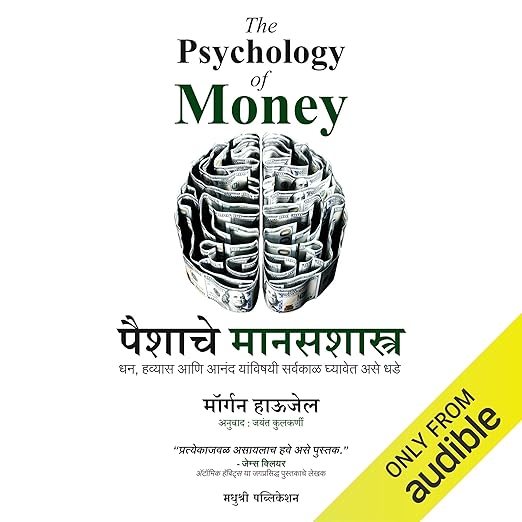
The commercial record is extraordinary. Over ten million copies sold around the world, a number one Sunday Times bestseller, and appearances on podcasts including Feel Better, Live More with Dr Chatterjee and The Diary of a CEO with Steven Bartlett. Housel has since written Same As Ever and The Art of Spending Money. The publisher describes this as the original book, and it is the one to start with.
One detail in the publication history is worth mentioning. This edition is dated 27 February 2026 and published by Harriman House, yet the same description reports over ten million copies sold, and the ratings behind it run to close to seventy thousand. The sensible reading is that the date belongs to this particular edition while the sales and the ratings have accumulated across several years. It is not a new book, and nothing in the description suggests the content has changed.
The Narration
The casting question that matters here is tone, not technique. Essays about the way people behave with money can be delivered as sermon, as lecture or as conversation, and only the last of those works, because the authority in this book rests on the reasonableness of its examples rather than on any expertise you are meant to defer to. Chris Hill is credited with the reading.
The format does a narrator one considerable favour and sets one trap. The favour is obvious. Each story is self-contained, so you never lose the thread by stopping, and a listener returning after four days is not penalised for it. The trap is sameness. Nineteen pieces of similar length, built to a similar shape, each turning towards a general lesson at the end, can settle into a single rhythm if the reading does not vary its energy from story to story. It is the standard risk of essay-collection audio, and the one place where a nineteen-part structure can work against itself.
No reviewer here evaluates the performance, so I can describe the demands of the material but not survey opinion on how they were met. What one review does confirm directly is that the chapters are short and the points clear, and a second praises the same clarity at the level of the whole book.
What Readers Say
A consensus of 4.6 across 69,194 ratings is formidable in a category where readers are usually quick to complain about being told nothing new. The written reviews say nothing at all about the audio.
The four-star review headed “Perspective as a UK reader” is the one I would hand to anyone browsing from this side of the Atlantic. It calls the book great, then says plainly that it would probably have earned five stars had the reviewer grown up in the United States. It praises the stories of extreme success and failure, notes that the book “makes you think about your own situation”, and then begins to describe a reservation before the text stops.
The five-star reviews qualify that rather than contradict it. The briefest is also the most representative: kelly louise cole on a book that is “easy to read due to the short chapters with clear points”. Fuat Y. arrives somewhere more interesting, admitting that many of the concepts were not new but that “what stood out was how engaging and clear the book is in bringing those ideas together”, and crediting Housel with addressing the questions the genre usually swerves, including “how much additional satisfaction we truly get from taking on more risk for incremental returns”.
Who Should Listen?
Anyone who wants perspective instead of tactics should start here, as should anyone who has ever wondered why sensible people do foolish things with their savings, and anyone who wants a finance book that will not leave them feeling lectured. It is a very good first book for a listener who finds the subject intimidating.
The wrong listener is someone who needs actionable British guidance on pensions, tax wrappers or mortgages. This is a book about behaviour, and nothing in the description promises it will tell you where to put your money. It is also the wrong choice if you already read widely in behavioural economics, since one reviewer concedes many of the concepts were not entirely new even while praising the presentation.
Listen to The Psychology of Money free with an Audible trial