Clara’s Verdict
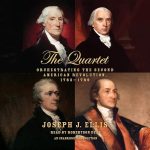
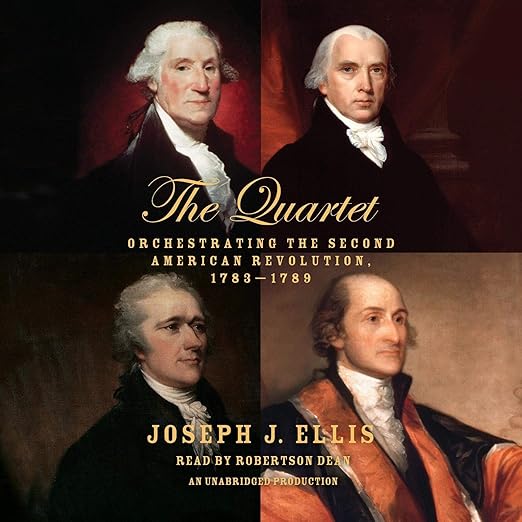
I came to Joseph J. Ellis’s The Quartet already familiar with his Pulitzer Prize-winning Founding Brothers, so my expectations were reasonably high. Robertson Dean’s narration landed in my ears on a grey Tuesday afternoon during a long train journey, and I did not look up once for the better part of three hours. Ellis has a gift for making political machinery feel urgent and human, and this particular argument – that the United States of America was not an inevitable outcome but an act of deliberate, almost conspiratorial statecraft – is one of the most clarifying framings I have encountered in American constitutional history.
The central thesis is bracingly revisionist without being contrarian. Ellis argues that the Articles of Confederation were not merely inconvenient but fundamentally broken, and that four men – Washington, Hamilton, Jay, and Madison, with the quiet assistance of Robert Morris and Gouverneur Morris – essentially engineered a second revolution to replace them. The Pulitzer board recognised Ellis’s abilities decades ago. This audiobook is proof that his talent for narrative compression has not diminished. The title’s framing – that Lincoln’s Gettysburg Address mythologised a unity that never actually existed in 1776 – is the kind of provocation that good history earns through evidence rather than assertion, and Ellis earns it.
About the Audiobook
Published by Random House Audio in May 2015, The Quartet runs to 8 hours and 25 minutes – a satisfying length that feels proportionate to the subject. The book covers the period between Yorktown and the ratification of the Bill of Rights, a span of roughly a decade that most popular histories skip over in their rush between 1776 and Lincoln. The Audible UK listing carries a 4.5-star rating from 2 reviews, both awarding full marks. The book is not part of a series, though it sits naturally alongside Ellis’s own Founding Brothers and American Sphinx as a sustained body of work on the revolutionary generation.
The argument proceeds chronologically but never mechanically. Ellis is particularly sharp on the gap between what the founders said in public – states’ rights, local sovereignty, resistance to centralized power – and what they privately believed was necessary: a federal government with real enforcement capacity and the ability to tax. The chapter on the Constitutional Convention in Philadelphia, where Madison and Hamilton effectively set the agenda before most delegates had unpacked their bags, is the highlight of the book. The account of the state ratifying conventions that followed is equally gripping, and the portrait of the Bill of Rights as a political concession rather than a philosophical ideal is genuinely unsettling in the best way.
The Narration
Robertson Dean is one of the more dependable narrators working in American history and political nonfiction, and he handles Ellis’s prose with quiet authority. His delivery is measured and clear without ever becoming professorial or plodding. Dean does not attempt to dramatise the material – this is not that kind of history book – but he understands where Ellis’s sentences build and where they resolve, and his pacing reflects that understanding. He manages the large cast of founding-era names and their associated arguments without losing the listener in a fog of Hamiltons and Madisons. The audio quality is clean throughout, which matters over eight-plus hours. Where some narrators of political history tend towards a kind of lecturing gravity, Dean maintains conversational accessibility without sacrificing weight.
What Readers Say
Both Audible UK reviewers awarded five stars, and extended responses from readers across territories reinforce the pattern. James Gallen, writing from the UK, described the book as essentially the story of a second American revolution – a framing Ellis himself uses and that clearly lands with readers who come to the book with some prior knowledge of the period. Robert Morris called it a brilliant analysis of what he termed arguably the most creative and consequential act of political leadership in American history. A Canadian reviewer praised it as one of the most engaging books on the behind-the-scenes effort of great men with a great vision. C. H. Cobb on the US store highlighted Ellis’s skill in conveying how foreign the idea of nationhood felt to citizens who had just spent years escaping it – the argument that nationhood smelled like the monarchy they had overthrown is one of the book’s most illuminating observations. The sole four-star review came from France and acknowledged the scholarly density while finding it entirely manageable.
Who Should Listen?
If you have read Founding Brothers and want to understand what happened in the decade before the Constitution took hold, this is the logical next listen. It rewards listeners who already have a basic grasp of American revolutionary history – the book does not spend time establishing context from scratch, and Ellis assumes you know who Hamilton and Madison are. Those coming to Ellis for the first time might find it slightly dense on political procedure in places, but the audiobook format helps here, since Dean’s measured delivery gives you time to absorb each development before the next arrives. Skip it if you are looking for character-driven narrative biography rather than institutional and political history – Ellis is interested in what these men did and why, more than who they were as private individuals.