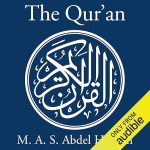
Translation is never a neutral act, and the translation of the Qur’an into English has produced an unusually wide range of results – from the archaic formalism of older versions that preserve the distance between the modern reader and the original, to contemporary attempts that risk smoothing away the complexity of what is, even for Arabic speakers, a text of profound difficulty and layered resonance. M. A. S. Abdel Haleem’s Oxford World’s Classics translation, narrated here by his son Ayman Haleem, represents one of the most academically respected and genuinely accessible English versions currently available. That combination of scholarly authority and readerly accessibility is rare, and in audio format it matters more than it would on the page.
I approached this as someone who came to the Qur’an through literary and historical study rather than through faith. From that position, Abdel Haleem’s choices are consistently intelligent and his introductory notes on each surah consistently useful.
Clara’s Verdict
The core achievement of this translation is its refusal of archaism without sacrificing the weight of the original. Abdel Haleem’s stated aim – that ‘archaisms and cryptic language are avoided and the Arabic meaning preserved by respecting the context of the discourse’ – is carried through with genuine care across the text. This does not mean the translation is colloquial or casual; it means that where older English versions would reach for biblical register to signal religious gravity, Abdel Haleem trusts contemporary English to carry the meaning without inherited formality obscuring it.
The inclusion of brief explanatory introductions to each surah (chapter) is particularly valuable in audio format. In a printed edition, you can pause and consult a footnote; in an audiobook, contextual framing before the text begins is the equivalent mechanism, and Ayman Haleem’s narration of these introductions gives each surah its own orientation before the text opens. One reviewer from 2012 notes specifically that the translation ‘makes it clear when the angel Gabriel is speaking’ – a disambiguation that older translations leave ambiguous and that is genuinely important for understanding the structure of divine speech within the text.
The book’s standing in academic and Islamic scholarly communities is strong. A 2021 review describes it as used by ‘many mainstream and Sufi Islamic scholars today to teach a better understanding of the religion’. That is an important credential: this is not a popular simplification but a scholarly translation that happens to be genuinely accessible to first-time readers. The Oxford World’s Classics series has been publishing scholarly yet accessible editions of foundational texts for over a century, and this edition maintains that standard.
About the Audiobook
Published by Audible Studios in October 2018. Runtime of 19 hours and 15 minutes. Rating of 4.7 from seven reviews. The Qur’an was revealed orally and has an oral tradition of recitation at the heart of Islamic practice, which means the audio format has a particular appropriateness for this text that most literary works do not share. That said, listeners should be clear that this is an English-language scholarly translation, not a traditional Arabic recitation (tilawah). Those seeking the Arabic experience of the Qur’an will need a different resource entirely.
The Narration
Ayman Haleem’s narration carries an authority that goes beyond professional competence: he is the son of the translator, has a native relationship to both the Arabic original and the English rendering, and brings to the performance an understanding of what his father was attempting in each translational choice. His delivery is measured and clear, without the performative reverence that can make religious texts feel remote in audio form. The pacing allows the structure of each surah to emerge naturally – the shifts in subject, the recurring patterns, the way individual passages accumulate meaning across the whole. For listeners coming to the Qur’an for the first time through this translation, the narration creates a genuine point of entry rather than a barrier.
What Readers Say
UK reviews are consistent in their praise for the accessibility of the translation. A 2021 reviewer recommends it for both individual study and group exploration, citing its use among Islamic scholars and its suitability for anyone ‘vaguely interested in Islam’. Another calls it ideal for understanding the ‘literal meaning of the original text’. The reviewers who are themselves Muslim praise the scholarly grounding; those approaching from outside the faith praise the clarity without finding it simplistic. The absence of critical reviews in the Audible UK set – across a text with significant potential for disagreement about interpretive choices – is a clean signal that the translation achieves something unusual: it satisfies both communities simultaneously.
Who Should Listen?
Muslim listeners seeking a contemporary English translation with scholarly credibility for personal study or reference. Non-Muslim readers approaching the Qur’an as a literary, historical, or religious studies object who want the most accessible serious translation currently available in audio format. Those who want to understand Islam’s foundational text in full, rather than receive excerpts or a summary. Not a substitute for Arabic recitation within religious practice, and not recommended as the sole resource for detailed comparative textual study – for that, a printed edition with fuller footnotes remains essential. But as an audiobook for sustained engagement with the complete text, this is the strongest option available in English.