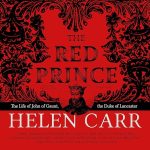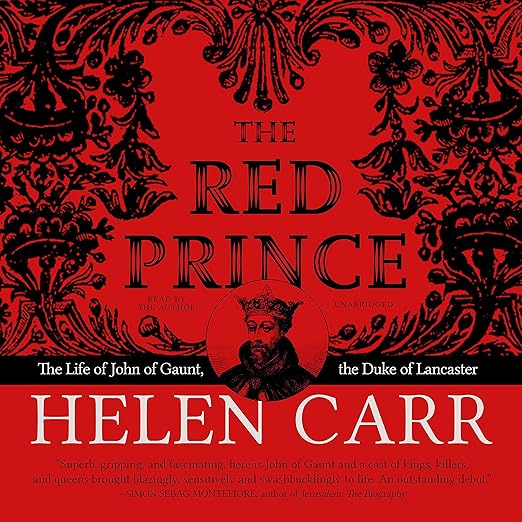
John of Gaunt is one of those historical figures who appears in everything without ever quite becoming the subject of it. He is Richard II’s uncle in Shakespeare, the dying speechmaker delivering ‘This sceptred isle’. He is the suspected usurper in the chronicles of the Peasants’ Revolt, whose London home the mob burned to the ground. He is the father of Henry IV, the grandfather of Henry V, and through his third wife, Katherine Swynford, the ancestor of the entire Tudor line. He is, in other words, everywhere in late medieval English history – and yet serious biography has been relatively scarce. Helen Carr’s The Red Prince, published in 2021 and narrated by Carr herself, is a welcome correction to that neglect.
I came to this book with a specific curiosity about how Carr would handle the Peasants’ Revolt of 1381, which stands as one of the most dramatic episodes of the period and one in which Gaunt plays an ambiguous role. He was hated by the rebels partly because he was rich, partly because he was powerful, and partly because the rumours surrounding him – that he wanted the crown, that he was scheming against Richard II – were persistent enough to function as political fact regardless of their truth. Carr addresses this with the nuance it deserves.
Clara’s Verdict
Carr paints a portrait of a man who was more complex and more admirable than his reputation in most popular accounts suggests. John of Gaunt spent decades as the most powerful non-royal figure in England, holding the levers of power during his father Edward III’s decline, attempting to contain his nephew Richard II’s erratic governance, and pursuing his own claim to the throne of Castile (the ‘Red Prince’ of the title refers to this Spanish ambition). He was a passionate supporter of John Wycliffe’s Bible translation project, a patron of Chaucer, and by the standards of the 14th century a surprisingly constant figure in an age of lethal political volatility.
One reviewer’s complaint about the quality of the prose in the first ten pages is worth addressing honestly: there is some unevenness in Carr’s writing style, and the opening sections can feel slightly rushed. But the same reviewer acknowledges the book is interesting, and most other readers find the prose becomes more assured as Carr settles into her argument. The underlying historical research is thorough, and Carr’s ability to dramatise the political dynamics of the period – the chess-like maneuvering between the great lords, the relationship between chivalric ideology and practical power – is genuinely strong.
About the Audiobook
Published by Blackstone Publishing in May 2021. Runtime of 9 hours and 33 minutes. Rating of 4.4 from a small but substantive body of UK-based reviews. Self-narration by the author means you are hearing the historian speak directly about her subject – an intimacy that carries its own kind of authority. For a biography of this period, Carr’s evident emotional investment in rehabilitating Gaunt’s reputation gives the narration an engagement that a assigned professional narrator, however skilled, might not match.
The Narration
Carr’s voice is clear and carries genuine enthusiasm for the material. She reads at the pace of someone who wants you to understand rather than someone performing a text, which is appropriate for a history that involves a fairly dense cast of medieval characters with overlapping claims and relationships. The technical limitations of self-narration are present – dynamic range and microphone technique are less polished than a studio-produced audiobook – but these are minor compared to the benefit of hearing a historian’s personal relationship to their subject come through in every chapter. One reviewer describes the book as a ‘real page-turner’, which is a high bar for medieval biography and a testament to how effectively Carr’s voice serves the narrative.
What Readers Say
UK reviews are substantive and consistent. One reader who describes themselves as always having found Gaunt fascinating reports that Carr’s book finally explains the complexity of his reputation. Another, who mentions a family claim to descent from John ‘on the wrong side of the blanket’, finds this book a gentle corrective to family mythology – one of those small delights of reading history closely. A third calls it ‘brilliantly written’ and ‘possibly one of the most fascinating historical biographies I’ve read to date’. The dissenting stylistic voice is genuinely minority opinion against a background of strong approval.
Who Should Listen?
Readers with an existing interest in the Plantagenet or early Lancaster period, or those drawn to the period through Hilary Mantel’s Wolf Hall trilogy who want to go back a century further. Also well suited to anyone interested in medieval biography that treats political machination, dynastic loyalty, and social upheaval as the interconnected forces they were. Some familiarity with the Houses of Plantagenet and Lancaster will make the cast of characters easier to hold – this is not an introductory guide to the period. Fans of Dan Jones’s work on the medieval period (The Plantagenets, The Hollow Crown) will find Carr a natural companion author.