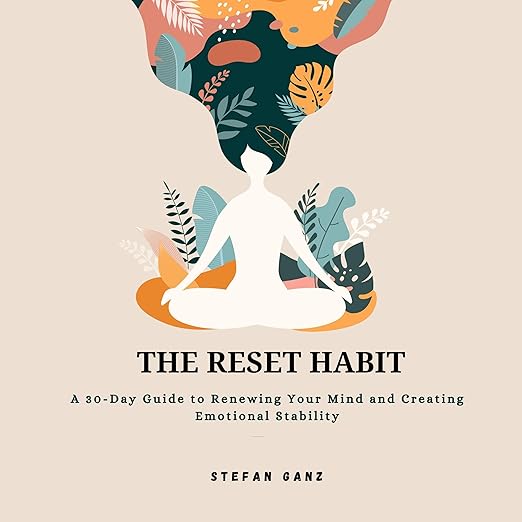
Clara’s Verdict
I approach 30-day transformation programmes with a healthy scepticism that the market has more than earned – the genre is glutted with promises of radical reinvention that last approximately as long as the initial enthusiasm. Stefan Ganz’s The Reset Habit deserves a fairer hearing than that framing might suggest, because he is careful to foreground something the genre usually buries in the marketing: this is about building repeatable practices, not achieving a once-and-done transformation. The subtitle’s emphasis on “emotional stability” over “happiness” or “success” signals a more honest ambition, and the brevity of the recording – just over an hour – means there is no padding. What’s here is purposeful and grounded.
About the Audiobook
The 30-day framework moves through four interconnected areas: mental decluttering, lifestyle realignment, emotional renewal, and environment redesign. Each daily reset is small and manageable – mindfulness exercises, journaling practices, gratitude rituals, digital detox sessions, sleep hygiene improvements, movement habits, nutritional adjustments, boundary-setting, and space redesign – with the explicit understanding that compounding small changes consistently over time produces more durable results than attempting wholesale reinvention in a single overwhelming push. This is not a new insight, but Ganz applies it with specific, practical structure that makes the general principle actionable.
The sections on emotional resilience and self-compassion are particularly grounded, avoiding the more grandiose claims of the spiritual self-help tradition while retaining genuine warmth. Ganz writes about forgiveness, boundaries, and self-trust in language that feels accessible rather than therapeutic-jargon-heavy. The final section – “simple self-support rituals that stabilise change long after the 30 days end” – is the most valuable: the problem with most 30-day programmes is that day 31 arrives with no framework. Here, the maintenance architecture is built in from the start. The audiobook is best approached as a companion to active daily practice rather than as passive listening; ideally, you would listen to each day’s section and then actually do the thing it describes.
The Narration
Gordon Webster narrates with a warm, unhurried delivery that suits the material excellently. This is not a book that benefits from urgency or drama, and Webster clearly understands that – his voice is steady and reassuring throughout, the quality you would want from a thoughtful guide rather than a motivational coach roaring at you to seize the day. The brevity of the recording means the pacing feels tight and purposeful; nothing is padded, nothing meanders. A clean, professional performance that serves the content well.
What Readers Say
This title is sufficiently new that it has not yet accumulated listener reviews at the time of writing. The absence of feedback makes it harder to assess how the programme lands in practice – which is, ultimately, the only measure that matters for a habit-building guide. What the content itself suggests is a pragmatic, evidence-adjacent approach that avoids the pseudoscience traps and metaphysical excess that undermine too much of the wellness audiobook category. The framework is realistic about what 30 days can and cannot achieve, which is itself a virtue in a field that routinely overpromises.
Who Should Listen?
Useful for anyone who is feeling mentally scattered, emotionally depleted, or stuck in patterns they recognise but can’t seem to shift – and who wants a gentle, structured framework rather than a dramatic intervention. It also suits listeners who have tried more intensive self-help programmes and found them overwhelming: the daily-reset model here is genuinely low-pressure. Those dealing with burnout, low-level chronic anxiety, or the exhaustion of sustained overcommitment may find particular value in the emotional-stability focus. This is a start-small, keep-going kind of programme, which turns out to be exactly the kind that works. Listen on Audible UK and begin day one at your own pace.
The decision to produce this as an audiobook rather than a print guide is a deliberate one that shapes how it works: listening to a calm, unhurried voice walking you through each day’s reset is itself a small act of intentionality in a way that reading a paperback is not. The format performs a part of its own content. For listeners who are particularly prone to mental clutter – who find that reading tips about slowing down and calming the mind while their internal monologue is already running three conversations simultaneously – the audio format may actually be a more effective delivery mechanism than the page.
The programme’s architecture – building from mental to lifestyle to emotional to environmental resets – reflects a sensible sequencing logic: you cannot reliably address emotional reactivity until you have created some basic stability in sleep, movement, and the immediate environment. Ganz doesn’t pretend that inner peace is simply a matter of deciding to feel differently; the physical and practical foundations are laid first, which gives the emotional work somewhere solid to stand.
The audiobook format also makes the programme accessible to listeners who struggle with traditional reading – those with dyslexia, visual impairment, or simply the kind of executive function difficulties that make sitting down with a book consistently difficult. For these listeners in particular, the audio delivery of a structured wellness programme has practical advantages that the print format cannot replicate.