Clara’s Verdict
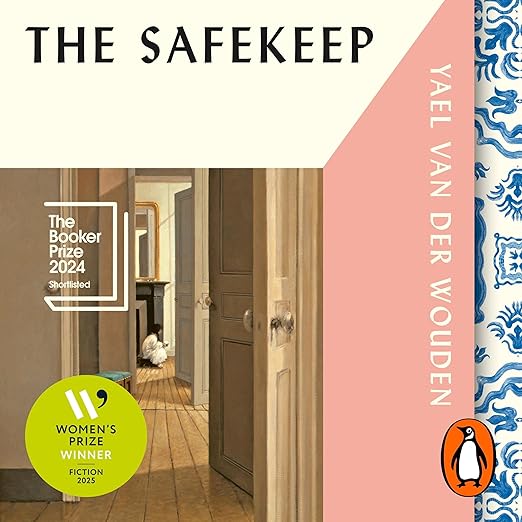
Yael van der Wouden’s debut novel is the kind of book that makes you put everything else aside. I came to The Safekeep already aware of its extraordinary reception – Booker Prize shortlist 2024, Women’s Prize winner 2025, Dylan Thomas Prize shortlist 2025 – and that accumulation of recognition creates a pressure that most debut novels would collapse under. This one does not. Van der Wouden has written something genuinely unsettling and, in the final third, genuinely devastating: a novel about control, repressed desire, and the terrible price of refusing to look honestly at history – personal and national. Stina Nielsen’s narration is a masterclass in restraint. At just under nine and a half hours, I found myself wishing it were longer, which is about the highest compliment I can pay.
About the Audiobook
The setting is the Netherlands, fifteen years after the Second World War. Isabel has constructed a life of exacting discipline in her late mother’s country house: everything in its precise place, every routine observed, a fortress of order maintained against a world she cannot entirely trust. When her brother Louis deposits his new girlfriend Eva as a guest for the season, the intrusion is more than inconvenient – it is existential. Isabel’s routines depend on control; Eva’s presence disrupts every corner of it.
The growing tension between the two women is the novel’s immediate dramatic engine, and van der Wouden handles it with considerable psychological precision. The attraction Isabel feels for Eva – and her refusal to acknowledge or examine it – is rendered through small, devastating details rather than explicit statement: the way she catalogues Eva’s belongings, the way she registers Eva’s body in space, the way her need for order becomes, in Eva’s presence, a barely suppressed compulsion. This is deeply Highsmithian territory: desire as threat, control as pathology, surfaces that barely contain what is moving beneath them.
But the novel’s historical dimension – which I will not fully articulate here without spoiling the revelation – transforms what begins as a psychological character study into something with a much larger moral scope. The systematic looting of Jewish property during the Nazi occupation of the Netherlands, and the postwar unwillingness of Dutch society to account properly for its complicity in that erasure, provides the structural revelation that the novel has been building towards. What Isabel’s immaculate house actually contains, what it means that she has been “safekeeping” it: these discoveries reframe everything that has come before. Booker Prize judge Justine Jordan called it “a brave and thrilling debut about facing up to the truth of history, and to one’s own desires.” That is exactly what it is.
The Narration
Stina Nielsen’s performance is precisely calibrated to the text’s demands. Isabel’s rigidity – the way she moves through her world, cataloguing and controlling – comes through in the narration’s measured pace and cool vowels. The scenes between Isabel and Eva carry genuine erotic charge delivered through restraint rather than emphasis, which is exactly right for a novel in which everything significant is communicated through what is not said. Nielsen handles the historical revelation with a quieter gravity that prevents it from feeling like an appendage to the psychological drama; it arrives as the key that unlocks what the whole novel has been about. The Penguin Audio production is impeccable throughout.
What Readers Say
One dimension of the novel that deserves separate acknowledgement is its treatment of postwar Dutch history. Van der Wouden – herself Dutch – is writing about her own national past, and the specificity of the guilt and denial she describes is not generalised European collective guilt but something more particular: the Dutch record on Jewish property restitution after the war is well documented and not flattering. The Safekeep engages this history with the precision of someone who has thought about it carefully, and the result is a novel that functions simultaneously as intimate psychological fiction and historical reckoning.
Readers are struck by both the quality of the writing and the moral seriousness beneath the surface elegance. J – loves books, reads books (★★★★★) called it “one of the best books I’ve read this year” and found the development of the two women’s relationship – from hostility through fascination to something else entirely – utterly compelling. broberts (★★★★★) described it as “magical, profound yet warm with empathy – perfection in a volume of joy.” LO1 (★★★★) praised its dual register: “a great love story which also paints a picture of Holland at the time following the Second World War.” Even the mixed three-star review acknowledged the “beautifully written elegant prose that simply flows.” The audiobook holds a 4.2-star rating across 16 ratings.
Who Should Listen?
Readers of Patricia Highsmith, Sarah Waters, and Ian McEwan will feel immediately at home – the psychological precision, the understated eroticism, the moral revelation handled without melodrama. Those with an interest in post-war European history and its long shadows, particularly around the Holocaust and Dutch complicity, will find the historical dimensions illuminating alongside the fictional. Anyone drawn to debut novels that announce a genuinely significant new voice – this is one of the most impressive first novels I have encountered in years. Listen to The Safekeep on Audible UK – a Women’s Prize winner that fully deserves its recognition and a great deal more.