Clara’s Verdict
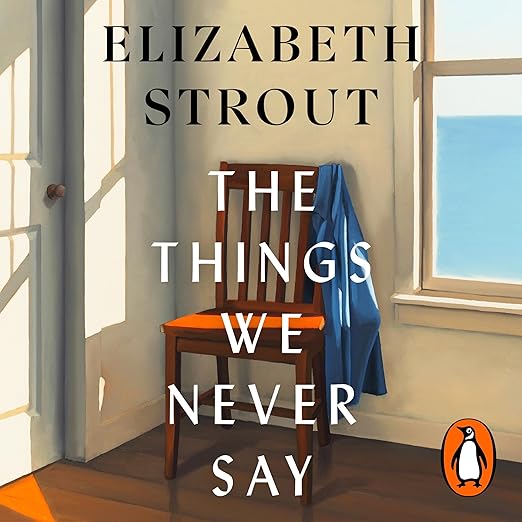
Elizabeth Strout has spent a career proving that the ordinary is not the same thing as the small, and The Things We Never Say is one of her most concentrated demonstrations of it. Artie Dam teaches history to teenagers. He has a wife of three decades, a sailboat, a house near Massachusetts Bay, and by every visible measure a life that is working. Inside it he is profoundly alone, and he turns one question over and over: how is it that we know so little about one another, even those closest to us.
Six hours and thirty-five minutes makes this one of the shortest serious novels I have listened to this year, and the compression is entirely deliberate. There is not a wasted scene. A 4.6 across 19,611 ratings is an unusually high figure for literary fiction of this kind, which tends to divide readers, and the book has held a place in the UK charts since its May 2026 release. Coming from a writer with a Pulitzer and a Booker shortlisting behind her, that combination of critical standing and popular reach is rarer than it sounds.
About the Audiobook
Artie is a man with a secret, and Strout is in no hurry to tell you what it is. She spends the early stretch building the surface instead: the classroom where he expands young minds and corrects their casual cruelties, the kind word offered to whoever needs it most, the holiday parties, the small talk with neighbours, the weekend sailing. He is, by every appearance, present and alive. The gap between that appearance and his interior is the novel’s whole subject, and the prose does something quietly remarkable in holding both at once without ever announcing the discrepancy.
Then Artie learns that life has been keeping a secret from him, one large enough to unsettle everything, and the second half is about what a person does with that information at his age. He has to chart a new course, reconsider the relationships he holds most dear, and make some peace with what he cannot know. Strout resists the two obvious endings available to her, which are collapse and redemption, and finds something more honest in between.
This is a standalone novel, so there is no reading order to negotiate, though readers who know her work will recognise the territory and the temperature. One of the reviewers here points out that there are ten other books to go on to, and recommends all of them, which is a reasonable position to take. What is worth saying to a newcomer is that this is a good place to start precisely because it is short. A shade over six hours is a small outlay of time for finding out whether a writer’s sensibility is yours.
The Narration
Robert Petkoff reads it. He is a narrator I have most often encountered in narrative non-fiction, where his particular asset is a clean, unfussy authority, and I want to be careful not to assume that translates automatically, because literary fiction of this kind asks for something quite different.
What it asks for is interiority. Almost everything that matters in this novel happens inside Artie’s head while he is doing something unremarkable with his hands, and a narrator has to make that audible without dramatising it. The temptation with a lonely protagonist is to read him sadly, which would be a disaster here, because Artie does not experience himself as sad. He experiences himself as functioning. The performance has to keep the surface intact so that the reader hears the loneliness underneath it rather than being told about it.
On that specific test, this works. Petkoff reads Artie as a competent, mildly amused, thoroughly civil man, and the restraint is what allows the more desolate passages to register. The habit of clarity that suits factual material serves Strout’s sentences well too, since her prose is deceptively plain and rewards a reader who does not add anything to it. My one reservation concerns the classroom scenes, where the teenagers are drawn quickly and get comparatively little vocal differentiation, so they occasionally arrive as a type rather than as individuals. Set against an entire book of sustained, disciplined interior work, it is a minor thing.
What Readers Say
Nearly twenty thousand ratings have settled this at 4.6, and the written responses keep circling the same quality, which is Strout’s ability to make unremarkable people compelling without inflating them.
Her ability to take everyday people and create characters that are interesting, flawed, recognisable and sympathetic, is simply wonderful.
Bluebell Girl, who has read the lot, describes Artie as leading what appears to be an average life, and the phrase appears to be is doing the work in that sentence. DeeDee, meeting Strout for the first time, found it “A moving and powerful story that has a familiar parochial setting but a powerful global base note”, which is an excellent description of the book’s scale. She adds something I have not been able to shake: “All the time you’re hoping he’s the one that’s right, because if he is, there’s hope for us”. Maryan Hadley, one of the four-star reviewers, called it another moving character study of a dedicated teacher “who will live on in the memory and break your heart”, and headed the review with the observation that a deceptively simple prose style is revealing unspoken truths about the human condition.
Who Should Listen?
For anyone who has never read Elizabeth Strout, there is no more efficient way of discovering whether she is a writer for you. It is short, it is complete, and it contains everything her admirers value, so a newcomer can settle the question over a weekend rather than committing to a series.
Beyond that, I would recommend it to anyone drawn to quiet fiction about interior lives, to readers already at home in her earlier novels, and particularly to listeners in middle age or beyond, for whom the central question about how little we know of the people closest to us tends to land with more force. It is also, for what it is worth, a good novel about being a teacher.
Set it aside if you want incident. The secret at the centre is not a twist and does not function as one, and anyone waiting for the plot to arrive will spend six hours waiting. Set it aside too if you are in a fragile frame of mind, because loneliness is examined here at close range and without much consolation offered along the way. Everyone else should give it an afternoon. It is the shortest thing on the current UK chart with this much in it.
Listen to The Things We Never Say free with an Audible trial