Clara’s Verdict
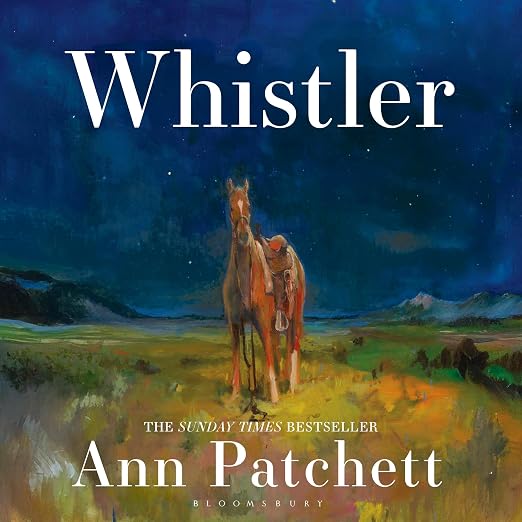
Ten hours and forty-three minutes in Ann Patchett’s own voice is a specific proposition, and I would take it over a great many professionally cast recordings. The listing is unambiguous on the point: “Bloomsbury presents Whistler written and read by Ann Patchett”. Novelists reading their own fiction is a risky business, because writing a sentence and delivering one are genuinely different skills, and the graveyard of well-meaning author narrations is crowded. Patchett is one of the exceptions, and this novel is unusually well suited to her.
Whistler is a quiet book about being known. It stands high in the Audible UK charts today, which is heartening given how little it does to court attention. There is no thriller mechanism, no reveal held back as bait. There are two people in a museum and a lifetime of consequence between them.
About the Audiobook
Daphne notices an older gentleman following her around the Metropolitan Museum of Art in New York. He turns out to be Eddie, her former stepfather, married to her mother for a short time when Daphne was nine, and unseen since. What separated them was, in the publisher’s careful phrasing, “the fateful event that changed the direction of both their lives”, and the description refuses to specify it. So will I.
Meeting again, they find that time has fallen away, and the novel becomes an extended act of joint consideration: their shared past, the present they have arrived at separately, and a decision to face the future together. Patchett is interested in an idea she states directly, that “the feeling of being known by one other person, even for a short period of time, can change everything.” A brief stepfather is a wonderfully odd vehicle for that argument, because the relationship has no legal standing, no biological claim and no obligation to persist. It survives on nothing but recognition.
This comes from the author of The Dutch House and Tom Lake, and the Sunday Times calls her “One of the most beloved authors of her generation”, which for once is not an overstatement. Nothing precedes it and nothing depends on it. Anyone who found The Dutch House to be a novel about a house and a grievance will recognise the emotional territory immediately.
The Narration
Patchett’s reading mirrors her prose, and that is the entire case for it. Her sentences are controlled and architectural rather than showy, built to be understood on first hearing, and she delivers them the same way: measured, consistent, entirely undramatic. She does not do voices in any conventional sense. Eddie and Daphne are distinguished by cadence and by a subtle shift in temperature rather than by pitch, and in a two-hander that intimate, anything more theatrical would feel like intrusion.
What self-narration buys you here specifically is authority over emphasis. In a novel where enormous weight rests on which word in a sentence carries the stress, having the person who chose the words also choose the stress removes an entire layer of interpretation. There are passages in this recording where a professional actor would almost certainly have played the emotion, and Patchett simply reports it, and the reporting is more affecting.
The honest limitation is range. Over ten and three quarter hours the register does not vary enormously, and a listener who needs vocal variety to stay engaged may find the evenness demanding. This is a recording that rewards attention rather than one that compels it.
What Readers Say
Just under twenty thousand ratings, 19,506 to be exact, have settled at 4.6, which puts this among the better received literary novels of the year, though I should note that the reviews visible here come from people reading in print or on a Kindle rather than listening. One reader made the format explicit, writing that she “Read on kindle but a definite purchase of the book.” Their subject is Patchett’s prose, which is at least the same prose.
On that prose they are close to unanimous. A five-star reader offered a compact and rather lovely verdict:
The writing is superb. And the story and characters match the quality of the writing. A terrific read!
Another described being caught immediately and never wanting it to end, while praising an ending she found perfect, and made the point that the characters are people you would want in your own life. A four-star reader was briefer and equally warm, calling it well written, engaging and a lovely story. What nobody in this pool describes is plot, which is telling. This is a book people respond to at the level of the sentence and the relationship.
Who Should Listen?
Anyone who loves Patchett already should simply take this, and the self-narration is a genuine addition rather than a compromise. It also suits readers of Elizabeth Strout and Anne Tyler, writers similarly committed to the proposition that a small life examined closely is not a small subject. The museum setting and the two-hander structure make it excellent company for a long solitary walk, where the book’s own pace and your own can match.
Look elsewhere if you need incident. There is very little here in the way of event, and the withheld past resolves quietly rather than detonating. The unvarying narrative register that I regard as a strength will read as monotony to some, and anyone who listens at high speed to keep engaged should probably try a sample at normal pace first, because this prose loses a great deal when hurried. It is a novel that asks for patience and repays it.