Clara’s Verdict
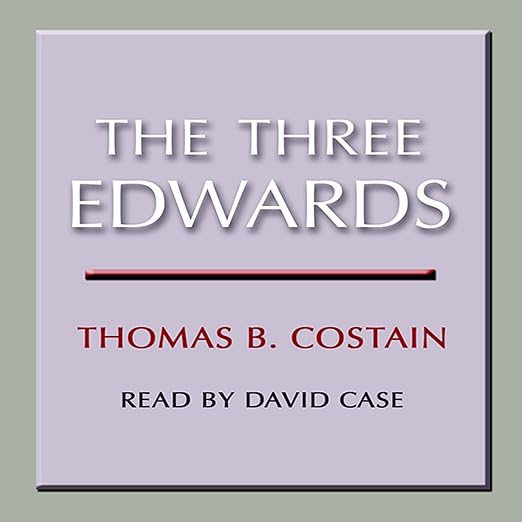
I came to Thomas B. Costain’s Plantagenet series through a footnote in a scholarly text on Edward I, and I am glad I did. The Three Edwards is the third volume in the quartet, covering three monarchs who between them defined the turbulent late Plantagenet era: Edward I, the conqueror and lawmaker who hammered Scotland and codified English statute; Edward II, one of England’s most catastrophically inept kings, whose reign ended in deposition and probable murder at Berkeley Castle; and Edward III, who rebuilt royal authority, transformed the army through the introduction of the longbow to devastating effect at Crecy, and set the stage for a century of conflict with France. These are not minor figures. They shaped the constitutional and military character of England for generations, and yet popular understanding of them remains thin compared to, say, the Tudors. Costain does something genuinely useful: he makes them human.
The method is not without controversy in academic circles. Costain writes in a register that sits comfortably between popular history and historical narrative, openly willing to use imagination where the medieval record falls silent. Academic historians have always been divided on this approach – some find the resulting portraits vivid and illuminating, others find them undisciplined. But for the general listener who wants to understand why Edward I was simultaneously a brilliant legislator and a brutal imperialist, or who wants to grasp the particular tragedy of Edward II – a man catastrophically unsuited to his role through no simple fault of character – Costain’s humanising instinct is exactly right. He does not falsify the record. He inhabits its gaps, which is a different and defensible thing.
Rated 4.3 out of 5 from 563 listeners, this is not a marginal title. Its audience is substantial and its reputation durable across decades of reading.
About the Audiobook
Published by Random House Audio in January 2009, this recording runs to 17 hours and 30 minutes – a substantial listen that rewards patience and sustained attention. The book is the third entry in Costain’s four-volume The Plantagenets series, and while some familiarity with the earlier volumes enriches the experience, the narrative is coherent enough for listeners who come to it fresh. The period covered spans roughly 1272 to 1377, taking in the Scottish Wars of Independence, the baronial conflicts that destabilised Edward II’s reign, his deposition by his wife Isabella and her lover Mortimer in one of medieval England’s most dramatic coups, and Edward III’s extraordinary martial ambitions in France that culminated in the early campaigns of what would become the Hundred Years War. For anyone whose knowledge of this era comes primarily from films about William Wallace or from Braveheart‘s particularly free interpretation of events, Costain provides essential corrective context, delivered without condescension.
The series as a whole has a companion spirit in Barbara Tuchman’s medieval work or in John Julius Norwich’s accessible surveys of Byzantine and Norman history – committed popular scholarship that takes its subject seriously without requiring the reader to bring specialist knowledge. The audio format suits the prose particularly well, because Costain writes in clear, resolved sentences that carry well at a listening pace.
The Narration
David Case handles the narration, and his performance is well suited to the material. His voice carries the authority of someone reading from serious history rather than performing for effect, which is precisely what Costain’s prose demands. The delivery is measured and clear, with enough variation to distinguish quotation from commentary and direct speech from analytical context. Case does not impose personality on a text that does not invite it; he serves the material with professional restraint. At seventeen and a half hours there are passages where the pace feels deliberate rather than urgent, but that reflects the nature of the text rather than any failing in the reading. Long-form history audiobooks require a narrator who can sustain attention across extended passages of political context, parliamentary reform, and military manoeuvre, and Case does that without strain or monotony.
What Readers Say
The majority of listeners place this among the best popular history audiobooks available in the format. Reviewer Historyboy described the Plantagenet series as ‘surely what history is all about – bringing the characters to life and putting flesh on their dead old bones,’ noting that Costain ‘gets inside the people and explains what made them what they were.’ The observation that medieval records are sparse and inaccessible, and that ‘a modicum of imagination is surely necessary,’ is an honest defence of the method that most readers who have tried to engage with primary sources from this period will recognise immediately. Mr. Charles I. Hunt, who had read the series in print years before returning to it in audio form, praised the books as ‘scholarly without being too academic,’ readable and entertaining while remaining accurate within the limits of what the surviving evidence allows. One listener described the reading experience at the point of Edward I’s death as so engaging that he felt it was ‘an excellent book in the set, one I could read many times.’ The sole low-star review concerned the physical condition of a print copy, an entirely irrelevant consideration for the audiobook.
Who Should Listen?
If you have any interest in medieval English history and want something that reads like a sustained narrative rather than a textbook, Costain rewards the investment generously. Start at Book 1 of the series if you can, but the series position should not deter you from entering here if the three Edwards are your particular period of interest. Listeners who prefer strict academic rigour over narrative reconstruction, or who require formal historical footnoting as a condition of trust, may find Costain’s imaginative licence frustrating. But for everyone who wants to understand what this era felt like to the people living through it, this is a deeply satisfying way to spend seventeen hours. Listen on Audible UK.