Clara’s Verdict
I need to address a practical matter at the outset. The listener reviews available for this Audible listing describe, consistently and specifically, a beautiful hardback book with stunning photographs, wonderful pictures of our planetary system, and a physical object of considerable aesthetic quality. These are reviews of the print edition, not the audiobook. The pool of audio-specific listener feedback for this listing is effectively a single 4.8-star rating with no accompanying text. That is a significant limitation on what I can tell you about the listening experience specifically, and I want to be honest about it rather than presenting print reviews as audio testimony.
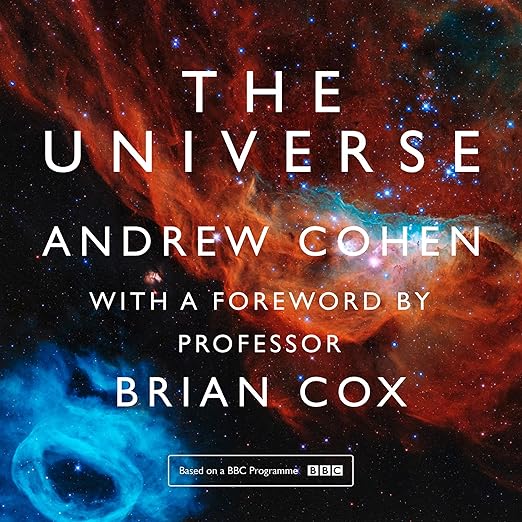
What I can tell you is what this audiobook represents. The Universe is a companion work to a BBC television series co-authored by Andrew Cohen and Professor Brian Cox, two of the most effective popular science communicators working in Britain today. Cohen wrote the book; Cox, who is listed as co-author and writes the foreword, narrates the audiobook. That biographical fact is meaningful: this is not a case of a publisher hiring a narrator to read another person’s words, but of one of the material’s actual creators voicing it.
About the Audiobook
The material covers the full breadth of contemporary cosmological understanding, from alien planets and black holes through to the formation of galaxies, the expansion of the universe, and what we now understand about the moments just after the Big Bang. Cohen’s text was written with access to the latest NASA mission data available in October 2021, when the book was published by William Collins, and represents a competent and thorough popular science survey of the field at that time. The running time is 8 hours and 32 minutes.
The structural challenge inherent in any television tie-in audiobook is the same regardless of subject: the visual format originated with images, graphics, CGI simulations, and telescope footage that do not translate to audio. On screen, Brian Cox delivers his cosmology against backdrops of genuine astronomical spectacle. On audio, Cohen’s prose must carry the weight that the visuals normally share. Whether the writing is sufficient to the task of conjuring the visual wonders of deep space in the listener’s imagination is the central question, and one that print reviewers cannot answer for audio listeners.
The cosmological content Cohen covers is worth describing in more detail, because the scope is genuinely ambitious. The book moves from the planets of our Solar System out through the variety of exoplanets now catalogued by telescopes like Kepler and TESS, into the structure of our galaxy with its spiral arms and the supermassive black hole at its centre, then to the large-scale structure of the universe with its vast filaments and voids, and finally to the question of the universe’s origins and ultimate fate. At each stage, the latest data available in 2021 is incorporated, which means the Laser Interferometer Gravitational-Wave Observatory’s detections of merging black holes and the early results from the James Webb Space Telescope’s predecessors are part of the picture. The James Webb Space Telescope itself was launched in December 2021, shortly after publication, so its extraordinary subsequent discoveries are not included, which is the one area where the book shows its age most clearly.
The Narration
Brian Cox narrates with his characteristic combination of genuine scientific enthusiasm and the informal warmth that has made him one of the most trusted faces of science communication in Britain for well over a decade. His voice is slightly casual, human in register, and well matched to the sense of wonder that runs through his public work. Cox speaks with the comfort of someone who actually finds the material astonishing rather than performing astonishment for an audience, and that distinction is audible. For listeners already familiar with Cox through his television work, the audio will feel like a natural continuation: the same voice, the same intellectual generosity, in a portable format.
What Readers Say
Marvellous book (5 stars, GladysC): “It is a beautiful book and full of wonderful pictures and information about our planetary system. Perfect for a budding astronomer!” [Note: print edition review]
Brilliant read (5 stars, jjcornwall): “Excellent book enjoying and learning with each page.” [Note: print edition review]
Stunning pictures (4 stars, A W Salsbury): “Fascinating book if a little over my head in terms of understanding. Pics amazing.” [Note: print edition review]
Who Should Listen?
This audiobook suits listeners who have enjoyed Brian Cox’s television work and want to engage with the cosmological material in a portable format, those who have an existing interest in astronomy at the popular science level and want an accessible but rigorous orientation, and anyone for whom Cox’s voice is itself a pleasure independent of any particular subject matter. Those who want the full visual experience the book was originally designed around should consider the print edition instead, which the available reviews unanimously praise for its physical quality and imagery. For listeners curious about whether they would enjoy cosmology as a subject, this audiobook’s warmth and clarity make it one of the more welcoming entry points available.