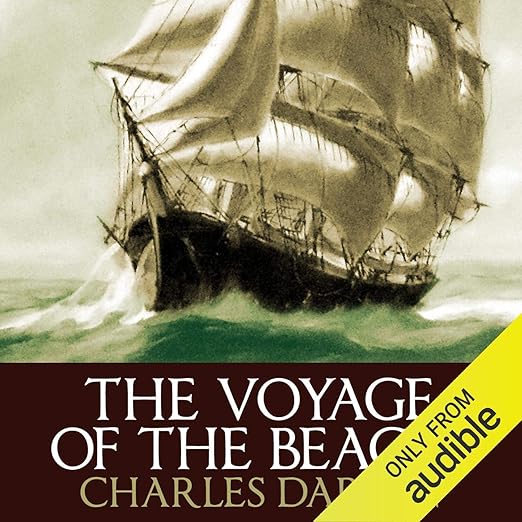
Clara’s Verdict
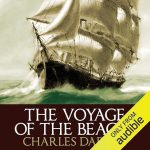
I spent several long train journeys last winter with Darwin’s voice in my ear, or rather Barnaby Edwards rendering it, and I came away with a vivid and slightly humbling sense of how much a single observant mind can accomplish when it is paying genuine, unhurried attention to the world. The Voyage of the Beagle is one of those books that earns the word classic not through reputation but through the force of its own particulars. Darwin was twenty-two when the Beagle sailed from Plymouth in December 1831. He was also, by his own admission, relentlessly seasick; I hate every wave of the ocean, he wrote to his family, and the physical misery gives the prose an immediacy that no amount of subsequent reverence has managed to flatten.
What strikes me consistently in listening to this account is how much more humane and curious Darwin sounds than the caricature of cold-eyed Victorian naturalist might suggest. His observations on the indigenous peoples he encounters in South America read, as one reviewer correctly noted, as surprisingly modern in their empathy and scepticism about colonial assumptions. His descriptions of Patagonian landscape carry genuine literary force. His account of the aftermath of an earthquake, later identified as a tsunami precursor, is vivid enough that a contemporary reader can feel the geological unease beneath the narrative. This is travel writing of the first order, and it happens also to be the notebook of a mind assembling the raw material that would eventually become On the Origin of Species.
The literary quality that the synopsis invokes by comparison to John Muir and Henry Thoreau is not empty marketing. There are passages in the Galapagos chapters particularly where the precise observation and the lyrical impulse work together in a way that produces something more than field notes. Darwin was a young man in full possession of his curiosity, and the record of that curiosity is genuinely compelling to read.
About the Audiobook
This Audible Studios production, released in April 2013, runs for 25 hours and 17 minutes and carries a rating of 4.2 from 500 listeners on Audible UK. That rating count is substantial and gives the score genuine statistical weight. The narrator is Barnaby Edwards, an experienced professional whose work across long-form non-fiction and classics consistently produces reliable results. At 25 hours, this is the complete and unabridged text, and Darwin’s prose style, while fully accessible to a general reader, belongs to the mid-nineteenth century and requires some adjustment of pace and register on the listener’s part.
The Narration
Barnaby Edwards reads Darwin with measured authority, letting the prose breathe without imposing undue theatricality on material that does not require it. One enthusiastic reviewer attributed the narration to Richard Dawkins, which is a factual error but an interesting one: it suggests the performance carries enough scientific credibility and embodied conviction that listeners project authority onto it. Edwards navigates the range of material competently, from the technical geological observations to the lyrical passages describing Galapagos flora and fauna. For a 25-hour Victorian scientific narrative, sustained quality of delivery is not a given, and Edwards maintains it throughout.
It is also worth noting that the experience of listening to Darwin at 25 hours is considerably more forgiving than reading him at equivalent length on the page. The audio format smooths the occasional density of his geological passages in a way that print does not, because the momentum of the spoken word carries you through stretches where a reader might pause and lose the thread. This is a text that benefits from being heard rather than scanned, and Barnaby Edwards’s measured delivery is well-matched to that quality.
What Readers Say
The reviewer pool of 500 reflects broad and genuine engagement. Leo John De freitas found the account positively exciting at points, singling out Darwin’s tsunami aftermath description as delicious to read in the context of what we now know. Chris noted it is better than On the Origin of Species for the general reader, finding the Beagle account readable with ease and enjoyment once you adjust to the older writing style. The reviewer who recommended the MobileReference Kindle edition (and the audiobook by extension) praised its structural clarity and navigability. The consensus across the 500-strong review pool is that this is one of those rare instances where a canonical text turns out to be significantly more entertaining than reverence for it might lead you to expect.
Who Should Listen?
Anyone with an interest in natural history, the history of science, or Victorian travel writing will find this rewarding across its 25-hour runtime. It sits particularly well alongside other nineteenth-century naturalist accounts, and the contrast with the dry theoretical apparatus of Origin of Species is illuminating. Those expecting dense scientific argument will be pleasantly surprised; this is narrative first and science second, observation before theory, and the personality of the young Darwin is very much present throughout. The audio format handles the long descriptive passages particularly well; this is a book that benefits from being experienced rather than scanned. Listen on Audible UK