Clara’s Verdict
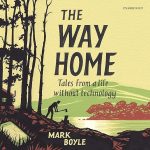
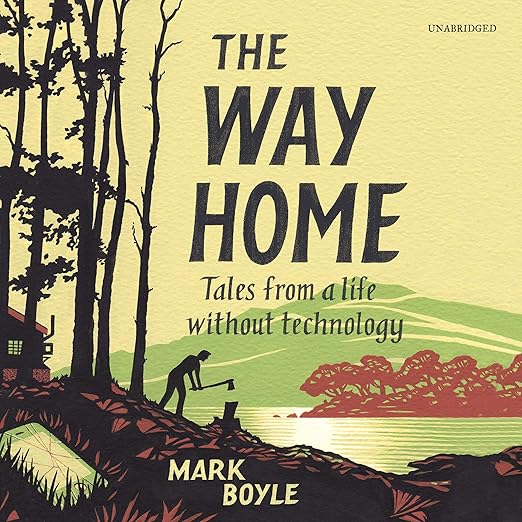
There is a particular kind of contemporary non-fiction that I find almost entirely unpersuasive but cannot stop reading – books that describe a radical life choice so honestly that even the failures and frustrations become arguments for the thing being attempted. Mark Boyle’s The Way Home is that book. Boyle, who became known for walking across Europe without money for his earlier title The Moneyless Man, describes in this volume his attempt to live without any modern technology whatsoever: no electricity, no phone, no internet, no car, no washing machine. Just a wooden cabin in rural Ireland, a smallholding, a stand of spruce at the edge of the property, and whatever he could learn to do with his hands.
I listened to this on a train to Edinburgh, which felt like exactly the wrong context and exactly the right one. The irony of consuming a book about radical technological withdrawal via wireless earbuds on a 125mph diesel train is not lost on me, but Boyle would probably appreciate the observation rather than hold it against you. He is not, despite what you might expect, a preacher. He is a writer in the genuine sense – someone trying to make sense of his own experience on the page – and the result is a book that earns comparison with Thoreau’s Walden not because it is similarly earnest, but because it is similarly honest about the gap between intention and reality.
About the Audiobook
The Way Home was published in 2019 and the audiobook, produced by Blackstone Audio, runs to 8 hours and 36 minutes. The title is part of a loosely connected trilogy of ideas – Boyle has moved progressively further from the conventional economy and the conventional life, and this volume represents the furthest point yet reached. It is structured loosely as a seasonal journal, moving through a year of life on the smallholding and accumulating both practical knowledge and philosophical reflection in roughly equal measure.
The practical content is substantial: building a cabin, making fire without matches, collecting water from a stream, foraging, fishing, keeping chickens, growing vegetables. Boyle is honest about the learning curve and about what he gets wrong in the early months. He does not romanticise the physical labour – there is a very good passage about the difference between knowing intellectually that building a fire without technology is possible and actually being cold in the dark at eleven o’clock in November while failing to do it. This honesty is the book’s core strength.
The philosophical dimension is more uneven. Boyle’s critique of industrial civilisation and the technology-mediated life is argued consistently and with evident conviction, but it occasionally tips into the kind of generalisation that loses specific force. His most interesting observations are the close, particular ones – what it feels like to exist within a seasonal rhythm after decades of artificial lighting, or how differently time passes without a phone. These passages have a quality of genuine discovery.
The Narration
Gerard Doyle narrates, and he is an excellent match for Boyle’s prose. Doyle has a quality of unhurried attentiveness in his delivery that fits the pace of the subject: a book about learning to slow down should not be narrated in a rush. He handles the philosophical passages with care rather than weight, and the more lyrical nature writing – of which there is a fair amount – without tipping into affectation. His Irish intonation sits appropriately with the rural Irish setting, lending a sense of geographical authenticity that a flatter accent would have missed. Over nearly nine hours, Doyle’s voice becomes as inseparable from the book’s texture as Boyle’s prose rhythm.
What Readers Say
The audiobook holds 4.5 stars from a single listener at time of writing, which is too small a sample to carry statistical weight. The print reviews are considerably more numerous and offer a clearer picture. S. Freeman praised Boyle as warm, sociable, and in no way preachy, noting that he comes across as genuinely curious rather than evangelical. Chanatkins described it as the book they needed during a period of digital overload, feeling fully immersed and mesmerised by the life Boyle built for himself. A reviewer called Apollo offered a sharp observation: this is not a book about the beauty of simple living but about how hard and complex it actually is, made up of a thousand simple things. The three-star review from Mark Johnson Personal Account is also worth noting: a reader hoping for guidance on their own screen addiction found the book pleasant but not transformative in the way they had hoped, which is an honest limitation – this is testimony, not self-help.
Who Should Listen?
This is for anyone who has ever looked at the amount of time they spend interfacing with a screen and felt a vague but persistent unease. It will not give you practical instructions for living without technology – it is not that kind of book – but it will give you a genuine account of what that life feels like from the inside, with all its difficulty and all its unexpected richness. Fans of Walden, of Robert Macfarlane’s nature writing, or of the back-to-the-land tradition generally will find much to admire here. Those who want either a practical guide or a straightforward polemic may find it too lyrical and too ambivalent. That ambivalence is what makes it worth your time.