Clara’s Verdict
My garden is a source of considerable pleasure about eight months of the year and a source of vague guilt for the remaining four. I have spent several winters looking at a patch of bare earth that was, in summer, genuinely productive, and thinking that there must be a more intelligent approach. The Year-Round Garden Blueprint by Sean Ray arrived in March 2026 at the exact moment I was beginning, once again, to feel the pull of early-season enthusiasm and wondering whether I could sustain it past October this time.
At just over an hour, this is not a comprehensive gardening manual. It is, more precisely, a philosophical reorientation, a case for thinking about the garden as a continuous practice rather than a seasonal hobby. Whether that case is made with sufficient depth and specificity to be genuinely useful depends on where you are starting from. But for the home gardener who lets the plot go dormant every November and wonders vaguely why, it offers a coherent answer.
About the Audiobook
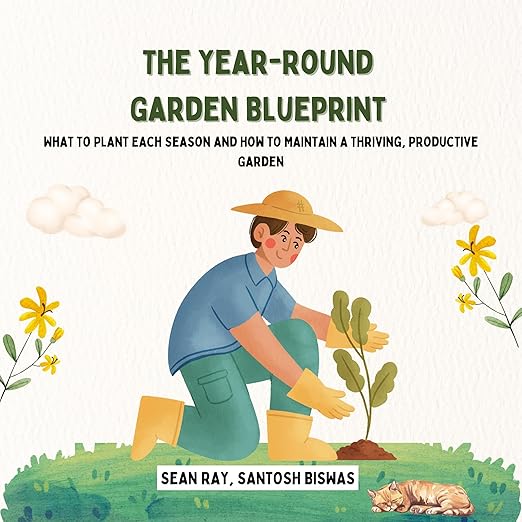
Published in March 2026 by Sean Ray with Santosh Biswas, The Year-Round Garden Blueprint is billed as a practical guide for transforming any growing space, from sprawling countryside gardens to compact urban balconies, into a productive, resilient ecosystem across all four seasons. The book’s central framework is built around what the author calls intentional cultivation: the idea that most gardeners fail to maintain year-round productivity not because of climate or soil or luck but because they plan reactively rather than proactively.
The content covers succession planting, crop rotation, soil regeneration, and seasonal timing, all core skills of any productive kitchen garden. Ray explains how thoughtful preparation, rather than reactive intervention, allows gardeners to extend harvest windows, protect crops from environmental stress, and maintain consistent productivity even through the colder months. The emphasis throughout is on structured planning rather than intuition, and the framing is deliberately accessible to those without professional horticultural training.
Ray positions the book as a corrective to the typical approach to gardening: enthusiastic in spring, exhausted by late summer, and entirely dormant by November. He argues that each of the four seasons has productive potential, and that most gardeners are simply not planning far enough ahead to access it. The winter sections are particularly worth noting: he makes a credible case for continued soil work, planning, and protected growing that most casual gardeners overlook entirely.
The limitations of the format are worth acknowledging honestly. At sixty-three minutes, the book can cover principles but not procedures in any detail. Listeners hoping for specific planting schedules, variety recommendations by region, or detailed instructions for soil preparation will need to supplement this with more specialised resources. The audiobook works better as a framework for thinking than as a step-by-step operational guide.
Ray also addresses the question of scale with useful flexibility. The framework is explicitly designed to work across very different contexts: a large allotment, a suburban back garden, or an urban balcony each present different constraints, and the book does not assume that all listeners are working with the same amount of space or the same soil conditions. This breadth of applicability is one of the more practically useful aspects of a short book, since it prevents the all-too-common trap of gardening advice that is only useful for people who already have the right setup.
The Narration
Narrated by B Fike, the production has a clean, instructional quality that serves the practical nature of the material. Fike reads with clarity and a pleasant, unhurried pace. This is not a performance that draws attention to itself, which is exactly right for a book of this type. There is warmth in the delivery without sentimentality, and the reading never feels mechanical despite the instructional content. A solid narration for a short, practical title.
What Readers Say
Released in March 2026, the audiobook has not yet accumulated ratings or reviews on Audible UK. As a recently published, independently produced title in the home and garden category, this is not unusual. Listeners considering it should treat it as an introduction to a framework rather than a definitive gardening resource, and may find it most useful as a seasonal prompt in late winter or early spring when planning decisions are most consequential.
Who Should Listen?
This is well suited to gardeners who feel they are not making the most of their growing space across the full year, particularly those who let the garden go dormant for several months and want a practical philosophy for changing that pattern. It is also a reasonable choice for urban gardeners with limited space who want guidance on making the most of whatever they have. Those with serious horticultural experience will find the material elementary. But for the home gardener who treats autumn as an ending rather than a transition, an hour spent with this audiobook in February or March could prove a useful nudge in the right direction.