Clara’s Verdict
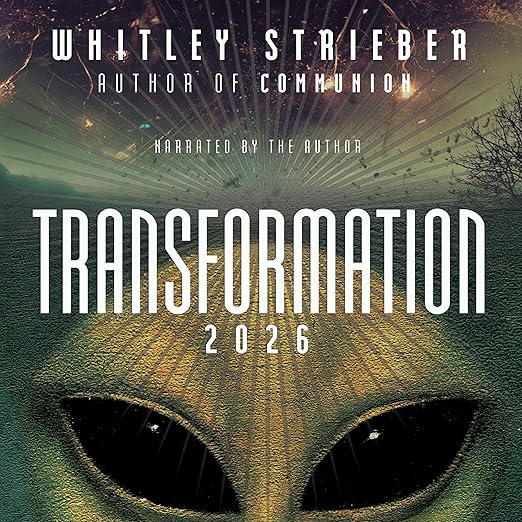
Whitley Strieber occupies a strange and singular position in literary culture. He is a serious novelist – The Wolfen, The Hunger, books that established him as a genuine talent in dark fiction – who in 1987 published Communion, an account of his claimed encounters with non-human beings, and has spent most of the decades since elaborating and defending that account. Transformation 2026 is an expanded edition of the 1989 sequel, updated with hundreds of new annotations reflecting forty years of reflection on a sustained personal experience. Whether you approach it as genuine memoir or as a remarkable psychological document depends on what you bring to it. Either way, it is unlike anything else you will find in audio.
What I find interesting about Strieber as a writer, regardless of one’s position on the visitors’ reality, is his absolute refusal to resolve the experience into comfortable narrative. He does not claim clear understanding. He claims sustained, confusing, frightening, and occasionally beautiful encounter – and he reports it with the rigour of someone who knows he will not be believed and has decided to be honest anyway.
About the Audiobook
Where Communion described the initial shock of encounter with the beings Strieber refuses to label aliens, angels, or demons, Transformation chronicles what happened next – six months of sustained, intimate contact with these entities as they moved through his family’s life. More than thirty named witnesses appear in the text, many of whom experienced events alongside the Striebers, which gives the account a corroborative weight unusual in literature of this kind. The 2026 expansion adds hundreds of updated annotations in which Strieber revisits his earlier assessments with the advantage, and the complication, of four additional decades of experience and observation.
The tone throughout is careful and resistant to easy interpretation. Strieber acknowledges fear, confusion, and mistakes made by both parties – “on both sides”, he writes, with a deliberateness that is either remarkable in its precision or remarkable in a different sense. He argues that the visitors are neither malevolent nor straightforwardly benevolent, but genuinely other: profoundly different from us in ways that matter, and yet recognisably conscious in ways that also matter. The 2026 edition’s central argument is that contact, if it comes openly, will not begin in government facilities – it will unfold in ordinary homes, as it arguably already has for those who have experienced it.
At fourteen hours, this is a substantial listen that rewards careful attention rather than background listening. The book moves between first-person memoir, witness testimony, and philosophical reflection, and the transitions require some adjusting to.
The Narration
Narrator information was not confirmed in the available data for this edition; listeners should check the current Audible UK listing for production details. The writing itself demands a narrator capable of sustaining emotional nuance across fourteen hours of material that shifts considerably in register – from visceral fear to philosophical speculation to something approaching wonder. The listening experience has received strong responses from those already familiar with Strieber’s work and approach.
What Readers Say
Bryan Upfield, who believes in the visitors’ reality, found it “transformative” and predicted mainstream contact is approaching. Katherine Hahn was moved to tears by Chapter 6 – Strieber’s description of a particular encounter she called “achingly beautiful and familiar”. Jesse Garden, reviewing from Canada, called it “peak Strieber” and a worthy addition to his long catalogue. A researcher into anomalous phenomena recommended it equally for established students and for those just beginning their investigation. Rated 4.5 out of 5 from 11 reviews.
Who Should Listen?
Readers already acquainted with Communion who want to follow the narrative forward into Strieber’s account of sustained contact. Those with a serious interest in anomalous experience, contact phenomena, or the outer edges of what memoir can do. This is not a comfortable listen and is not intended to be; it is the record of a family living through something that resisted all their attempts to explain or normalise it. For committed readers of this territory, the expanded 2026 edition is the most complete version of the account yet available. New readers should almost certainly start with Communion first.
Listen on Audible UK: Get Transformation 2026 on Audible UK