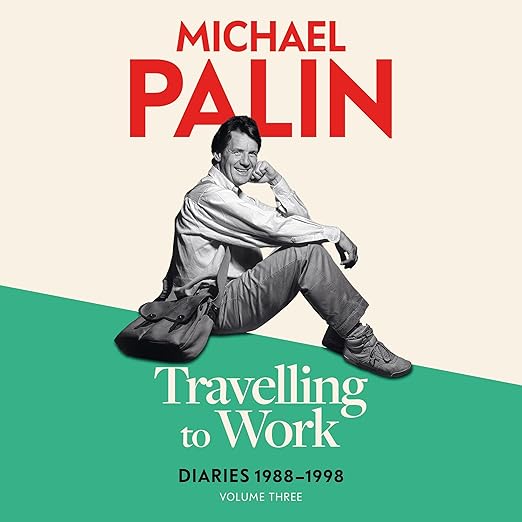
Clara’s Verdict
There is a particular pleasure in listening to a diarist who writes the way Michael Palin writes — with the eye for the telling detail and the instinct for the absurd that defined his comedy work, applied to the material of an actual life rather than a constructed sketch. Travelling to Work covers ten years from 1988 to 1998, a period that begins with Palin travelling the Adriatic as the first choice for Around the World in 80 Days and ends with Full Circle. In between he films American Friends, takes the lead in Alan Bleasdale’s GBH, writes his first novel Hemingway’s Chair, appears in Fierce Creatures, and produces two more travel series. Most people’s careers consist of one of those things, if they are fortunate. Palin managed all of them in a decade and had time to worry about each one in his diary.
This is the third volume of the diaries, following Halfway to Hollywood and, before that, the Monty Python years. Each stands independently — this one opens with enough context that newcomers will orient quickly — but there is a cumulative pleasure to following the whole arc that rewards reading in sequence, watching the public persona consolidate while the private man remains engaged with the same anxieties throughout.
About the Audiobook
What strikes me most about Palin’s diaries in audio form is the texture of professional anxiety that runs beneath all the success. He is always worrying about something — a review, a performance, whether he has offended someone, whether the next project will work. One reviewer notes this quality and calls him a sensitive chap, which is exactly right. Palin is not a mythologiser of his own life; the diaries are candid about doubt, about waiting, about the difference between public success and private uncertainty. That quality is what separates genuine diary memoir from retrospective PR, and it is why these books retain their appeal across rereads and relistenings.
The Weidenfeld and Nicolson production is unabridged and runs twenty-three hours and forty-eight minutes. For a diary spanning ten years, that is an appropriate length — you get genuine immersion in the rhythm of his working life, the repetitions and the interruptions, without the artificial compression of an abridged edition that would lose the texture and the rhythm that is, in diary writing, much of the point. The cumulative effect of small daily observations, lunches noted and conversations remembered, builds a portrait of professional life in the British creative industries of the late eighties and nineties that is both specific and strangely universal.
The Narration
Palin reading his own diaries is a case where the author narration question resolves immediately and completely. These are private writings performed by the person who wrote them, and the alignment between voice and prose is total. You can hear the slight note of self-mockery when he describes his own worries, the warmth when he talks about his children, the genuine delight when a project clicks. No professional narrator, however skilled, could produce that particular authenticity. The rating of 4.4 from 590 listeners — a large and experienced sample — reflects an audience that has found this format to work exactly as it should. Several reviewers specifically single out the self-narration as a major asset of the production.
What Readers Say
The reviews are consistent and thoughtful. One describes him as easy to listen to and praises the capacity to weave the minutiae of daily life into an entertaining and surprisingly interesting tapestry. Another calls the writing very clear and free of less-interesting parts, which for twenty-three hours is a meaningful claim. A third reviewer, less effusive, notes that once famous, Palin was seemingly always invited to judge competitions or appear on awards panels — a vicariously glamorous existence that the reviewer acknowledges while also registering a faint note of distance from it. That is an honest response, and it reflects the one genuine limitation of celebrity diaries: the social world they describe is unavoidably exclusive, however modest the diarist himself may be about it.
Who Should Listen?
Travelling to Work is essential listening for anyone with an existing interest in Palin, in the British creative industries of the late eighties and nineties, or in the diaries-as-form as a mode of autobiography. It works for travel enthusiasts who know the Pole to Pole or Full Circle series and want the behind-the-camera version. It works equally for readers interested in the texture of a creative working life across different kinds of project simultaneously. Twenty-three hours is a substantial commitment, but this is company that earns and justifies every minute of it.