Clara’s Verdict
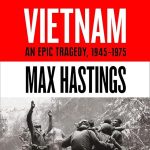
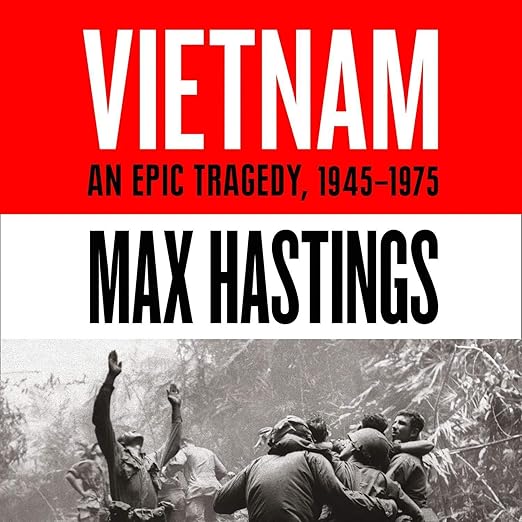
I started Max Hastings’s Vietnam on a long train journey north and finished it several days later with the distinct sensation of having lived inside a vast, complicated catastrophe for a week. That is not a complaint. Hastings is among the most dependably serious historians writing in English today, and this is the book he was probably always going to write: the Vietnam War as a human disaster that neither side deserved to win, told through the testimonies of the people who fought and died and endured on every side of the conflict. Antony Beevor called it Hastings’s masterpiece. The Sunday Times called it “a masterful performance.” Gerald Degroot in The Times named it “by far the best book on the Vietnam War.” High praise, and largely earned.
Peter Noble narrates across 33 hours and 48 minutes — a considerable investment, and one that rewards sustained attention. Published by William Collins and released in September 2018, this audiobook has had time to find its readership and be properly assessed.
About the Audiobook
Hastings spent three years interviewing participants on both sides of the conflict and working through American and Vietnamese documents and memoirs before writing this account. The result is an epic narrative spanning the French defeat at Dien Bien Phu in 1954, the Tet offensive, the air blitz on North Vietnam, and battles less familiar to Western audiences — including the near-annihilation of a US Marine battalion at Daido. Critically, Hastings resists the common framing of Vietnam as primarily an American story. He makes the point explicitly and returns to it throughout: forty Vietnamese died for every American. The war was, overwhelmingly, a Vietnamese tragedy.
The voices he marshals range from Vietcong guerrillas and Southern paratroopers to Saigon bargirls, Hanoi students, infantrymen from South Dakota, Marines from North Carolina, and Huey pilots from Arkansas. The effect is a moral panorama rather than a simple narrative — one that refuses to assign righteousness to any of the parties involved. US atrocities are documented with the same precision as communist atrocities. The famous image of the napalm-burned child is placed alongside the countless eviscerations and murders carried out by the other side, documented with the same unflinching detail.
One reviewer here flags Hastings’s political background — former editor of the Daily Telegraph — and suggests reading with that colouring in mind. That is fair advice. Hastings is not a neutral observer, and his scepticism about American adventurism coexists with a clear-eyed view of communist brutality. The book is most honest when it is most uncomfortable, and it is frequently both.
The Narration
Peter Noble brings a measured, authoritative register to the material that serves the scale and gravity of the subject. At nearly thirty-four hours, Noble must sustain concentration across an enormous range of voices and contexts: combat narratives, political analysis, personal testimony, and Hastings’s own analytical commentary. He does so with consistent clarity. The narration does not dramatise where the text requires restraint, which is the correct choice for a work of this historical seriousness. The distinction between a historian’s assessment and a participant’s testimony is always clear in Noble’s delivery.
What Readers Say
David Bryson, writing from the United Kingdom, described Hastings as absorbing facts “much as boron absorbs neutrons” and praised his ability to hold the reader’s attention across the full length of the work, from page one to page six hundred and fifty, “without fatigue.” Andy Salvador — who had previously read four other Hastings books — described this as the only book a newcomer to the subject would ever need, though he cautioned that the detail can be “overwhelming” for someone approaching the conflict for the first time. Chris D offered a measured critique, praising the comprehensiveness while noting Hastings’s occasionally “tortuous phrases.” Thomé Madeira, writing from Brazil, quoted a Vietnamese veteran and called it “a crude portrait of America’s loss of innocence.” Across five Audible ratings, the audiobook holds a 4.6 average.
Who Should Listen?
This is essential listening for anyone who wants to understand the Vietnam War in full: its origins in French colonialism, its American escalation, and its aftermath for the Vietnamese people on both sides. It is a long, demanding listen, and Hastings can be dense. Newcomers should be prepared to encounter a great deal of information and to hold multiple perspectives simultaneously. Those already familiar with the war will find in Hastings a comprehensive and morally serious account that takes the complexity seriously rather than resolving it into a simple verdict. Ken Burns’s documentary series makes an excellent companion if you want additional visual and testimonial material alongside this audio.