Clara’s Verdict
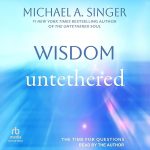
Michael A. Singer occupies a curious position in contemporary spiritual publishing. The Untethered Soul found an audience that went well beyond the usual spirituality readership, reaching people who would not normally read in this space at all, drawn by the clarity of his central proposition and the absence of religious specificity. Wisdom Untethered arrives as a third volume in what is now effectively a trilogy, and it does something interesting with format: it is structured as a dialogue, a series of direct questions and answers, which gives it an immediacy that neither of its predecessors quite had.
The reviews are genuinely divided on this one, and the honest thing is to flag that upfront. Some readers find the Q&A format revelatory. Others find the prose, and two reviewers raised concerns about AI-assisted writing, repetitive and reduced in quality compared to Singer’s earlier work. Both responses seem fair based on the available evidence, and they reflect a real tension in the book between its aspiration and its execution.
I should note that Singer reads his own work, which makes the audio version a distinct and arguably superior experience to the print edition for this particular title. The self-narration adds a quality of presence that a performed reading cannot replicate, and for content this rooted in the relationship between teacher and student, that presence matters considerably. It is the primary reason to choose the audio format here over print.
About the Audiobook
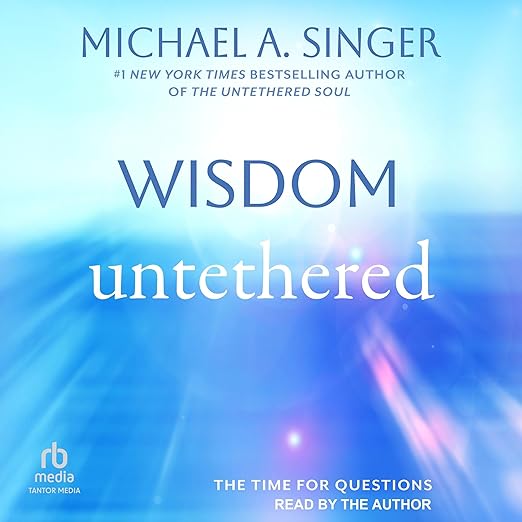
Published by Tantor Media in March 2026, Wisdom Untethered: The Time for Questions presents Singer’s teaching in dialogue form, addressing what he identifies as the universal struggles of inner life: the need to control outcomes, the fear of change and surrender, and the search for peace in external circumstances rather than internal release. The book’s central claim is familiar from Singer’s earlier writing: peace is not something to be found or achieved. It is something that emerges when the internal obstacles to it are removed.
The Q&A structure is the book’s primary formal innovation. Rather than presenting a linear argument or a series of chapters developing a theme, Singer responds to questions directly, some apparently from students and some constructed as representative of common struggles. This gives the book an accessible, conversational texture, and at its best it creates the feeling of sitting in a room with someone who has genuinely thought hard about these questions and is not performing wisdom at you.
The content covers ground familiar from The Untethered Soul and The Surrender Experiment: the watching consciousness, the process of releasing rather than managing emotional pain, and the distinction between the person who experiences and the experience itself. Returning readers will recognise these frameworks and will likely either find the repetition reinforcing or redundant depending on where they are in their own engagement with the material.
At eight and a half hours, this is longer than the dialogue format might suggest it needs to be, and the repetitiveness that several reviewers note is a real concern. Singer’s core teachings have not changed substantially across three books, and the book would be stronger with tighter editing. The value is nevertheless real for readers who return regularly to this kind of material for recalibration rather than novelty.
The Narration
Singer reads his own work, and this is a meaningful choice that transforms the audio version into something closer to a direct transmission than a recorded book. His delivery is calm, considered, and unhurried in a way that suits the content precisely. This is not material to be rushed through, and Singer does not rush it. The Q&A format benefits particularly from self-narration, as the transitions between question and response land more naturally in Singer’s own voice than they likely would in anyone else’s reading of them.
What Readers Say
With a 4.4 rating from 13 UK reviews, the response reflects genuine admiration alongside substantive criticism. One reviewer described it as another life-changing book and praised both the depth and the accessible format. Another raised a pointed concern about AI involvement in the prose, citing structural patterns they associate with language model output and suggesting Singer’s readers deserved better. A third noted significant repetition that could have been edited to a shorter runtime. On the other side, a reader who has made flashcards from Singer’s earlier books described the new volume as answering questions they had carried since first reading The Untethered Soul. The divergence is real, and worth weighing against your own relationship with Singer’s earlier writing before committing to the eight-hour runtime.
Who Should Listen?
Those who found The Untethered Soul or The Surrender Experiment genuinely transformative will want this, and Singer’s self-narration makes the audio format the strongest version of the experience. New readers should begin with The Untethered Soul first: the foundational ideas are better presented there, and this volume lands more fully with that context behind you. Those who prefer their spiritual content dense and tightly edited may find the pacing frustrating. Those who return regularly to Singer’s work for recalibration will find plenty to sit with here, even if not everything in it is new. Listen on Audible UK