Clara’s Verdict
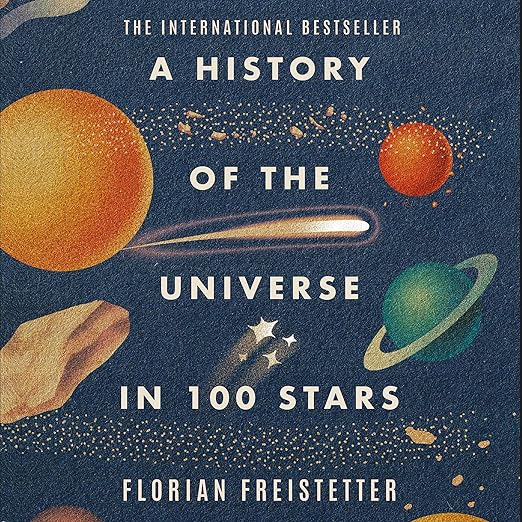
Popular science audiobooks live or die by the quality of their examples, and Florian Freistetter – an Austrian astronomer – has chosen his one hundred stars with the eye of a storyteller rather than a cataloguer. The Demon Star, whose flickering brightness alarmed ancient Egyptian astronomers. The star from which we first proved that the Earth rotates on its own axis. The stars that may harbour planets capable of hosting life. A History of the Universe in 100 Stars, narrated by Richard Burnip, is not a comprehensive atlas of the cosmos; it is a personal selection that uses individual stellar objects as entry points into the broader drama of how we came to understand the universe.
I find this approach – the particular as a door into the general – more satisfying than the survey, and Freistetter handles it with considerable grace. Whether you come to this as a science enthusiast or as a curious generalist, there is something here for you.
About the Audiobook
Each chapter is short – rarely more than ten minutes – and covers a single star, tracing its discovery, its scientific significance, and the human stories attached to it. The format is deliberately non-linear; stars are chosen for what they reveal rather than for any systematic classification. This means the book can be dipped into at any point, though the accumulated effect of reading it sequentially is more powerful: a cumulative sense of the human project of stargazing as an ongoing conversation between generations of curious people and a largely indifferent sky.
The content spans from the Big Bang to the current Gaia mission, touching on extinction events, the search for extraterrestrial life, and the possibilities of interstellar travel. Freistetter is not afraid of the speculative, but he is careful to distinguish between established science and informed conjecture. The translation from German is confident and reads naturally in English – a non-trivial achievement for science writing.
At 8 hours and 29 minutes, this is a satisfying length for the scope of material covered.
The Narration
Richard Burnip narrates with clarity and a low-key enthusiasm that suits the material. He does not oversell the wonder – Freistetter’s prose does that work – but he keeps the listener oriented through the variety of topics and the short-chapter structure. The production by Quercus is clean and well-balanced. Some reviewers have noted minor translation issues with units of measurement, which a careful listener may catch; these are small blemishes in an otherwise well-produced audiobook.
What Readers Say
This audiobook holds a rating of 4.1 out of 5 from 50 ratings – a reasonable score reflecting a range of responses. Enthusiastic listeners describe it as “wonderful,” noting that it can be read cover to cover or dipped into by chapter depending on interest. One reviewer called the format “ideal for a teenager or student” while another found it “shallow” by comparison with more rigorous popular science. That gap is itself instructive: this is a book pitched at curious generalists rather than scientific specialists, and your satisfaction will depend significantly on which you are. UK readers who enjoy the format of short, self-contained chapters on a single theme – the In Our Time radio programme has a similar structure – will find it particularly congenial.
Who Should Listen?
This is an excellent audiobook for listeners who want to understand how the history of astronomy connects to broader questions of human culture, myth, and scientific progress, without requiring existing specialist knowledge. It works well as a companion to stargazing – the short chapters mean you can look up after each one. Parents looking for accessible science audiobooks for older teenagers will find it age-appropriate and engaging. Those who already have a solid grounding in astrophysics will find the depth insufficient, but that is explicitly not the audience Freistetter is addressing.
An engaging, humanising approach to the cosmos. Listen to A History of the Universe in 100 Stars on Audible UK and discover what each star has to say.