Clara’s Verdict
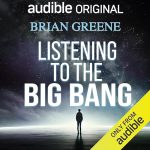
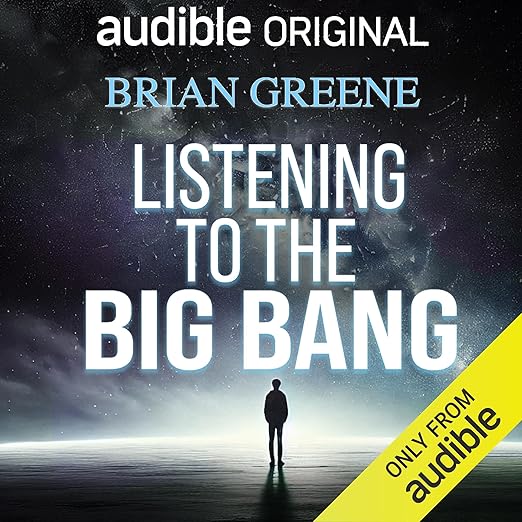
Brian Greene is one of science communication’s most gifted practitioners – a theoretical physicist who writes with literary clarity and, in Listening to the Big Bang, demonstrates that the history of cosmological ideas is as gripping a human story as any novel. At two hours and forty-four minutes, this Audible Original is brief, but it earns every minute. Greene narrates his own work, which gives the performance an authenticity that matters: you are not receiving someone else’s interpretation of Greene’s ideas but his own understanding of why this history is important and what it means. An uncommonly elegant piece of popular science.
About the Audiobook
The premise is an exploration of how humanity arrived at the Big Bang as the leading account of cosmic origins – not as a triumphant march of rational progress but as a genuinely contingent human story, populated by unlikely characters: a Russian dissident, a Jesuit priest, an American mule skinner, and numerous others whose contributions to cosmological theory were shaped as much by personal circumstance and cultural context as by scientific genius.
Greene traces the development of thought from mythology through mathematics to the observational evidence of the expanding universe and the cosmic microwave background radiation – the literal “sound” of the universe’s earliest moments. But he is equally interested in the questions that remain open: Was the Big Bang a singular event, or might there be a series of bangs? What, if anything, existed before it? Why is there anything rather than nothing? These questions sit at the edge of what current science can answer, and Greene is honest about that edge, which makes the inquiry more rather than less compelling.
The “listening” of the title has double meaning: it refers both to the act of listening to this audiobook and to the scientific practice of detecting cosmic sound waves – the gravitational wave detectors and cosmic microwave background experiments that have turned cosmology into an acoustic as well as a visual science. The connection between the two forms of listening is handled with Greene’s characteristic lightness of touch.
The Narration
Greene narrating Greene is a significant asset. His delivery is measured and precise, with the rhythm of someone accustomed to making difficult ideas accessible without simplifying them. He does not rush. The passages of narrative – the human stories behind the science – are told with warmth and a sense of their own drama. The passages of physical explanation are clear and well-paced. This is a short audiobook and it feels exactly the right length: dense enough to be substantive, brief enough to sustain full attention throughout.
What Readers Say
Listening to the Big Bang holds an impressive 4.9 stars from 36 listeners – a near-perfect rating that reflects both the quality of the content and the enthusiasm of Greene’s existing audience. Reviews praise the combination of human storytelling and scientific rigour: listeners describe coming away with both a clearer understanding of cosmological history and a renewed sense of wonder at the questions the science has opened rather than closed. The Audible Original format suits the material well: this is content conceived for audio rather than adapted from print, and the result is tight and purposeful. As a standalone short listen or a companion to longer popular science titles, it is warmly recommended.
Who Should Listen?
For anyone curious about cosmology and the human history behind scientific ideas – readers of Carlo Rovelli, Jim Al-Khalili, or Greene’s own The Elegant Universe and The Fabric of the Cosmos. Also ideal for listeners with limited time who want substantive, enriching content: under three hours, this is perfectly suited to a long commute or an evening’s attentive listening. A model of what popular science audio can achieve when it takes both the science and the storytelling seriously.