Clara’s Verdict
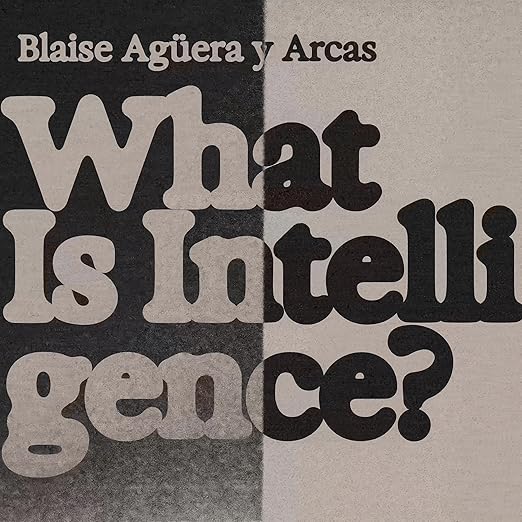
This is a genuinely ambitious book, and it is important to be honest about what that ambition produces. Blaise Agüera y Arcas – a distinguished AI researcher at Google – sets out to answer nothing less than the title question across 17 hours of audiobook. He brings formidable interdisciplinary range: neuroscience, evolutionary biology, information theory, philosophy of mind. The result is a work that is often brilliant, occasionally maddening, and consistently worth arguing with.
The fact that Agüera y Arcas reads his own work adds authority, but also means the text’s occasional structural looseness goes uncorrected. A strong editorial hand would have made this a great book; as it stands, it is merely a very good one.
About the Audiobook
What Is Intelligence? builds its case around the “predictive brain” hypothesis – the idea that intelligence, in both biological and artificial systems, is fundamentally about predicting the future. From this foundation, Agüera y Arcas ranges across the computational properties of living systems, the evolutionary origins of intelligence, entropy and time, consciousness, free will, and the ethics of AI. His central argument – that modern large language models do have a genuine claim to intelligence, consciousness, and agency – is deliberately provocative and seriously defended.
The book is best read, as one reviewer notes, alongside something like Philip Ball’s How Life Works – the two texts illuminate each other’s blind spots productively. At 17 hours, this requires commitment, but the intellectual rewards are substantial for readers prepared to engage actively rather than passively.
The Narration
Agüera y Arcas reads his own work, which is a double-edged choice. The authority he brings to the material – particularly when discussing his own research – is irreplaceable. His delivery is thoughtful and measured, comfortable with complexity without becoming academic. However, a professional narrator might have imposed more discipline on the book’s occasionally digressive structure.
The recording quality is excellent. For the significant portions of the book dealing with mathematical or biological concepts, Agüera y Arcas’s pacing is patient without being slow – he clearly understands which ideas require time to settle.
What Readers Say
It holds a rating of 4.4 out of 5 from 54 listener reviews on Audible.
Dr Mike (4.0/5) writes: “I bought this because of a favourable review in the Financial Times; don’t think that review was quite justified.The book comes across, to me, as being somewhere uncomfortably between a serious text on the subject and a popular account of it. It’s sixteen years since I was a…”
Eran Mukamel (5.0/5) writes: “This book is a pleasure and a provocation. Eloquently and elegantly linking ideas from neurobiology, psychology, information theory, and the history of computation, I found myself thinking about our Minds, Brains and AIs in new and refreshing ways. The author has an original…”
WIKSTRÖM PATRIK (3.0/5) writes: “The author has gathered a hundred-ish chapters related to AI and intelligence. Some of these are really interesting. Particularly the ones on human intelligence and the links he’s able to make between human and machine intelligence. But many of these little chapters are…”
dmn (2.0/5) writes: “The guy is obviously very intelligent. But the book is virtually unreadable. I am up to page 270 and have given up. I don’t recommend it at all.”
The range of responses here – from “best book ever” to “unreadable” – reflects the book’s genuine difficulty rather than any failure of quality. This is not a popular science text dressed up in academic clothing; it is a serious intellectual argument that occasionally moves faster than the reader can follow. The most critical reviews tend to come from readers who expected something more accessible; the most enthusiastic from those already working adjacent to the material.
Who Should Listen?
Essential for anyone working in AI, neuroscience, or philosophy of mind who wants a rigorous synthesis from someone with direct research experience. Also recommended for intellectually adventurous generalist readers prepared for a genuine challenge. Those wanting an accessible introduction to AI should look elsewhere – but if you want to know what a leading AI researcher actually thinks intelligence is, this is where to start.
Listen to What Is Intelligence? on Audible UK and form your own conclusions.