Clara’s Verdict
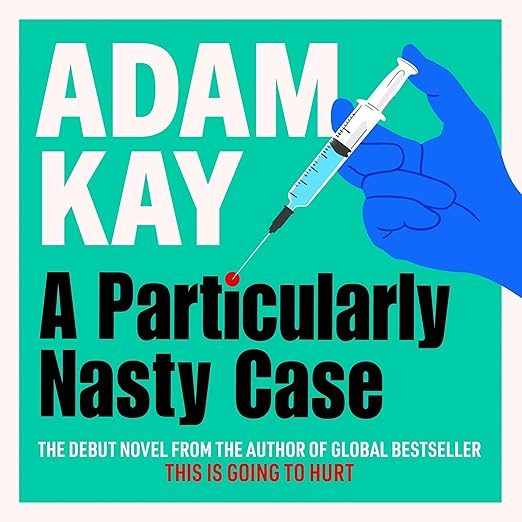
Adam Kay spent years writing about the NHS with a fury that was, on close inspection, indistinguishable from love. A Particularly Nasty Case is his debut novel, and it is – mostly – a very entertaining and intermittently surprising thing. Andy Serkis reads it, which is something of a casting coup. The premise is both simple and genuinely promising: a toxic hospital consultant dies of what is officially a heart attack, but fellow doctor Eitan Rose cannot leave it alone. Nobody else suspects foul play. The police are satisfied. The coroner is satisfied. Eitan’s colleagues are increasingly concerned about his mental health. Kay’s comic timing is as sharp here as in his memoirs, and there are passages in this novel that are genuinely, involuntarily funny.
About the Audiobook
Dr Eitan Rose is returning from a disciplinary suspension when a senior colleague notorious for making junior doctors’ lives miserable drops dead of an apparent cardiac event. Nobody else sees anything suspicious – perhaps because, as one character notes, there are people throughout the hospital who had excellent reasons to wish him ill. Eitan, however, has the instincts of someone who has spent his career looking for what others have missed, and the investigation that follows becomes increasingly chaotic as his personal life and professional standing simultaneously spiral.
Kay is operating in the territory of the medical comedy-mystery: Richard Osman crossed with a particularly dark episode of Scrubs. The hospital setting provides him with obvious satirical material – the institutional dysfunction, the hierarchy of suffering, the gap between what NHS medicine is supposed to be and what it actually is – and he deploys it with the ease of someone who has lived it. Where the novel is strongest is in its honest portrayal of what it actually feels like to have a “socially unacceptable” mental illness whilst trying to function in a high-stakes professional environment. Where it loses some momentum is in the middle third, where the investigation and personal life strands occasionally pull against each other rather than reinforcing. The resolution, however, is described by multiple reviewers as genuinely unguessable – which is high praise for any mystery.
The Narration
Andy Serkis is one of the most versatile voice performers currently working, and he commits fully and completely to this material. His range of voices is enormous – the full cast of hospital staff, patients, investigators, and personal contacts is sharply differentiated – and he has the comedic instincts required to make Kay’s jokes land at precisely the right moment. For a book that moves between dark comedy and genuine emotional weight, Serkis’s ability to modulate tone without losing either register is critical. One reviewer noted moments of laughing whilst “not being sure whether I should be laughing or empathising” – that ambiguity is very difficult to sustain in performance across 10 hours and 9 minutes, and Serkis manages it throughout.
The novel also has things to say about the specific vulnerability of people with mental health histories within institutions that are poorly designed to support them – the way a history of psychiatric difficulty can be weaponised by colleagues, the impossible double bind of being both visibly unwell and professionally competent. Kay writes about this with the directness of someone who has been close to that experience, and it lends the comedy a purposeful edge rather than mere entertainment value.
What Readers Say
Rated 4.0 out of 5 from a growing readership. The response is warmly divided in an interesting way: readers familiar with Kay’s previous work who adjusted to the fictional mode tend to rate it highly, whilst those hoping for more of the same memoir voice sometimes take time to calibrate. One reviewer called it “an absolute barnstormer” and praised its portrayal of mental health in a professional context. Another found it “funny and clever if sometimes relentless.” The “snort out loud laughs” mentioned by one listener are real – the comedy is not decorative here but structural to how the book works.
Who Should Listen?
Fans of This Is Going to Hurt and Kay’s other NHS memoirs are the obvious primary audience, though the shift to fiction warrants a mild note. Medical thriller enthusiasts who enjoy their mysteries laced with dark comedy will find this a natural fit. It is also a rewarding listen for anyone who has worked in or alongside the NHS, where the institutional satire arrives with particular accuracy. Listen on Audible UK: get A Particularly Nasty Case on Audible UK. The audiobook also works particularly well for listeners who enjoy comedy novels in audio format – Serkis’s timing transforms already-funny writing into something even more effective than the page version. Available on Audible UK, Kobo, and Scribd. Listeners who come away wanting more Kay should begin with This Is Going to Hurt if they have not already – the memoirs provide essential context for understanding the satirical impulse behind the fiction.