Clara’s Verdict
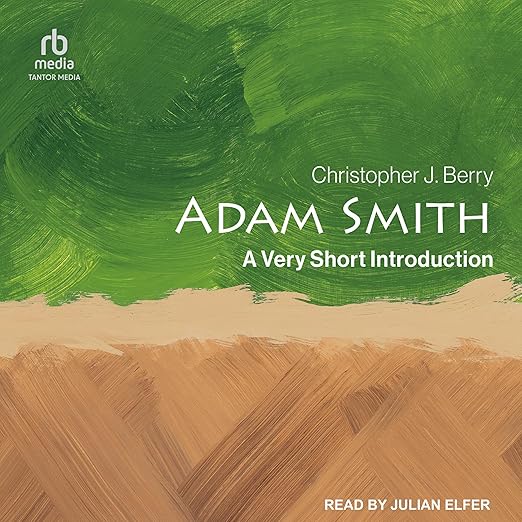
The Oxford “Very Short Introduction” series has long been one of academia’s better gifts to the general reader, and Christopher J. Berry’s volume on Adam Smith is among the strongest in a strong catalogue. At three hours forty minutes, it does something genuinely difficult: it takes one of the most caricatured figures in the history of ideas – the “father of economics,” the prophet of the invisible hand, the patron saint of free-market ideology – and shows you the actual human being behind the slogans. Smith was a moral philosopher before he was an economist, and Berry’s great service is to put that back at the centre of the account. Rated 4.6 from thirteen listeners, this is a book for curious minds rather than specialists, and it rewards the curiosity generously.
I have a particular impatience with the Smith who gets cited in political argument – the one whose work has been reduced to a handful of decontextualised sentences about self-interest and market efficiency. Berry’s book is an implicit and thoroughly evidence-based refutation of that Smith, and it is all the more effective for doing its work through biography and intellectual history rather than polemic.
About the Audiobook
Berry’s argument is essentially corrective. The Adam Smith who has been co-opted by libertarians and free-market ideologues is a simplification – distorted to the point where Smith himself, reading their citations, would likely be astonished. The real Smith – the Smith of The Theory of Moral Sentiments as well as The Wealth of Nations, of the history of astronomy and the analysis of language – was interested in justice, in sympathy, in the social conditions that make genuine prosperity possible, not merely in the mechanics of market transactions. Berry traces how Smith’s defence of free trade and competition was always embedded in a broader moral and philosophical framework, rooted in his understanding of human nature as fundamentally social and sympathetic rather than atomised and self-interested.
The book situates Smith in the intellectual context of eighteenth-century Glasgow and Edinburgh with enviable clarity, placing him within the Scottish Enlightenment and in conversation with contemporaries like Hume and Ferguson. It also covers the less-known aspects of Smith’s work that tend to be ignored in favour of the economics: his pioneering study of the history of astronomy as an illustration of what drives humans to seek explanations, and his analysis of the development of grammar and language. Smith emerges from Berry’s account as one of the Enlightenment’s most genuinely comprehensive thinkers – someone whose range and depth make the economic readings look not just partial but impoverished.
The Narration
Julian Elfer is an experienced audiobook narrator and he handles the academic prose of a Very Short Introduction with easy authority. The material is dense in places – this is a serious intellectual biography compressed into a small space – but Elfer’s clear enunciation and measured pace help the listener absorb the argument without needing to rewind constantly. The tone is appropriately scholarly without being arid or forbidding. There is a quality of engaged intelligence in the delivery that conveys the sense that Elfer finds the material interesting, which transfers to the listener. At under four hours, it never outstays its welcome and leaves you wanting more rather than relieved to have finished.
Berry is also admirably clear about what we cannot know about Smith – where the documentary record is thin, where interpretation must necessarily remain provisional. That scholarly honesty, unusual in a work aimed at a general audience, actually strengthens the book’s credibility. It does not pretend to resolve debates that genuine Smith scholars have been conducting for decades. It opens those debates to readers who may not have known they were happening, which is the more valuable service.
What Readers Say
Thirteen ratings at 4.6 stars suggest a small but thoroughly satisfied audience. The book attracts listeners who came wanting to understand Smith properly and found themselves genuinely surprised by how much they had previously misunderstood. The consistent theme in positive responses is the relief of encountering a nuanced account after years of simplified myth-making, and the pleasure of discovering that the real Smith is a far more interesting and humane thinker than the caricature. For a book this short, the responses it generates are unusually thoughtful – people write about it as a book that changed their understanding of something, rather than simply confirmed or extended what they already knew.
Who Should Listen?
Essential for anyone interested in economics, political philosophy, or the history of ideas who wants to get past the caricature and engage with the source. Equally valuable for readers who have never thought much about Smith but want an accessible gateway into Enlightenment thought and its continuing relevance. Business leaders who cite Smith regularly in support of market ideologies should probably listen to this before their next conference speech. Students of economics who have read snippets of The Wealth of Nations without the broader context will find the picture it provides genuinely illuminating. Available on Audible UK.