Clara’s Verdict
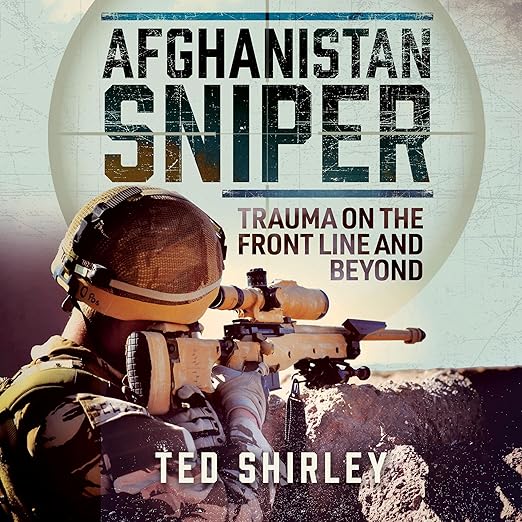
Military memoirs occupy a peculiar position in the literary landscape: they are simultaneously among the most important testimonies we have of contemporary warfare and among the most unevenly executed books in any genre. At their best, they force civilian readers to confront realities that distance and abstraction otherwise protect us from. Afghanistan Sniper, written and narrated by Ted Shirley – a Welsh infantry veteran who completed two tours in Helmand Province, qualified as a sniper, and spent over a decade afterwards battling PTSD – belongs to the best of the tradition. It is honest about violence in a way that does not glamorise it, and honest about the psychological cost of that violence in a way that the genre does not always manage. Published by 12Point Audio and arriving in May 2026, this is a memoir for people who want the complete story, not only the action.
About the audiobook
Shirley’s account begins with selection: a Welsh infantry battalion identifying its most capable men for sniper training, the rigorous and demanding cadre that follows, and the close friendships formed between the young men navigating it together. Grief arrives early and establishes the memoir’s emotional register before the main deployment has begun: the cadre loses one of its own to the Taliban shortly after qualification, a loss whose weight Shirley carries throughout everything that follows.
The Helmand deployment itself is described in specific and technically precise detail. Shirley and his fellow snipers participate in an air assault operation described as the largest since the Second World War; they engage enemy targets from distances of a mile; in one instance, a single round accounts for two Taliban fighters simultaneously. The operational sections are written without false modesty and without gratuitous glorification: Shirley describes what snipers actually do, and what it actually feels like to do it, with the specificity that makes this category of memoir uniquely valuable to civilian readers who otherwise have no access to this reality.
But the memoir’s most significant achievement is its second half. Upon returning from Afghanistan, Shirley begins to experience what will eventually be diagnosed as post-traumatic stress disorder – a condition that takes over his life and sends him on a downward spiral lasting more than a decade. Faced with medical assessments offering little hope of recovery through conventional means, he resolves to take control of his own rehabilitation and document the process of finding his own solutions. It is this section – its honesty about the depth of the crisis and the difficulty of the recovery, its refusal of easy resolution – that elevates the memoir from a compelling war account to a document of lasting importance.
The narration
Shirley narrates his own memoir, which is both the obvious choice and the only one that could work. His Welsh accent and characteristically understated delivery bring an authenticity to the operational sections that no professional narrator could replicate, and the passages describing his PTSD at its worst – the disintegration of his sense of self, the specific texture of that decade – benefit from the combination of restraint and evident emotional memory that only someone recounting their own experience can achieve. Duration is listed as “Not Yet Known” pending the May 2026 release, but the depth and scope of the material suggest a substantial listen well suited to the audiobook format.
What readers say
As a forthcoming May 2026 title, listener reviews have not yet accumulated. What can be assessed from the material itself is the quality and seriousness of the source: Shirley writes with the precision of someone trained to observe and report accurately, and the memoir’s structure – moving from the professional pride of qualification through the operational intensity of Helmand to the long civilian aftermath – is the right shape for the story it tells. However, the quality of the source material positions this alongside the most significant recent British military memoirs. The combination of precise operational detail, an unusually frank account of PTSD, and the narrative of self-directed recovery – presented by a credible, unmediated narrator who lived every moment of it – is rare in the genre and will find a readership that extends well beyond the military community into anyone with personal or professional interest in veteran mental health and recovery.
Who should listen?
This will be essential for veterans and their families, particularly those navigating PTSD or the aftermath of operational service. It is also an important listen for civilian readers interested in the Afghan war from a ground-level Welsh infantry perspective – a view that differs significantly in character and emphasis from the American and senior officer accounts that have dominated the English-language military memoir genre. Mental health professionals, researchers working on veteran resilience, and anyone involved in the care and support of service leavers will find Shirley’s account of self-directed recovery both clinically interesting and humanly compelling. This is not comfortable listening. It is necessary listening.
Listen to Afghanistan Sniper on Audible UK – a raw and extraordinary account of service, loss, and a decade-long journey back from the edge.