Clara’s Verdict
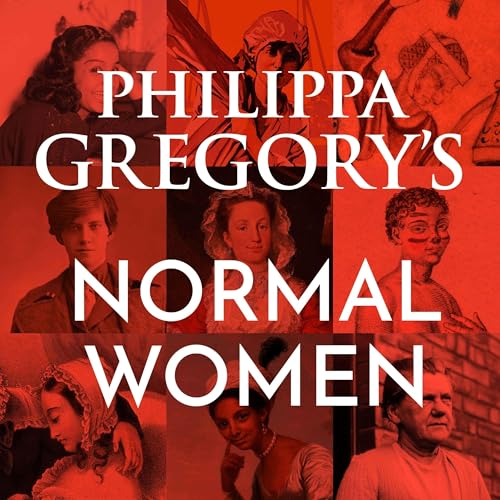
Philippa Gregory is introduced on her own listing as a bestselling historical novelist, so there is a certain satisfaction in watching her turn to non-fiction and write about the people her genre usually leaves in the background. Normal Women covers nine hundred years of England with ordinary women in the foreground, and the listing carries a Blackstone credit with a date of 27 February 2024. It sits at 4.4 from 1,074 ratings. I found it a bracing, argumentative, occasionally exhausting piece of work, and I mean all three of those words as description rather than complaint.
The one thing I would flag before anything else is that the listing does not state a running time. On a nine-hundred-year survey that is not a trivial omission, because the difference between a ten hour distillation and a twenty hour march changes the purchase entirely. Check the length on the product page before you commit.
About the Audiobook
The book’s method is to keep hitting you with things you did not know and could reasonably have expected to. The publisher’s copy opens with three of them, and I will let it speak for itself:
Did you know that there are more penises than women in the Bayeux Tapestry? That the Peasants’ Revolt of 1381 was started and propelled by women who were protesting a tax on women? Or that celebrated naturalist Charles Darwin believed not just that women were naturally inferior to men, but that they’d evolve to become ever more inferior?
Those three establish the register immediately. This is history written to correct a record rather than to admire one, and the Darwin line in particular tells you the book is prepared to go after reputations.
Glamour UK is quoted on the listing saying it “should be included in every history lesson”, and Booklist gave it a starred review calling the work stellar and recommending it be savoured. The publisher describes it as Gregory’s magnum opus, a landmark of feminist non-fiction that redefines the roles ordinary women played across British history. The description then cuts off mid-sentence just as it explains how she places women at the centre of the story of England, which is a shame, because that sentence was about to tell you the book’s organising principle.
The structure that description implies is cumulative rather than narrative. Gregory moves through centuries assembling evidence, and the pleasure is in the accumulation. That has consequences for listening, which I will come to, but it also means the book behaves less like a story and more like a case being built. That is a great deal of ground, and the copy is candid that this is an ambitious work rather than a light one.
The Narration
The listing leaves the reader unnamed, but the Booklist quotation inside the copy settles the question: it describes Gregory as “author and lead narrator”. So she reads it herself. The word lead is doing quiet work there, since it implies she is not alone in the recording, though the listing does not name anyone else and I will not guess at who.
Self-narration on a book like this is an asset and I would argue for it strongly. Normal Women is a polemic as much as a survey, and a polemic wants the voice of the person making the argument. A hired reader can deliver the Darwin passage accurately; only the author can deliver it with the specific dryness of someone who has been waiting to say it. The starred review quoted on the listing singles out the confidence of that delivery, which is the quality this material most needs and the one an inexperienced author-reader most often lacks.
The honest risk is stamina, both hers and yours. A fact-dense survey read by its author can settle into a single lecturing pitch over many hours. One reviewer reports a related difficulty from the page rather than the microphone, confessing to needing breaks for something lighter because the book was so fact-packed. That warning transfers to audio and arguably intensifies, since you cannot pause on a paragraph to let a statistic land. My advice is to take this in deliberate sessions of an hour or so rather than treating it as background listening.
What Readers Say
For serious non-fiction that average is a solid figure, and the reviews behind it do more descriptive work than most. One five star reader calls it essential reading and makes a practical point I want to pass on: it is “carefully referenced (online) so you can check the evidence”. That is a real strength of the book and a real complication for the audio edition, because references you are meant to consult are the one thing a recording cannot hand you.
The fullest response is a five star review calling it a fascinating and devastating read, and it summarises the argument better than the publisher does. It describes “how women’s labour moved from valued and paid to being invisible and free”, traces the origin of the double shift, and follows the slow relocation of what counted as a woman’s job into a house where nobody could see it being done. The same reader found it empowering to learn that women brewed ale commercially, held guild membership, took to the football pitch before men did, and boxed. Empowering and devastating in the same breath is, I think, exactly the right reading of this book.
The four star review supplies the caveat. That reader found it very interesting and informative, needed lighter reading in between, and singles out “the stories of individual women” as the most enjoyable part. That last observation is the most useful buying guidance in the whole set: the biographical passages are the ones people remember, and the structural argument is the part that asks for effort.
Who Should Listen?
Come to this if you want your assumptions about English history dismantled, and do not mind an author who argues rather than merely reports. It will suit readers of social history, anyone who has ever wondered why the women go missing from the standard account somewhere between the guildhall and the factory gate, and Gregory’s own novel readers who are curious about the research underneath the fiction. The Glamour comment quoted in the copy, that it belongs in every history lesson, also makes the case for anyone who suspects the version of history they were taught left most people out.
Two groups should think twice. If you want narrative history with a single throughline and a cast you follow to the end, the accumulating survey structure will frustrate you, and the four star reviewer’s need for breaks is a fair warning about density. And if the online referencing is part of the appeal, understand that a recording gives you the argument but not the apparatus, so keep a means of checking the citations within reach. Listen above all for the individual lives, which are where this book is at its most vivid.