Clara’s Verdict
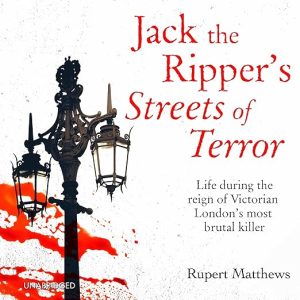
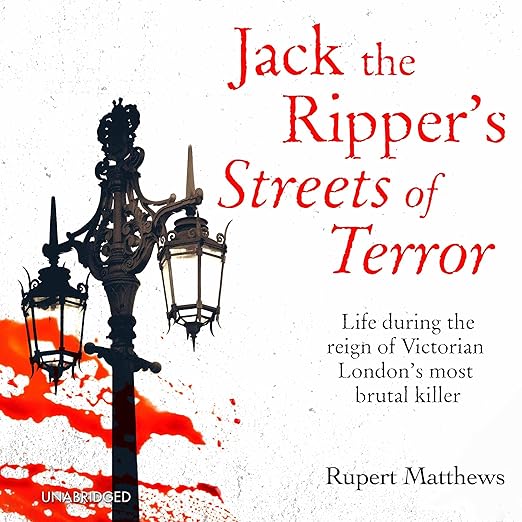
The Jack the Ripper industry is vast and often dispiriting – endless speculation about identity, breathless true-crime sensationalism, and a consistent tendency to treat the five victims as backdrop to a puzzle about a killer who was never caught and probably never will be. Rupert Matthews takes a genuinely different approach in Streets of Terror: he sets aside the identity question almost entirely and asks instead what it was actually like to live through the autumn of 1888 in the East End of London. The result is a work of social history as much as true crime, and it is considerably more interesting for that choice. Rated 4.3 from 265 listeners, it has found a dedicated and thoughtful audience among those who want substance and context alongside their true crime. At nearly seven hours it is thorough without being padded, and I found it considerably more disturbing than the usual Ripper material precisely because it humanises the experience rather than spectacularising it.
About the Audiobook
Matthews reconstructs the experience of ordinary Londoners during those terrible weeks of 1888 – not the detectives, not the politicians, not the theorists who came afterwards, but the people who lived in Whitechapel, read the newspapers, heard the rumours spreading through the streets, and felt the very specific terror of knowing that a killer was operating in their neighbourhood and that nothing and nobody seemed able to stop him. The book draws extensively on contemporary newspaper accounts, personal diaries, police records, and official correspondence to recover the atmosphere of the period in granular detail.
What Matthews uncovers is a picture of collective fear that is both historically specific and uncomfortably recognisable: the way rumour distorts perception, the way fear seeks a scapegoat, the way the need to explain the inexplicable produces increasingly bizarre theories. The anti-Semitic violence that erupted alongside the murders – Whitechapel’s Jewish community targeted by mobs seeking someone to blame – is given careful and sober attention. The riots, the false accusations, the vigilante patrols, the letters claiming to be from the killer and the newspaper coverage that amplified them: all of it contributes to a portrait of a city unravelling under the pressure of unexplained, seemingly unstoppable violence. This is the broader story behind the murders, and it is the one that most Ripper books ignore.
One of the book’s most valuable passages deals with the way the Ripper murders were covered by the press – the sensationalism, the rumour amplification, the way newspapers competed to be more frightened-sounding than their rivals – and draws implicit connections to how fear circulates in public discourse today. Matthews does not make the comparison heavy-handed; he simply presents the historical material with enough detail that the parallels become apparent to the attentive listener without needing to be announced.
The Narration
Phil Fox handles the material with appropriate gravity. The narrative covers genuinely disturbing historical events – violence against women, mob justice, institutional failures – and Fox’s measured delivery keeps the tone in the right register throughout: serious without being exploitative, engaged without being sensationalised. The pacing is well-suited to the documentary nature of the material; this is not a thriller, and Fox does not read it as one. Clear diction throughout makes it accessible despite the density of historical detail and the range of contemporary voices Matthews draws on.
What Readers Say
Two hundred and sixty-five ratings at 4.3 stars, and the responses are broadly very positive among listeners who appreciated the social-history focus. UK reviewer hh called it “very insightful and gives a slightly different view of a terrible time.” Maxwell described it as “excellent, with lots of detail and facts previously unknown.” A Good Read’s reviewer Ray found it “very interesting” and announced plans to seek out the author’s other work. The dissenting voice – Andrew Harrison at three stars – noted the book is “very general in many parts, almost generic when it comes to the murders themselves,” finding it adequate for newcomers but thin for those already deeply familiar with the subject. That honest divide between “great introduction to the context” and “not enough forensic depth for experts” accurately describes both the book’s strengths and its scope.
Who Should Listen?
Ideal for listeners who want to understand Victorian London and its social conditions rather than consume yet another theory about the killer’s identity. It pairs beautifully with other works on East End history, late Victorian poverty, and the social history of gender and violence in the period. Recommended as an accessible and intelligent entry point for those coming to the subject fresh, and as a valuable counterbalance for those who have read extensively about the murders but less about the world that produced them. Available on Audible UK.