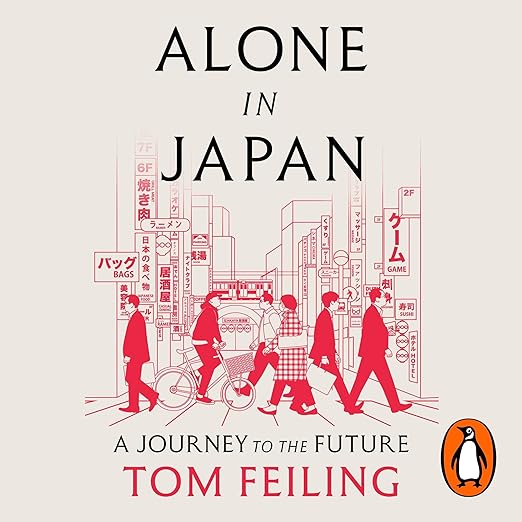
Clara’s Verdict
Tom Feiling is a reporter who knows how to sit with a subject long enough to see past the surface version. His previous work on cocaine, on Colombia, on the West Indies demonstrated a patience with complexity that most travel journalism cannot afford. Alone in Japan is his most personal book and, I think, his most unsettling. He moved to Tokyo as a student in the early nineties when Japan was a rising superpower and a global symbol of prosperity, civility and technological ambition. When he returned 24 years later, he realised it was now a warning rather than a beacon: a country so clean, so prosperous, so civil that its people had largely stopped having children, or relationships, or sex.
The population will fall by a third with each new generation if nothing changes. That is not a projection from a polemicist. It is a demographic reality that Feiling documents through interviews and data and an unusually candid set of conversations with people across the full social spectrum. I listened to this over three evenings in late February and found myself taking notes, which is not something I do with travel writing as a rule. The book earns that response because Feiling does not editorialise. He accumulates evidence and lets it speak for itself, which turns out to be considerably more disturbing than any argument he might have constructed on top of it.
About the Audiobook
Published by Penguin in February 2026 and running 12 hours and 57 minutes, this is a Penguin Audio production narrated by Feiling himself. The book spans urban megacities and remote villages, rice fields and mango farms, old people’s homes and coffee shops. It is not a polemic about birth rates in isolation but a portrait of how sexual behaviours, economic pressures, and evolving social expectations intersect to produce the situation Feiling is documenting. The Audible rating of 4.0 from 8 reviews reflects genuine variation in how readers respond to the book rather than inconsistency in quality.
Reviewer P. J. Martin’s summary captures the core finding accurately: the low birthrate appears to be a consequence of a deliberate choice to avoid relationships, driven by too much hard work and insufficiently rewarding human connection. Louise’s three-star review offers a structural critique worth taking seriously: the narrative can feel uneven, some chapters rich and immersive while others read as surface-level snapshots. That is fair. Feiling is not equally at home in every section. But his best passages, particularly those in rural areas and in conversations about what men and women actually want from each other, are among the sharper pieces of long-form reportage published in 2026.
One of Feiling’s most productive research threads is his investigation of the hikikomori phenomenon: young men who have retreated almost entirely from social life, sometimes for years. The way he places this alongside broader economic data about the cost of relationships, the punishing hours expected of workers, and the inadequacy of institutional support for family formation, builds a picture that is social and economic as much as it is psychological or cultural.
The Narration
Feiling reading his own work is the right decision for a book this deeply personal. His voice has the quiet authority of someone who has spent years listening carefully and earned the right to draw conclusions. The pacing is measured without being slow, and he reads the more sombre passages without either dramatising them or flattening them into the neutral delivery of a reporter who has switched off his own response to the material. For non-fiction with this much interview material and this many individual voices woven together, a single narrator who fully inhabits the perspective of the text is preferable to an actor who might make the subjective sections feel performed rather than lived.
What Readers Say
The eight Audible reviews are substantive and from readers who clearly engaged seriously with the material. D R BECK describes it as perfect for anyone who has visited Japan on holiday or business and is interested in digging below the surface to understand the country’s demographic issues and what can be learned from an ageing but well-developed society. Richard G identifies the most resonant quality: its relevance as an insight into our own future as birth rates fall across the western world. Nemra’s review is particularly useful for prospective listeners, calling it sharp and compassionate, serious in tone but never sensational, and recommending it for anyone interested in ageing societies or the future of human relationships under economic pressure.
Who Should Listen?
This is for readers who follow long-form journalism and want a book that takes Japan seriously as a subject rather than treating it as exotic backdrop. It rewards anyone curious about demographic decline, solo living, the economics of human connection, or the gap between a society’s public face and its private lives. Listeners who want a single coherent argument rather than a reporter’s accumulation of evidence may find the structure frustrating in places. Those who enjoyed books like Peter Frankopan’s historical journalism or Oliver Bullough’s Moneyland will find Feiling’s patient, accumulative approach recognisable and satisfying.