Clara’s Verdict
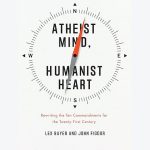
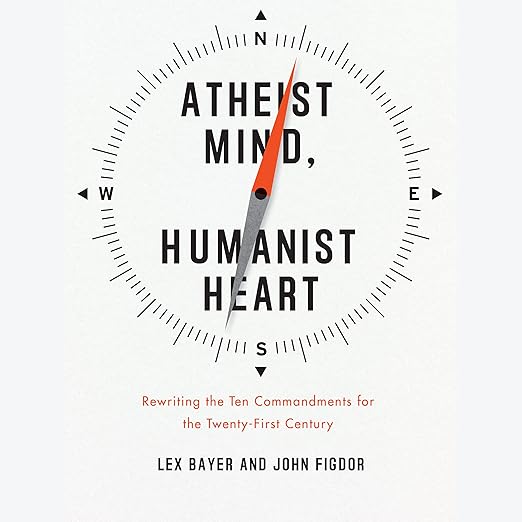
I’ll be honest: I picked up Atheist Mind, Humanist Heart half-expecting another polemical broadside – the sort of atheism book that spends more energy mocking the faithful than building anything new. What Lex Bayer and John Figdor have done instead is rather more interesting, and considerably more useful. This is a constructive manifesto for secular living, and it’s all the better for refusing to define itself in opposition to religion. At five-and-a-half hours, it’s lean, thoughtful, and genuinely worth your time – whether you’re a lifelong non-believer trying to articulate your worldview, or someone quietly drifting away from faith and wondering what comes next. I’ve reviewed enough books in this space to know how rare it is to find one that builds rather than tears down, and this one does exactly that.
About the Audiobook
The book opens with a deceptively simple question: if you don’t believe in God, what do you believe in? Bayer – a Silicon Valley entrepreneur – and Figdor – a humanist chaplain at Stanford – argue that atheism need not be merely reactive. They set out to construct what they call a set of “non-commandments”: ten principles grounded in reason, empathy, and evidence rather than divine authority. The process by which they reach these principles is itself the heart of the book; the destination matters less than the method.
Their philosophical approach is Socratic in spirit. Each chapter invites the listener to interrogate their own assumptions, working from first principles toward a coherent ethical framework. Topics range from the nature of knowledge and the limits of certainty, through personal ethics and social responsibility, to the question of meaning in a secular life – what it means to live well when you’re not living for something beyond death. It’s accessible without being simplistic, and the authors are admirably honest about the difficulty of some of these questions. They don’t pretend secular humanism has all the answers – which, paradoxically, is one of its greatest strengths as an intellectual position.
What strikes me most is the tone: warm, curious, and genuinely inclusive. This book isn’t written for culture-war veterans; it’s written for the thoughtful person who finds themselves among the growing ranks of the non-religious and wants something to anchor their worldview. The demographic it addresses is real and substantial – one third of young adults in the United States now identify as non-religious – and it speaks to that audience with the seriousness the question deserves. It’s a short book, and the compact chapter structure means individual ideas sometimes feel slightly underdeveloped, but that’s a minor caveat against an overall achievement that is quietly impressive.
The Narration
Lex Bayer narrates his own work here, and that proves to be a double-edged sword. He brings an obvious personal investment to the material – there’s an authenticity to hearing one of the authors speak these ideas aloud – but his delivery can feel slightly unpolished compared to a professional narrator. The pacing is measured and clear, and he handles the more philosophical passages with commendable steadiness. For a book this conversational in tone, the author’s voice ultimately feels like the right choice, even if a seasoned narrator might have added more warmth to the quieter moments. The production quality is clean and the running time of five hours and 36 minutes sits comfortably within a single day’s listening.
What Readers Say
Listeners have responded warmly to the book’s constructive approach. One UK reviewer, Paul K, described it as “an excellent introduction to a non-theist outlook,” praising the compact chapters and accessible framework – particularly for those leaving faith-beliefs behind. Another praised the book’s philosophical ambition at considerable length, comparing it to constructing a new building from its foundations: “This project has real ambition, scope, complexity.” The modern “non-commandments” drew particular praise from multiple reviewers, who found them more coherent and humane than their biblical counterparts. The book currently holds a 4.1 rating from 54 listeners – a respectable score for a title operating in one of the more contentious corners of the non-fiction catalogue.
Who Should Listen?
This audiobook is ideal for anyone navigating a secular worldview who wants something more substantive than internet atheism but less academic than professional philosophy. It works equally well for the curious agnostic, the lapsed believer seeking a new ethical anchor, and the confident humanist who wants a cleaner articulation of what they already believe. If you’ve been to a funeral recently and found yourself unable to answer your own questions about meaning and ethics without reaching for language you no longer find adequate, this is a good place to start. At just over five hours, it’s an easy listen across a long commute or weekend walk. You can find it on Audible UK, Kobo, Scribd, and Storytel.