Clara’s Verdict
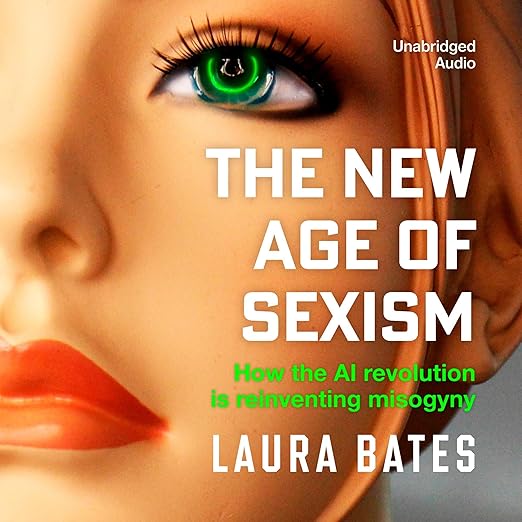
Laura Bates has been doing this work for over a decade – first with the Everyday Sexism Project, then with Everyday Sexism, then with Men Who Hate Women – and she has developed a rigorous, courageous methodology that involves going to the places most researchers decline to enter. For The New Age of Sexism, she went further than ever: into the metaverse, into AI-generated pornography, into chatbot systems designed explicitly to simulate sexual compliance, into schools where children are describing forms of abuse that adults haven’t yet named or addressed. The result, at eight and a half hours, is one of the most important non-fiction audiobooks I have listened to this year. Important does not always mean enjoyable; I found sections genuinely disturbing. But this is completely, urgently necessary work, and the audiobook format – with Bates reading her own text – makes it as powerful as it could possibly be.
About the Audiobook
Bates’s central argument is that the rapid development of AI and digital technology has not been a neutral force in relation to gender. Power over these technologies is concentrated, overwhelmingly, in the hands of a small number of wealthy men. The values and assumptions baked into AI systems – from chatbots to image generators to recommendation algorithms – reflect and amplify existing misogyny rather than challenging it. Meanwhile, the harm is immediate and concrete: deepfake pornography targeting real women without consent, virtual environments that normalise sexual violence as entertainment, AI tools accessible to teenage boys that are reshaping their understanding of what women are for.
Bates structures the book around her own investigative journey – visiting, testing, documenting at considerable personal cost – and combines this with testimony from affected individuals, conversations with researchers and campaigners, and careful analysis of the commercial and regulatory failures that have allowed these technologies to develop in a near-vacuum of accountability. She is not anti-technology; she is opposed to the deployment of power without responsibility, and she is very clear, in specific terms, about what the consequences of that irresponsibility look like for real women and girls right now.
The book covers the metaverse and virtual reality environments, deepfake pornography and image-based sexual abuse, AI chatbots and sexbot technology, online education environments and gaming spaces, and the way algorithmic recommendation systems amplify misogynistic content toward young male users. It is comprehensive and devastating in equal measure.
The Narration
Bates reads her own book, as she has done for her previous titles, and she is one of the strongest author-narrators working in non-fiction today. Her voice carries the weight of someone who has sat with this material for years and is genuinely, purposefully angry – not performatively, but in the controlled, directed way of someone who has converted sustained outrage into sustained research. When she describes what she found in the metaverse or in the AI systems she tested, the tone is precisely measured: factual, documented, devastating. There is no hysteria, which makes the content more shocking, not less. Her delivery throughout the more harrowing sections is a masterclass in restraint serving truth.
What sets this book apart from similar works in the technology-and-society genre is Bates’s willingness to be a first-person witness rather than a distant analyst. She does not simply summarise reports; she goes to the places she is writing about, tests the systems herself, and documents what she finds. This approach carries obvious personal costs, and she names them. The resulting book has a moral weight that purely theoretical treatments cannot achieve.
What Readers Say
Rated 4.5 from 231 Audible UK listeners. One reviewer called it “a masterful insight into toxic cultures of online spaces that are not yet being spoken about in mainstream media.” Another, working in tech, described it as “essential reading material both as an eye-opener and a resource for change.” A parent of daughters wrote that “it terrifies me that they will grow up in a society where this is a growing industry” and thanked Bates for the research. One listener noted the difficulty of the material – “hard to read in parts, but absolutely essential” – which accurately describes the experience. There is essentially no meaningful dissent among reviewers; the discussion is about whether the book goes far enough, not whether it needed to be written.
Who Should Listen?
This audiobook is for anyone who wants to understand what AI and digital technology are currently doing to gender relations – which should, by that criterion, be a very large number of people indeed. It is particularly vital for parents of teenagers, teachers, policy-makers, and anyone working in technology or education. Bates argues convincingly that the decisions being made now about how these technologies are designed and regulated will shape gender relations for the next generation, and that the window for meaningful intervention is narrowing. If you have read Men Who Hate Women or Everyday Sexism, this is the essential sequel. If you haven’t, this is a perfectly valid and urgent starting point.