Clara’s Verdict
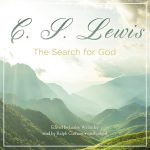
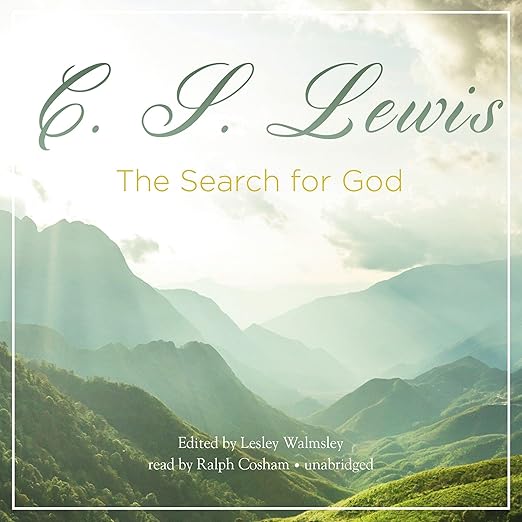
C. S. Lewis is an author I approach with something between admiration and caution. His apologetics – the rigorous, logical defence of Christian belief – can feel, in the wrong mood, like being cornered by the most persuasive debater at a sherry party. In the right mood, there is no sharper, more honest intellect in twentieth-century religious writing. The Search for God collects nine of his shorter essays, originally part of the larger C. S. Lewis: Essay Collection and Other Short Pieces, and presents them in a form well-suited to repeat listening: brief, dense, fully argued. Ralph Cosham’s narration is exactly what this material needs. Three hours and two minutes of Lewis’s best prose – questioning, testing, concluding – is an uncommonly valuable use of an afternoon.
About the Audiobook
The nine essays gathered here range across Lewis’s central preoccupations: the relationship between reason and faith, the nature of Jesus Christ as a historical and theological problem, the inadequacy of progressive mythology, the question of what theological language can and cannot do. The titles give a sense of the scope: “The Grand Miracle,” “Is Theology Poetry?,” “The Funeral of a Great Myth,” “God in the Dock,” “What Are We to Make of Jesus Christ?,” “The World’s Last Night,” “Is Theism Important?,” “The Seeing Eye,” and “Must Our Image of God Go?”
Lewis writes for a general intelligent reader, not a specialist audience, and the essays are characterised by his signature quality: the ability to make a complex argument feel inevitable in retrospect. “The Grand Miracle” – his treatment of the Incarnation – is perhaps the finest single piece here. “The Funeral of a Great Myth” takes aim at the progressive narrative of human development with a precision that has aged better than many expected. Throughout, Lewis is bracingly honest about the difficulties of belief and the intellectual demands of scepticism in equal measure.
For anyone encountering Lewis for the first time, this collection offers an excellent introduction to his essayistic mode. For those who know him well, it will repay careful re-listening.
It is worth noting that Lewis wrote these essays across different periods of his life, and they reflect the range of contexts in which he was engaging with questions of faith – the wartime BBC broadcasts that produced works like “God in the Dock,” the academic context of Oxford debates, and the pastoral concerns of correspondence with readers who were themselves struggling with belief or disbelief. The brevity of each piece is not a sign of superficiality; Lewis is one of those rare writers who thinks in complete arguments. Each essay arrives at its conclusion, states it clearly, and stops. In an age of expansive non-fiction that often mistakes length for substance, there is something almost radical about this.
The Narration
Ralph Cosham was one of the finest British audiobook narrators of his generation, and his performance here is exemplary. His voice is measured, precise, and carries the quality of someone who has understood what they are reading before they begin to speak. Lewis’s prose has a particular rhythm – argumentative, parenthetical, frequently self-interrupting – and Cosham handles it with intelligence. He does not impose drama where Lewis is being austere, and does not flatten Lewis’s occasional wit. At three hours and two minutes, this is a short performance, but one that demonstrates what a great narrator adds to already excellent source material. The production from Blackstone Audio is clean and unfussy.
What Readers Say
With a rating of 4.5 out of 5 from 56 listeners, this collection has found an audience that appreciates its quality. The rating places it consistently among Lewis’s higher-rated audio releases. Listeners familiar with his work know what to expect; those encountering him here for the first time frequently discover an intellectual companion they did not know they needed. The essays’ brevity – each complete in under thirty minutes – makes them well-suited to the audiobook format, allowing listeners to consider each argument before moving to the next.
This title has not yet accumulated a large number of written reviews, though its rating speaks for itself among those who have listened.
Who Should Listen?
Anyone with a serious interest in religious thought, philosophy of belief, or the intellectual history of twentieth-century Christianity should know these essays. They are also valuable for sceptics who want to engage with the strongest version of the opposing case – Lewis is the kind of opponent who makes you think, even when you resist his conclusions. The short essay format makes this ideal for commuters or for listeners who prefer their non-fiction in concentrated doses. At just over three hours, it is a commitment that pays dividends well beyond its length.
Listen to The Search for God on Audible UK – Lewis at his most direct and most essential.