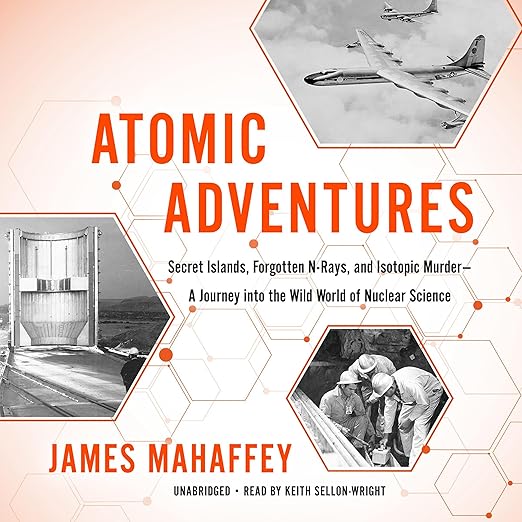
Clara’s Verdict
I hold a particular affection for science books written by people who love their subject and have the skill to make that love contagious. James Mahaffey’s Atomic Adventures is precisely that kind of book: a tour through the wilder, stranger, less-told corners of nuclear history, written by a physicist and nuclear engineer who clearly finds the whole story – the ingenuity, the hubris, the occasional genuine lunacy – as entertaining as he expects his readers to. At nearly fourteen hours, it’s a substantial listen, but Mahaffey’s prose and Keith Sellon-Wright’s narration make it feel considerably shorter.
Audible rating: 4.5/5 (326 ratings)
About the Audiobook
Mahaffey isn’t writing a standard nuclear history. This is a collection of chapters, each standing largely alone, that range from lost reactors on Pacific islands through trees affected by nuclear testing (some changing gender, some blooming in winter) to the question of why we have nuclear submarines but not nuclear aircraft, and why cold fusion remains stubbornly fictional. There are cowboys who somehow acquired access to a reactor. There is a chapter explaining why dirty bombs are, despite their terrifying reputation, not nearly as devastating as popular imagination assumes. There is a history of radiation counting as fashion accessory.
Mahaffey’s governing conviction is that nuclear science is one of humanity’s most extraordinary intellectual adventures – dangerous, yes, but also improbably creative, frequently surprising, and potentially essential to our energy future. He argues this case not through polemic but through narrative: each chapter is a story, and the stories are genuinely gripping. The accompanying reference material is noted as available in the Audible library for those who want to follow up.
The Narration
Keith Sellon-Wright handles the thirteen-hour-plus runtime with assurance. He’s a narrator who understands that Mahaffey’s dry wit needs to be served rather than overshadowed, and his delivery has the right register – engaged, slightly wry, technically fluent without sounding like a documentary voiceover. The nuclear nomenclature and historical references flow naturally, which matters in a book where the technical precision is part of the pleasure. Sellon-Wright doesn’t condescend to the material, and he doesn’t condescend to the listener. For a long, wide-ranging audiobook, that consistency of tone is what keeps you returning to the next chapter.
What Readers Say
Rated 4.5/5 across 326 Audible ratings – an unusually high count that reflects years of enthusiastic recommendation. One reviewer called it “stone-cold the best treatment of nuclear physics for the layman ever – exceptionally readable.” Another described it as “an authoritative and engaging narrative history of some of the most interesting and occasionally crazy adventures in big box physics.” A third noted the randomness of the chapter structure – “it jumps between personal stories, historical accounts, and descriptions of relevant nuclear physics” – but concluded: “If you stop looking for a theme and just enjoy the ride, this is a very enjoyable book.”
The 4.5 average across 326 ratings is one of the stronger scores in the science and history space.
Who Should Listen?
Science enthusiasts who want narrative rather than textbook, and history readers who want something beyond the Manhattan Project and Cold War familiar. Mahaffey’s ability to reach non-specialist audiences without dumbing down makes this accessible to anyone with curiosity and a tolerance for occasional technical density. Particularly recommended for listeners who’ve read Richard Rhodes’ The Making of the Atomic Bomb and want the stranger, less-told epilogues that mainstream nuclear history tends to omit. Also excellent for those who think they have a settled view on nuclear power – pro or anti – and would benefit from a more nuanced account of what the technology has actually been and done.
Listen to Atomic Adventures on Audible UK – essential listening for anyone curious about science’s wildest chapter.