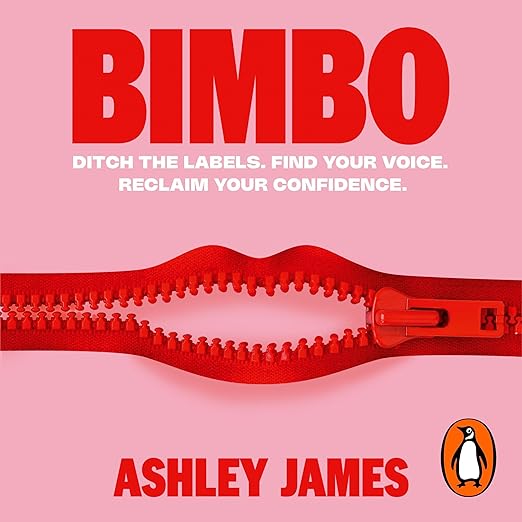
Clara’s Verdict
Books that set out to dismantle the language used against women are, frankly, ten a penny. Books that actually do it – with wit, personal honesty, and a genuine feminist framework – are considerably rarer. Ashley James’s Bimbo belongs firmly to that second category. James narrates her own work, which turns out to matter enormously: this is a book that derives much of its power from the intimacy of a woman speaking directly to you about experiences she has clearly spent a great deal of time examining and reexamining. At eight hours and forty-seven minutes, it’s a substantial listen that earns its length.
I’ll be honest: I came to this one expecting polished celebrity memoir dressed up in feminist clothes. What I found was something angrier and more considered than that. Jameela Jamil called James “a much-needed force” and “a defiant and expansive thinker.” That’s accurate, and it’s not language that gets used about books that don’t deserve it.
About the Audiobook
Published by Penguin in February 2026, Bimbo takes its title from one of the many reductive words the English language has devised for women and their choices, and works outward from there. James moves through the trajectory of a life shaped by such labels – the “bossy” child, the “tarty” teenager, the woman who “let herself go” after motherhood, the “left-on-the-shelf” singleton. She pairs personal experience with structural analysis, arguing that these labels aren’t random cruelties but symptoms of systems designed to keep women competing with each other rather than directing their energy at the conditions they share.
The book is divided into digestible chapters, each anchored in a specific word or phrase and the cultural weight it carries. James is at her best when she connects the personal and the political – when a story from her own life opens into a broader observation about how women are trained to police each other and internalise their own diminishment. She’s also funny, which matters considerably: this is not a grim endurance test. The writing has an energy to it, a sense of someone who has worked things out through anger and come out the other side with something useful to say. The endorsements from Jameela Jamil, Carol Vorderman (“raw and gloriously unapologetic”), and Bryony Gordon (“the book I’ve been waiting for my whole life”) suggest a book that speaks to women across generational lines, and the content bears that out.
The Narration
James reads her own work, and it’s unambiguously the right call. Her voice carries an authority over this material that no professional narrator could replicate – she knows where the emotion lives, and she delivers it without either deflating it or overplaying it. The sections that draw on personal experience feel genuinely confessional rather than performed. The humour lands because it’s coming from the person who lived the experience. At eight hours and forty-seven minutes, it’s a committed listen, but James’s energy sustains it throughout without flagging.
What Readers Say
Bimbo holds a 4.3 out of 5 from 84 Audible UK listeners. Many reviewers described reading it in a single sitting despite having newborns, deadlines, and other reasonable obstacles. “Such an eye opener and a must read for all women,” wrote one. Another found it “deeply human and incredibly relatable,” praising James’s honesty about internalised misogyny and the difficult process of unlearning beliefs instilled from birth. One dissenting voice – a reader with substantial existing feminist reading behind her – found insufficient analytical depth for a more academically experienced audience, calling it thin on insight. That is a fair observation: this is accessible feminist writing rather than feminist theory, and its strength lies precisely in that accessibility. The majority of readers have found it empowering and, notably, have recommended it immediately to others.
Who Should Listen?
Readers who enjoyed Untamed by Glennon Doyle, We Should All Be Feminists by Chimamanda Ngozi Adichie, or Girlhood by Melissa Febos will find much to engage with here. It’s particularly well suited to women in their twenties and thirties who are in the process of articulating something they’ve always felt but not quite named. It would also work well for book clubs looking for a discussion-ready feminist text with both personal and structural dimensions – the digestible chapter format makes it easy to read in sections and return to specific arguments.
Add your voice to the conversation – listen to Bimbo on Audible UK.