Clara’s Verdict
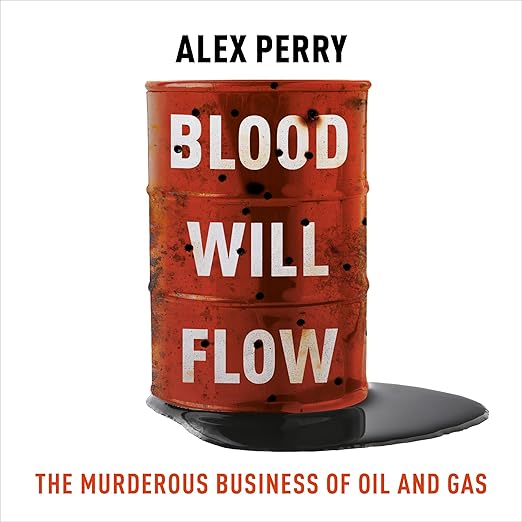
Investigative journalism at its finest is a rare thing, and Blood Will Flow by Alex Perry belongs in the same conversation as the genre’s classics. Perry spent years reconstructing the events of 24 March 2021, when 500 ISIS militants attacked Palma, a small coastal town in northern Mozambique, site of one of the world’s largest offshore gas developments. What he found – and what he presents here, read in his own voice with a quiet controlled fury – is a story of corporate negligence, geopolitical indifference, and human catastrophe that the world largely failed to notice. This is the kind of audiobook that makes you feel the obligation to pay attention. Perry is not a neutral reporter; he has a point of view and he earns it, page by page, through meticulous reportage. The Financial Times called it a page-turner, and that is not hyperbole.
About the Audiobook
The attack on Palma was, by some measures, the second largest act of terror in modern history – and yet the name barely registers for most Western listeners. Perry’s book sets out to explain both the attack itself and the reason for our collective ignorance. The answer, he argues, is that the attack was inseparable from the $50 billion in foreign investment concentrated in those offshore gas fields, including over £1 billion from the British government. An oil and gas compound defended by attack helicopters and 1,000 soldiers was minutes away from the besieged hotel where eighty construction workers and local civilians sheltered. Help did not come.
Perry’s investigation is global in scope: he travels from Europe to the United States to Mozambique, tracking roughnecks, mercenaries, corporate spooks, and billionaires who have shaped the narrative – and suppressed the truth – about what happened. The book builds towards a legal drama and a political scandal that is still unfolding. Perry is explicit about the stakes: energy companies imperil the planet, and the moral cost of their profits is human lives. This is reported with rigour and written with the controlled anger of someone who has looked the evidence in the face.
At nine hours and forty-four minutes, it is a concentrated and intense listen – not one to put on in the background.
The Narration
Perry reads his own work, which is a risk that pays off completely here. His voice carries the weight of someone who spent years on this story, and there is a controlled urgency to his delivery that a third-party narrator could not replicate. He does not perform outrage – he reports it, which is far more effective. The production from Ithaka is clean and appropriately spare. When Perry’s voice drops during the most harrowing reconstruction sequences, the effect is genuinely unsettling. This is one of those cases where the author reading their own work adds a documentary dimension that enhances rather than competes with the prose.
What Readers Say
Early responses are exceptional. With a perfect 5.0 rating from 3 reviewers, the book is being hailed as “the most astonishing piece of investigative journalism” one reader has encountered. Another describes it as “fascinating and eye opening” about the human cost of the oil and gas industry, calling it “expertly written and researched.” A third, writing from direct experience with business in Mozambique, confirms the accuracy of Perry’s account of corruption and exploitation: “This book does an excellent job in exposing some of the problems.”
- Pixie (5.0 stars): “The most astonishing piece of investigative journalism I have ever read. It’s the story of the second biggest terror attack of all time and how Big Oil brought it about. It deserves a place on university reading lists everywhere.”
- Mint Condition (5.0 stars): “A fascinating and eye opening read about the human cost of the oil and gas industry. Expertly written and researched.”
- Mike Burrell (5.0 stars): “This book does an excellent job in exposing the corruption promoted by Total and Frelimo. Really good stuff.”
Who Should Listen?
Blood Will Flow is for anyone who takes seriously the idea that journalism exists to hold power accountable. It will appeal to listeners drawn to narrative non-fiction in the tradition of Jon Lee Anderson or Patrick Radden Keefe – writers who combine deep reporting with literary craft. It will also be of particular interest to anyone working in energy, development, or international affairs who wants to understand what “externalities” actually look like when rendered in human terms. This is a brave, important book, and the audiobook format – with Perry’s own voice giving testimony – makes it even more compelling.
Listen to Blood Will Flow on Audible UK – a book you will not easily forget.