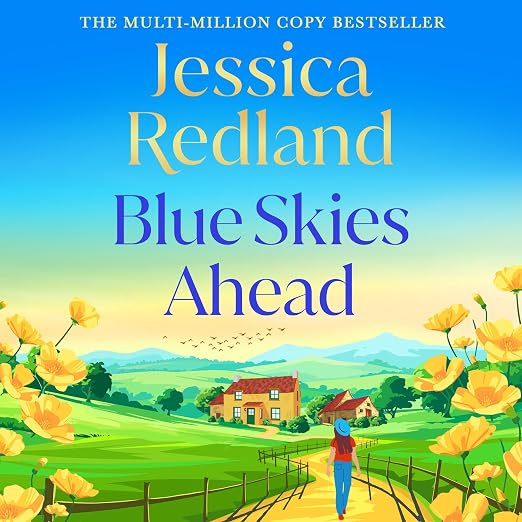
Clara’s Verdict
Comfort fiction carries a faintly patronising reputation that it has done nothing to earn, and Jessica Redland is a useful corrective. Blue Skies Ahead opens a new series and it does the difficult thing well: it establishes a place, a household and a set of unresolved tensions in nine hours and twenty-six minutes without ever letting the warmth curdle into sentimentality. The marketing leads with the romance. The book leads with a mother and daughter who have stopped talking to each other.
It arrived on 27 July 2026 and is already well up the Audible UK charts, which tells you a good deal about the size of Redland’s readership. Karen Cass narrates, and the assignment is harder than a countryside romance usually implies, for reasons I will come to.
About the Audiobook
Grace arrives at Hazelwick Farm with her teenage daughter Maddie and her mother Frances, three generations under one roof, intending to build a family business together. She has dreamt of fresh air, open skies and days spent caring for animals. What she gets is a farm that is not ready to open, a mother whose presence complicates as much as it helps, and a daughter who has barely spoken to her since the divorce. Grace does not know how to fix something she does not fully understand, which is the most truthful line in the entire description.
Caleb, the handsome tenant she keeps crossing paths with whether she intends to or not, is the romance the cover promises, and he is well handled. But the load-bearing relationship is Grace and Maddie, and Redland is disciplined about not resolving it early. A reviewer identified the setting as Northumbria, which the publisher’s copy leaves vague, and praised the sense of place: “Set in Northumbria, an area I am not familiar with, Jessica’s writing created a real sense of place.”
This is book one of The Blue Skies Collection. Nothing precedes it, so this is the correct place to begin, and the line that gives the book its title sits at the very top of the description: “This is an exciting new start for you all. Blue skies are ahead.” Redland is signalling her intentions plainly. Nobody is going to be blindsided by tragedy here.
The Narration
Karen Cass is a British narrator well suited to the register this book operates in, and she has the light touch that domestic fiction of this kind requires without the archness that can creep into cosy narration. The real technical demand of Blue Skies Ahead, and it is not obvious from the description, is that she has to hold three generations of women in a single voice: a grandmother, a mother starting over, and a teenager whose defining characteristic is that she will not speak.
That last one is the genuine test. A withholding adolescent is the hardest thing to perform in audio, because the character’s whole function is absence, and the narrator has to make silence and monosyllables carry emotional information rather than simply sounding sullen. Frances needs age without frailty, since she is a working partner in the venture rather than a burden. Grace has to be the one voice that never gets to rest.
None of the reviews so far comment on the recording, and I will not pretend otherwise. Cass narrates the first book of a new series here, and a series narrator is a long-term relationship, so it is worth sampling with that in mind.
What Readers Say
A rating of 4.8 sits against just 43 ratings, and the reason is recency rather than obscurity. The book has been available for a matter of days. That figure will move as the general readership arrives, and I would not lean on it heavily yet, though everything about the early response points the same direction. Several of these reviewers received advance copies, one noting explicitly: “Thanks to Netgalley and Boldwood books for my arc copy”. They are describing the text, not this performance.
The most persuasive endorsement came from an established Redland reader who had already worked out what she was in for:
The stories and characters feel real and make the book unputdownable until you have to finish!
A first-time reader of the author said she would now seek out others, and singled out the twists and turns of Grace’s attempt to make the venture succeed. A third reviewer, who admitted knowing she was in for an emotional rollercoaster and went willingly, wrote that “The setting of Hazelwick Farm absolutely captured my imagination”. Place, in this early response, is doing as much work as plot.
Who Should Listen?
Anyone who reads Veronica Henry, Cathy Bramley or Trisha Ashley with pleasure will find themselves on entirely familiar ground, and the multigenerational household gives this a bit more structural interest than a straight village romance. It is a good candidate for a listen spread across a week of ordinary tasks, and the fact that it opens a series means the investment compounds rather than ending.
Set it aside if you want your fiction to hurt, or if a plot resolved through patience and conversation rather than incident sounds like a long nine hours. Readers who prefer a completed series before starting will also want to wait, since further volumes are clearly intended and one reviewer is already asking for them. The romance, I should add, is gentle. Nobody is coming to Hazelwick Farm for heat.