Clara’s Verdict
There are books that change the way you see the world, and there are books that change the way you hear it. Braiding Sweetgrass does both. Robin Wall Kimmerer is a botanist, a professor of plant ecology, and a member of the Citizen Potawatomi Nation, and she brings all three perspectives to bear in a work that is at once scientific, lyrical, and morally serious. The central argument – that humans are the younger brothers of creation and must learn to listen before we can hope to heal the relationship between ourselves and the natural world – sounds simple. In Kimmerer’s hands, it is anything but. And the fact that she narrates her own work, for 16 hours and 44 minutes, gives the audiobook an intimacy and authority that no hired narrator could replicate.
About the Audiobook
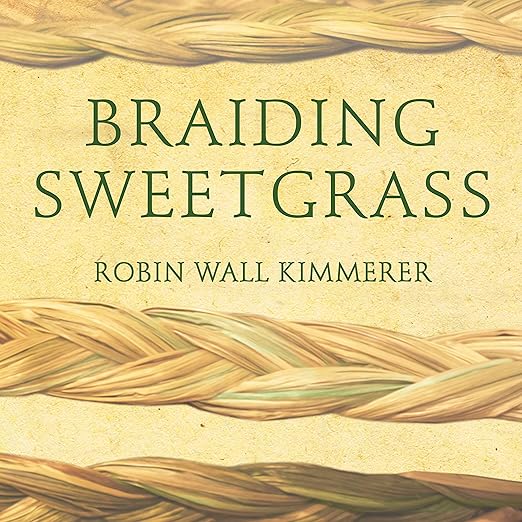
Kimmerer structures the book around teachings – some botanical, some indigenous, some personal – woven together like the sweetgrass of the title. She writes about asters and goldenrod, about the grammar of animacy in the Potawatomi language, about what it means to live in reciprocal relationship with the land rather than simply extracting from it. Each chapter returns to a central conviction: that the awakening of wider ecological consciousness requires us to acknowledge what the natural world gives us and to cultivate genuine gratitude in return.
This is not a book with a simple thesis or a linear argument. It circles, doubles back, pauses on the particular before widening to the universal. Scientific knowledge sits alongside traditional ecological knowledge without one diminishing the other; both are treated as valid ways of knowing. The result is a book that works as environmental writing, as memoir, as philosophy, and as a kind of extended meditation on what it means to be human in relation to other living things. Published by Tantor Audio in June 2016, it has accumulated a devoted readership and a reputation that continues to grow.
The Narration
Kimmerer narrates her own book, and the decision is entirely vindicated. Her speaking voice has the quality of her prose – measured, precise, full of quiet passion. She reads as a scientist who has learned to love language rather than a writer performing scientific authority, which is exactly what the material requires. There are passages of genuine poetry in the text and she handles them with the confidence of someone who knows exactly how they are meant to sound. At 16 hours and 44 minutes, some listeners may find the pace deliberate, but that deliberateness is itself a form of argument: slow down, pay attention, let the world speak.
What Readers Say
The audiobook carries a 4.7-star rating. Zsofia W., writing from the UK, described the experience as unlocking “a world of connection, reciprocity, deep reverence toward nature in a way I’ve never seen before.” Jacinta called it “one of those books” that “enlarge you and make you feel whole,” adding that it offered “hope that’s grounded in wisdom” rather than empty optimism – a distinction that matters. Lucy Rothwell praised it as “informative, spiritual and deeply moving,” recommending it widely to friends interested in nature. Jeff Muir offered the most measured assessment: “lots of lovely analogies,” though conceding it “gets a bit repetitive after a while” – a fair point for a 16-hour listen structured around recurring themes. I. Hohler, who expected disappointment and received revelation, noted that “the author is both a scientist and a poet.”
Who Should Listen?
For anyone who feels something has gone wrong in our relationship with the natural world and wants to think seriously about what an alternative might look like. Readers of Robert Macfarlane, Annie Dillard, or Barry Lopez will find a natural companion here. Kimmerer’s perspective – indigenous and scientific simultaneously – offers something genuinely different from the standard nature writing canon. Ideal for long walks, long commutes, or any period when you want to be slowed down rather than speeded up. Available on Audible UK.