Clara’s Verdict
Michael Pollan has a gift for making you reassess something you thought you understood – a gift most fully deployed in The Omnivore’s Dilemma and How to Change Your Mind. Caffeine, at just over two hours, is a miniature by comparison: an Audible Original conceived and written specifically for audio, and it shows both the possibilities and the limits of that format. It is lean, witty, and consistently interesting, but listeners expecting the depth of Pollan’s longer works will need to calibrate their expectations. This is an extended essay rather than a book, and it is best appreciated on those terms.
Pollan reads it himself, which is the correct choice. His manner is that of a very well-read friend explaining something at length over coffee – the irony of which is not lost on him.
About the Audiobook
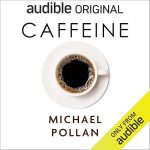
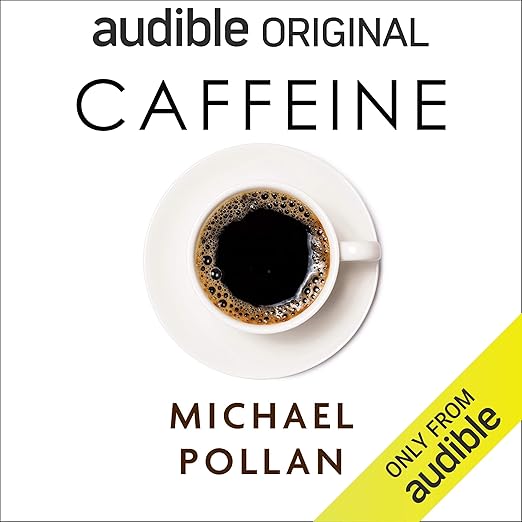
Caffeine: How Caffeine Created the Modern World runs to 2 hours and 2 minutes, published by Audible Originals in January 2020. Pollan’s argument is, at its broadest, this: caffeine is the most widely consumed psychoactive drug in the world, and its adoption – first of coffee, then of tea – shaped the Industrial Revolution as meaningfully as the steam engine. The alertness caffeine provides was not incidental to modern productivity; it was, in Pollan’s telling, its precondition.
He traces the history of the drug from its origin in a small region of East Africa, where the coffee plant evolved caffeine as a pesticide, through its spread across the Islamic world and then Europe, and into the present day, where two billion cups of coffee are consumed globally every single day. He interviews Matthew Walker, whose work on sleep forms the scientific backbone of the section on caffeine’s neurological effects, and he supplements this with a personal experiment: going off caffeine entirely to discover what he had actually been feeling before he started feeling it again.
The self-experimentation is classic Pollan and the section on sleep science is genuinely illuminating. The historical survey is compressed but well-curated. At two hours, there is no room for indulgence, which is both the format’s strength and its limitation.
The Narration
Pollan narrates with the ease of someone who has been performing his own work for years. His voice is warm and exploratory – he gives the impression of thinking through the material in the moment, which is a sophisticated and difficult effect to achieve. At two hours, there is no risk of fatigue, and the pacing is immaculate.
For listeners who have enjoyed Pollan’s other audio work, the familiar voice is itself a pleasure. For newcomers, this is a good introduction to his style, though the longer books will offer more.
What Readers Say
Caffeine holds a 4.3-star rating from 9 UK listeners. Liam Kelleher gave it four stars and offered an honest assessment: “Pollan is a great writer and superb narrator” but noted that the BBC’s In Our Time had covered much of the same history in a single hour-long episode. The critical two-star review from l8machine felt the book “almost patronising” in its treatment of caffeine addiction. The majority, however, found it an enjoyable and informative short listen. Carolin Krenzer simply called it a “fun short read,” which is exactly what it is.
Who Should Listen?
Pollan devotees who want to complete the catalogue. Listeners looking for a short, stimulating listen on a commute or during exercise. Anyone curious about the cultural history of coffee or the science of caffeine and sleep, with the understanding that this is an overview rather than a deep investigation. If the subject genuinely grips you, pair it with Matthew Walker’s Why We Sleep for the full picture.
Listen to Caffeine on Audible UK – two hours of Michael Pollan on the drug that made the modern world, and probably got you out of bed this morning.