Clara’s Verdict
Serhii Plokhy’s Chernobyl was shortlisted for the Baillie Gifford Prize, and on its merits, the recognition is deserved. This is not simply a technical account of the worst nuclear disaster in history, though the technical account is precise and clear. It is a study in systemic failure – in the relationship between political ideology, managerial culture, and catastrophic engineering decisions – that argues convincingly for Chernobyl as one of the proximate causes of the Soviet Union’s collapse. Narrated by Leighton Pugh over nearly fourteen hours, it is the definitive audiobook treatment of the subject, and Yuval Noah Harari’s endorsement – “insightful and important, that often reads like a good thriller” – is not hyperbole.
About the audiobook
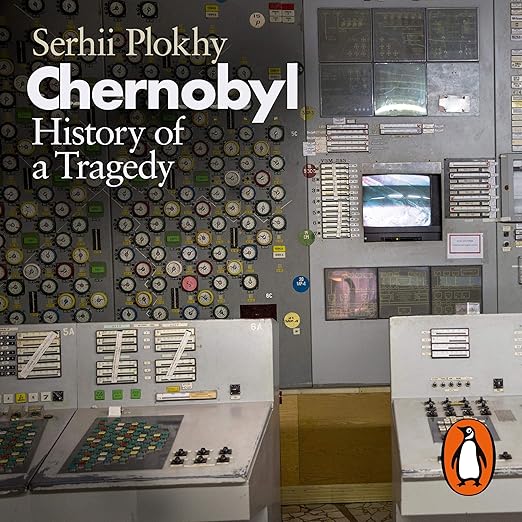
Published by Penguin and released in January 2019, Plokhy’s account begins on the morning of 26 April 1986 and reconstructs the disaster from multiple perspectives: the engineers who ran the fatal turbine test, the firefighters who arrived first on a scene they didn’t understand, the scientists, politicians, and administrators who had to manage the consequences in a system organised around concealment rather than transparency. His central argument is that the immediate cause of the explosion – a turbine test that went wrong – was vastly less significant than the deeper systemic causes embedded in Soviet political culture and its nuclear industry.
Plokhy draws on an extraordinary range of archival sources, declassified documents, and interviews with survivors to reconstruct the night of the disaster with remarkable vividness. But he is equally interested in the aftermath – the evacuation of Pripyat, the extraordinary efforts to stabilise the reactor, the political fallout that stretched from Kiev to Moscow to Washington. The book’s final chapters trace the disaster’s contribution to the Soviet Union’s eventual disintegration.
The narration
Leighton Pugh is a gifted narrator for serious non-fiction, and his reading here is excellent. He brings a grave, considered quality to the more harrowing passages – the firefighters’ stories, the accounts of radiation exposure – without descending into sensationalism. His handling of the technical sections is clear and well-paced, and he manages the shift between scientific detail and human drama with assurance. The Ukrainian and Russian names are handled respectfully and consistently throughout. At 13 hours and 35 minutes, his performance is sustained and authoritative.
What readers say
Rated 4.6 out of 5 stars from 2 reviews. One UK reviewer gave five stars and described “an extremely detailed analysis” that was “fascinating, horrifying, and intriguing in equal parts – a book you can’t stop once you start.” They praised specifically the way the night of the accident “comes to life via vivid storytelling, always using the voices of those who were present.” A four-star review from another UK listener noted some chapters were “a bit waffly” but confirmed it was “a good read” and fair to the subject. An additional review praised it as “excellent and insightful history,” noting its strength as a persuasive case study in Soviet systemic dysfunction.
Who should listen?
Essential for anyone interested in the history of the Soviet Union, nuclear technology, or the politics of catastrophic risk. This is also an outstanding listen for those whose interest in Chernobyl was sparked by the HBO/Sky Atlantic television series – Plokhy’s book is far richer in historical and political context than any dramatisation can be, and the two complement each other excellently. It will appeal to readers of serious narrative history, geopolitics, and anyone who wants to understand how political systems shape technical decisions with civilisational consequences.
Listen to Chernobyl on Audible UK: Get it on Audible.