Clara’s Verdict
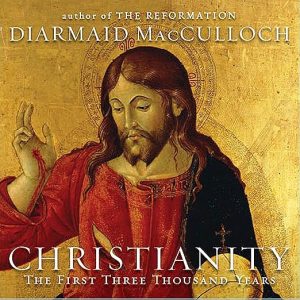
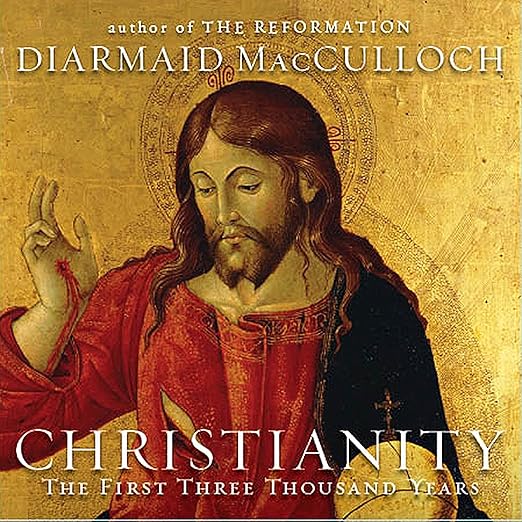
Few books genuinely justify the word “monumental”, but Diarmaid MacCulloch’s Christianity: The First Three Thousand Years earns it without embarrassment. At forty-six and a half hours of listening, this is not a casual audiobook – it is an education. MacCulloch, Emeritus Professor of Church History at Oxford, brings to the subject not only formidable scholarship but a prose style that remains readable at 1,184 pages of underlying text. What he has produced is, quite simply, the most comprehensive single-volume history of Christianity in English, and Walter Dixon’s narration does it the justice it deserves.
I should be honest: this is not a book for the commute. It rewards sustained, attentive listening over weeks rather than hours. But the rewards are commensurate with the investment – by the end, you will understand not just what Christians believe, but why those beliefs took the shapes they did, and how they have driven some of history’s most consequential events.
About the Audiobook
MacCulloch begins not with the Nativity but with ancient Israel and the Hebrew Bible – a deliberate and important choice that situates Christianity within a longer religious and cultural inheritance rather than treating it as a sudden rupture. From there, the book follows three main strands of the faith – Eastern Orthodoxy, Roman Catholicism, and Protestantism – across three millennia and across the globe, giving careful attention to the often-neglected Christian traditions of Africa and Asia that Western church histories routinely elide.
The range is staggering. We move from the formation of the New Testament canon through the great Councils, the schisms, the Crusades, the Reformation and its multiple aftershocks, the age of mission and colonialism, the evangelical revivals of the eighteenth and nineteenth centuries, and into the twentieth century’s cataclysms. Throughout, MacCulloch maintains a clear-eyed pragmatism about the relationship between faith and power – he is neither an apologist nor a debunker, but a historian in the fullest sense. His account of how Christianity both enabled and constrained the Enlightenment is particularly illuminating.
MacCulloch is himself the son of an Anglican clergyman, and there is a quality of felt understanding in his writing that purely academic historians sometimes lack. He writes about faith with genuine respect for what it means to believers, even when he is being critical of institutions.
The Narration
Walter Dixon is one of the reliable workhorses of serious non-fiction narration, and he is very well suited to this material. His voice carries natural authority without pomposity – essential for a text that can tip into academic density in places. Dixon navigates MacCulloch’s lengthy, clause-heavy sentences with composure, maintaining comprehensibility even when the subject matter grows genuinely complex. He handles the extensive cast of historical figures – monks, crusaders, reformers, theologians, slave traders, abolitionists – without recourse to theatrical differentiation, which is exactly the right call for a work of this register.
What Readers Say
With a 4.4 rating, this is genuinely well received by the small but committed cohort who have tackled it. UK listeners have been characteristically measured in their praise: one described it as “thorough, in-depth, and comprehensive, not drab or boring in the least” and was particularly struck by its attention to Eastern Christianity including Syriac Christians of Kerala. Another noted that “it’s worth persevering with as the stories of how some of the elements were discovered” – clearly mixing up their MacCulloch with Aldersey-Williams, but the sentiment of persevering through density to reach reward is apt. A more searching reader noted that the book “swings to the academic paper in places” and can be cross-referential to a fault, which is a fair observation. MacCulloch himself would probably accept it.
Who Should Listen?
This audiobook is for serious listeners with a genuine interest in history, ideas, and the forces that have shaped civilisation. It is not a devotional text, nor is it a polemical one – it is history at the highest level of scholarly ambition. Believers who can tolerate a non-confessional approach will find it illuminating; non-believers who are tired of facile dismissals of religion will find a more textured account than they might expect. If you’ve read and admired Tom Holland’s Dominion or Karen Armstrong’s A History of God, MacCulloch is the next step up in scope and rigour.
Begin this one on Audible UK via this link – and clear your schedule.