Clara’s Verdict
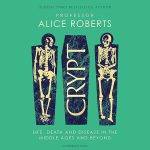
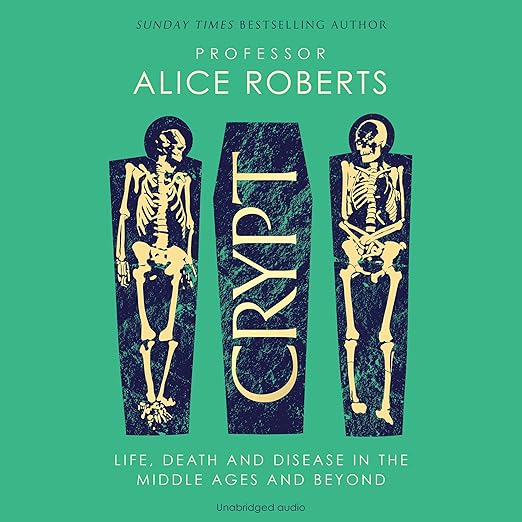
Alice Roberts occupies a peculiar and valuable position in British popular science writing: she is a working academic who also happens to be genuinely brilliant at explaining what her discipline actually does. Crypt is the third and final book in her trilogy on osteoarchaeology – the study of human remains – and it’s the most ambitious of the three. It takes on medieval Britain, which is a remarkable period for anyone interested in disease, power, faith, and the bodies that bore the brunt of all three.
A Sunday Times number one bestseller and one of Waterstones’ best history books of 2024, Crypt is the kind of audiobook that makes you genuinely angry you weren’t taught history this way. Roberts uses bone evidence, genome sequencing, and contemporary archaeology to tell stories that the written record – almost entirely composed by and about the powerful – simply cannot tell. The result is intimate, surprising, and at times genuinely moving.
And Roberts narrates it herself. That, for a book of this kind, matters enormously.
About the Audiobook
Crypt is structured as seven distinct stories, each anchored to a specific set of human remains and a specific historical moment. The breadth is impressive: we move from the patients of one of England’s earliest hospitals to the victims of the St Brice’s Day Massacre of 1002, in which Ethelred II ordered the killing of Danish settlers. We encounter the devastating spread of plague and syphilis through medieval Europe. We follow the murder of Thomas Becket in Canterbury Cathedral and the subsequent destruction of his tomb during the Reformation. And we meet the archers who went down with Henry VIII’s flagship, the Mary Rose.
What unites these stories is Roberts’ use of cutting-edge science: palaeopathology, ancient DNA analysis, isotope tracing. Techniques that barely existed twenty years ago are now allowing archaeologists to determine not just who people were but where they were born, what diseases they carried, whether they were migrants, what they ate, and how they died. Roberts explains these methods with admirable clarity – never oversimplifying, never getting lost in jargon – and the result is a history of Britain that is genuinely more inclusive than anything previously possible.
She is also, it should be said, refreshingly clear-eyed about the limits of her discipline. The science can tell us a great deal, but it cannot tell us everything, and Roberts is careful not to overclaim. That intellectual honesty makes the moments where the evidence does speak clearly all the more powerful.
The Narration
Roberts reads her own work, and the effect is precisely what you’d hope for. There is an ownership to self-narration that professional readers – however skilled – cannot replicate: she knows where the emphases belong because she made the arguments, and the result is a measured, engaged delivery that feels like a very good lecture rather than a reading. Her voice is clear and unhurried, with enough warmth to prevent the more technical passages from becoming dry. The Canterbury section is particularly well delivered – Roberts has an evident personal connection to the material, and it shows.
At just under ten hours, the audiobook is an efficient package for the amount of ground it covers. The production is clean throughout, with no distracting background elements.
What Readers Say
The response on Audible has been strong: 4.5 stars from 604 reviewers, with a notably high proportion of detailed, engaged reviews. “Brilliant read – packed with fascinating insights into how people lived and died throughout history. Well written, accessible and full of intriguing detail,” wrote one UK listener. Another praised Roberts’ ability to “help you understand the facts on a technical level, but also make you feel them in your bones” – a phrase that, given the subject matter, is inadvertently perfect.
The Daily Telegraph called it “compulsive”; the Evening Standard “gripping.” A recurring theme in reader responses is the Canterbury chapter, which several describe as unexpectedly affecting. More than one listener found themselves rethinking their knowledge of medieval history wholesale. That kind of intellectual reorganisation is what the best popular science writing achieves, and Roberts achieves it here.
Who Should Listen?
This is for anyone with an interest in British history, archaeology, or the history of medicine – but it will also appeal to readers who simply want well-written, intellectually rigorous narrative non-fiction. You do not need to have read the previous two books in the trilogy (Roberts provides all the context you need), though dedicated listeners will want to go back to Buried and Ancestors afterwards.
It would pair particularly well with Mary Beard’s Roman history audiobooks or Dan Snow’s work for listeners who want popular history that doesn’t talk down to them. Available on Audible UK, Kobo, Scribd, and Storytel. Listen to Crypt on Audible UK – one of the most genuinely illuminating history audiobooks I’ve reviewed this year.