Clara’s Verdict
Paul Theroux is not a comfortable travel writer, and Dark Star Safari – his overland journey from Cairo to Cape Town – is not a comfortable book. It is, however, an exceptional one. Theroux made his first African journey as a young teacher in Malawi in the 1960s, and returning forty years later he finds a continent that has been, in his blunt assessment, largely failed by the foreign aid and missionary presence that was supposed to help it. Whether you agree with him or not – and many readers have strong feelings either way – the writing is extraordinary: precise, wry, full of the kind of detail that only extended overland travel by local transport can produce.
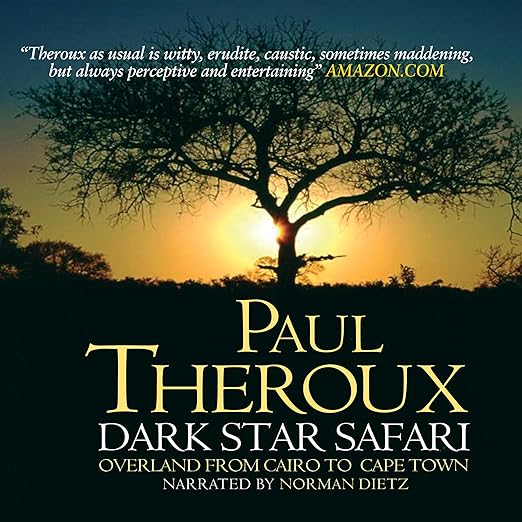
This audiobook edition, narrated by Norman Dietz, was published in early 2026 and brings one of the great modern travel books to a new generation of listeners. At nearly twenty-three hours, it is a commitment – but then the original overland journey from Cairo to Cape Town took months, and some proportion of that physical duration is worth giving to the account of it.
About the Audiobook
The route alone is formidable: Cairo to Cape Town by train, boat and cattle truck, through Sudan, Ethiopia, Kenya, Uganda, Tanzania, Malawi and Mozambique, with diversions into the complexities of each country’s post-independence history. Theroux is not content merely to describe landscapes, though his landscape writing is superb. He is constantly asking why – why has Africa’s development stalled, why do aid workers seem to insulate themselves from the populations they claim to serve, what has actually been achieved by decades of international intervention?
The personal strand – revisiting his old school in Malawi, tracking down former students now in their fifties, measuring the distance between promise and reality – gives the book an emotional dimension that pure reportage lacks. At nearly twenty-three hours, the audiobook is a substantial commitment, but it moves with the unpredictable energy of the journey itself.
The Narration
Norman Dietz narrates for W. F. Howes Ltd., and his delivery suits Theroux’s prose well. Theroux writes in a style that is simultaneously lyrical and acerbic – capable of a beautiful descriptive sentence immediately followed by a sharp, deflating observation – and Dietz handles these tonal shifts with evident experience. He does not perform the text so much as inhabit it, which is exactly what this kind of personal travel writing requires.
At nearly twenty-three hours, this is a long listen by any standard, but the pacing is consistent and the material never drags. For listeners who find long travel books more rewarding than quick narratives – who want the sense of a genuine journey, with all its delays and detours and unexpected conversations – this is an ideal audiobook experience.
What Readers Say
Readers who know Theroux’s work well tend to consider this his finest travel book. A.R.V. Riding, writing on Amazon UK, called it “one of the best travel books ever written” – praise which, from someone familiar with nearly all of Theroux’s output, carries weight. They particularly praised his quality of asking not just what but why, which elevates the book above conventional travel journalism.
J. O’Connor noted how the book changed their perspective on African nations and on the role of aid workers and missionaries – the kind of genuine intellectual provocation that marks the best non-fiction. Erik Peterson, who read the book while recovering from malaria in a Malawian hospital, offered the most vivid testimonial to its keeping power. One dissenting voice noted that the book can be relentlessly bleak – Theroux is not interested in consoling fictions. The original edition holds a rating of 4.4/5 from 1 listener ratings on Audible.
Who Should Listen?
A note on expectations: Theroux is not a comfortable companion. He has opinions – about aid work, about missionaries, about the effects of Western intervention – that are stated directly and without the diplomatic hedging that most non-fiction adopts when tackling contested ground. Some readers find this bracing; one reviewer abandoned the book because the accumulated bleakness became too heavy. Both responses are entirely legitimate. What is not in question is the quality of the writing and the rigour of the observation. This is a book that takes Africa seriously enough to be honest about what he finds, which is itself a form of respect.
Essential for serious readers of travel writing who want something with intellectual ambition beyond the usual adventure memoir. Equally valuable for anyone interested in modern African history, in the politics of international development, or in the legacy of colonialism as experienced on the ground by a shrewd and unsparing observer.
Not recommended for anyone seeking an uncomplicated, uplifting journey – Theroux is honest to a fault, and that honesty sometimes makes for uncomfortable listening. If you want travel writing that treats you as an adult, listen on Audible UK.