Clara’s Verdict
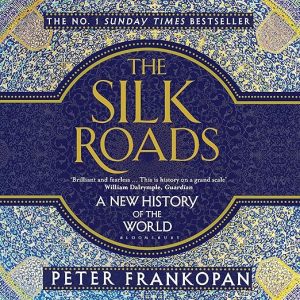
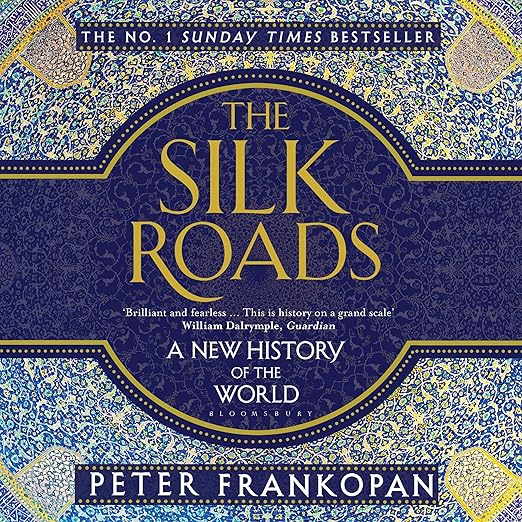
Peter Frankopan’s The Silk Roads is one of those books that genuinely shifts how you think – not through polemic or provocation, but through the patient accumulation of evidence for a different way of seeing the world. Its central argument is elegant and radical in equal measure: the conventional Western narrative of civilisation (Greece, Rome, Christianity, Renaissance, Enlightenment, Industrial Revolution) leaves out most of human history, which was made and remade in the lands stretching from eastern Europe through Central Asia to China and India. The audiobook, narrated by Mike Grady across 25 hours, is a superb way to spend extended time – this is genuinely one of the most important popular history books of the past decade, and the audio format suits its breadth beautifully.
About the Audiobook
Frankopan is an Oxford historian with a specialism in Byzantine and Silk Road history, and it shows in the depth and specificity of his command of the material. He covers roughly 2,500 years of human activity across a geographic arc that most Western readers know primarily through its contemporary geopolitical crises: the Middle East, Central Asia, China, India, Persia. His argument is not that the West has been unimportant, but that its importance has been wildly overstated relative to the civilisations that surrounded, preceded, and shaped it.
The scope is vast. Frankopan traces the ancient trade networks that linked the Mediterranean to Persia, India, and China; the spread of the world’s great religions along these routes; the rise and fall of the Mongol empires; the catastrophic arrival of the Black Death and how it travelled; the opening of Atlantic sea routes by European powers and what that displacement meant for the land networks they bypassed; the colonial period; the twentieth century’s reshaping of the region through oil, war, and superpower competition; and the contemporary reassertion of Central and East Asian economic power. The Silk Roads are rising again, Frankopan argues, and understanding their history is prerequisite to understanding the present.
He is equally comfortable writing about ancient Persian trade networks and twenty-first-century Central Asian pipeline politics, and the transitions between centuries never feel forced. The same intellectual ligaments connect the fall of the Mongol empire to the discovery of American silver to the British East India Company to the present-day Belt and Road Initiative – Frankopan is one of the few historians who can make that connective tissue visible without making it feel schematic. Throughout, the writing is bracingly confident and rigorously accessible. Frankopan never lets scholarly care become an obstacle to readability – he has a gift for the telling detail and the perfectly chosen example. At 25 hours, this is a substantial listen, but it never drags.
The Narration
Mike Grady is an excellent choice for this material. His delivery is measured and authoritative without becoming ponderous, and he handles the breadth of the subject – covering more than two dozen countries and two and a half millennia – with steady confidence. The pacing gives listeners time to absorb dense geopolitical and historical information without feeling rushed. For a book of this scope, clear narration is not optional; Grady provides it reliably from first chapter to last.
What Readers Say
Critical response has been exceptional. One UK reviewer described it as “geopolitics over 2,000 years – a perspective of exceptional value,” specifically praising Frankopan’s success in moving beyond the Western-inevitability narrative. Another called it “magisterial” and “an epic book with an epic theme,” noting that Euro-centrism omits people and places of “the utmost importance” and that Frankopan’s scholarship is “delivered in a very readable style.” A reviewer writing from Germany praised it as “Weltgeschichte neu erzählt – world history retold from the margins to the centre.” The book holds a 4.6 rating from 9 listeners. The Guardian called it “brilliant and fearlessly wide-ranging”; the Daily Telegraph named it History Book of the Year; the Evening Standard called it “dazzlingly good.” It was the number one Sunday Times bestseller on publication.
Who Should Listen?
The book’s publication in 2015 preceded several of the geopolitical developments – the Belt and Road Initiative’s acceleration, the renewed tensions along the old Silk Road corridors – that have since made its central argument feel prophetic rather than merely revisionist.
Anyone with an interest in world history, geopolitics, or the forces shaping the contemporary rise of China, India, and Central Asia as global powers. The Silk Roads is particularly valuable for listeners whose reading has been predominantly Western-focused – it doesn’t replace that knowledge, but it recontextualises it in ways that change how you read the newspaper. Also strongly recommended for business readers interested in the deep historical roots of current trade patterns, and for anyone who found themselves asking, after recent decades of geopolitical upheaval in the Middle East, “how did we get here?” Frankopan’s answer is thorough, illuminating, and delivered with a historian’s precision and a storyteller’s skill. Available on Audible UK, Kobo, Scribd, and Storytel.