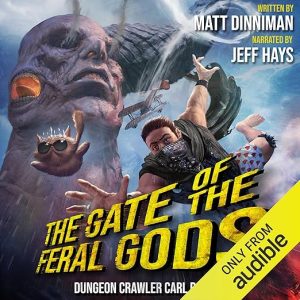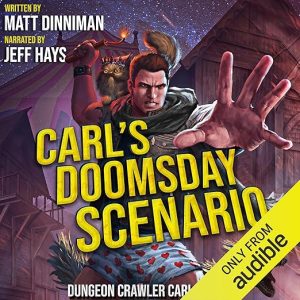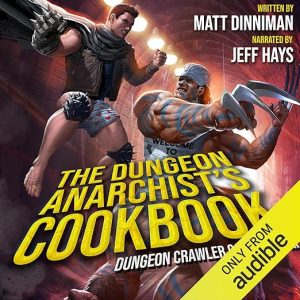
Clara’s Verdict
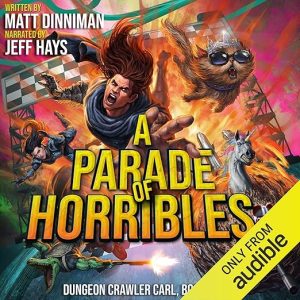
I put this one off for a long time, and I was wrong to. The title reads like a joke. The premise reads like a joke. A man, his ex-girlfriend’s cat, and a sadistic game show with no precedent anywhere in the universe does not sound like the description of a book that will make you feel anything. Then, some way into these thirteen and a half hours, Matt Dinniman quietly reveals that the joke has been load-bearing all along, and that the thing he is actually writing about is the attention economy.
The setup is beautifully cruel. Every building on Earth collapses and sinks into the ground at once, from Buckingham Palace down to the smallest shed. Those structures, and everyone inside them, are atomised and rebuilt as an eighteen-level labyrinth large enough to circle the globe. Once you go in, you cannot get out, and each level runs on a timer. What makes it more than a competent apocalypse is the rule that governs survival. It is not about strength or dexterity. It is about followers, views and clout. You do not merely have to kill the monsters. You have to kill them entertainingly, or the audience stops watching and you are finished.
About the Audiobook
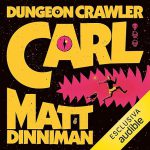
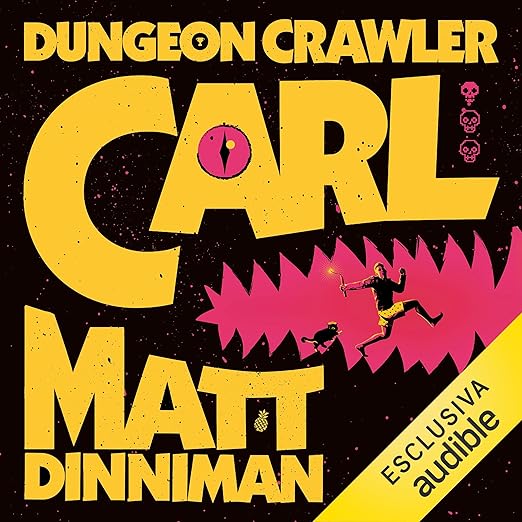
This edition arrived from Audible Studios on 28 January 2021 and runs to thirteen hours and thirty-one minutes. It is the first book in the Dungeon Crawler Carl series, and here the reading order matters. A dungeon of eighteen levels and a steadily growing audience is a structure built to compound, and starting at the top is the only way the escalation means anything at all.
The satire is what elevates it above the crowded field it sits in. Books built on game mechanics usually treat the system as a scaffold for power fantasy. Dinniman treats it as a broadcast format, and the incentives inside the dungeon are ones a streaming platform would recognise instantly. The book says so outright: not strength, not dexterity, but followers, views and clout. Personality outperforms competence, and an audience has to be built before it can be kept. All of it is played entirely straight inside the world’s own logic, which is why it lands as satire and not as a lecture.
A word about register before you start, because this one polarises. The reviews call it violent and gory without hesitation, the humour is irreverent by design, and it is packed with pop-culture references that will delight some listeners and date the book for others. It is also, by the same reviewers’ account, poignant. That last quality is the one nobody warns you about, and it is what separates the book from the parody it could so easily have been.
The Narration
Jeff Hays narrates, and the narration is a substantial part of the case for choosing audio here. Three things run at once: Carl, the cat travelling with him, and the game itself, which the book stages as a broadcast enjoying the carnage far too much. On the page you assemble those registers yourself. A narrator either hands them over fully formed or lets them blur into a single voice, and a great deal of how this book lands depends on which.
Comic timing is the obvious requirement. The harder one is tonal range, because the reviews describe a book that manages to be poignant and funny at the same time, and a reader who cannot turn cleanly between those two leaves the emotional beats stranded in the wrong key. Add a large cast of humans and monsters that all has to stay distinguishable, and this becomes one of the more demanding narration jobs the genre offers. If you take one recommendation from me, make it this: hear Dungeon Crawler Carl rather than read it.
What Readers Say
Upwards of 94,000 ratings have landed this at 4.6 out of 5, and the written responses follow a pattern I find rather charming. The five-star review at the top of them, from Ashers, begins by confessing to being unconvinced by the title and ends by giving in completely.
It is hands down one of the most entertaining books I’ve ever read.
The same review singles out Carl and Princess Donut as one of the most unlikely double acts it has come across, and it is easy to see why that pairing is what it dwells on. A four-star listener, S. Hewlett, needed a few chapters to settle into it and then delivered the sharpest description of the book’s texture on the page.
DCC is violent, gory, bizarre, poignant and funny. Like any great RPG should be.
The third review, from Mr Craig Wilkinson, is the most useful for working out whether you are the audience.
Will resonate especially with gamers but is equally an entertaining jaunt for anyone who likes irreverent humour and an unusual premise.
Who Should Listen?
Gamers will get the most jokes, but the book is nowhere near as gated as the premise suggests, and that reviewer is right that a taste for irreverence and an appetite for the odd are the real entry requirements. It suits anyone who enjoys apocalyptic comedy, satire of internet culture, or long series with a large cast worth investing in. Thirteen and a half hours goes remarkably quickly, and a first volume covering a dungeon of eighteen levels is plainly not planning to stop where it stops.
Steer clear if graphic violence and crude humour are things you avoid, because the reviews reach for violent and gory without hesitation and the book makes no apology for either. Readers who dislike game mechanics rendered as prose should also think twice, since a dungeon that runs on levels, timers and follower counts is going to keep telling you so. If none of that puts you off, you are in for one of the most purely enjoyable things in audio.