Clara’s Verdict
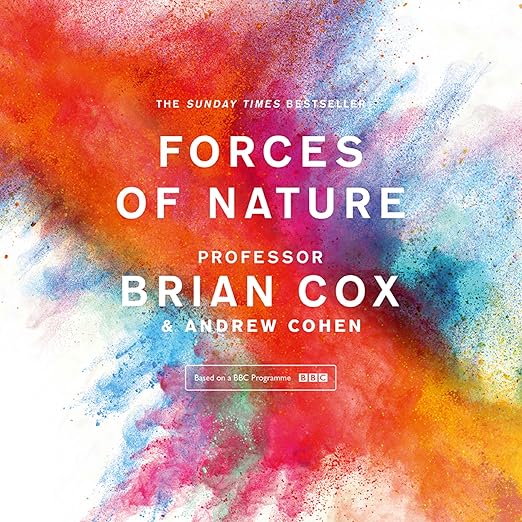
Brian Cox has an unusual gift: the ability to make the fundamental laws of physics feel not just comprehensible but genuinely moving. Forces of Nature was originally the companion to his BBC One television series of the same name, and while it works perfectly well without the programme, the experience of having watched Cox stand on a Himalayan precipice while explaining why snowflakes are hexagonal does lend the audio a particular vividness. Samuel West’s narration carries that visual quality into pure sound with considerable skill, and the result is seven hours of science that functions, at its best, as a sustained act of wonder. This is what popular science writing can be when it is done well – rigorous, lyrical, and impossible to put down.
About the Audiobook
Cox’s starting point is deceptively simple: what are the underlying laws that govern everything around us, from the shape of a raindrop to the spiral of a galaxy? The book travels from Iceland’s mid-Atlantic ridge to Indonesian volcanoes, from the precipitous cliffs of Nepal to the Florida coastline, using each location not merely as a scenic backdrop but as a gateway into a deeper physical principle. Why are rainbows always the same shape, wherever you encounter them? Why does life so frequently organise itself into spirals? What does the precise hexagonal structure of a snowflake reveal about the nature of matter at the molecular level, and why does that structure arise every single time?
The approach is cumulative and carefully constructed – each answer reveals a larger pattern, until the everyday world becomes a window onto the universe beyond it. Cox is careful never to condescend, but equally careful never to lose the general reader in technical abstraction. The result is a book that manages to be rigorous and lyrical simultaneously, which is a more difficult balance to maintain than it appears. The Sunday Times bestseller tag is well deserved. Published in 2017, the book has dated gracefully – the fundamental laws, after all, do not update themselves between editions.
The Narration
Samuel West is among Britain’s finest audiobook voices, and he is beautifully matched to this particular material. His educated, unhurried delivery gives the science room to breathe, and his instinct for where emphasis will land with most effect means the key moments – the revelatory connections between apparently unrelated phenomena that Cox deploys so well – arrive with appropriate weight and clarity. At seven hours and fifteen minutes, this is a comfortable half-day listen, and West makes it feel shorter than it is. He does not attempt to impersonate Cox, which is the right decision; instead, he captures the spirit of the writing – serious, enthusiastic, and fundamentally optimistic about the capacity of human knowledge to illuminate the world around us.
What Readers Say
With a 4.6 rating, listener response is consistently warm and thoughtful. “This book tells an incredible story,” wrote one UK reviewer. “It covers not only humanity’s developing knowledge but applies it to explain deeply and meaningfully the answers to some seemingly simple questions. Cox has covered it all tremendously and written a book that will leave you fascinated by the world around you and connected deeply to it all.” Another praised the book’s ability to serve both enthusiastic science readers and general audiences: “Cox manages to explain things very well in laymen’s terms – it’s not a light read if you’ve never studied physics, but he doesn’t dumb down the science and speaks to you as an equal.” A third noted that it functions perfectly as a companion to the television series while standing entirely on its own merits.
Several listeners noted that the book works particularly well in audio format: Cox’s writing has an inherent rhythm that suits the spoken word, and Samuel West’s narration draws out that musicality in ways that silent reading does not always surface.
One reviewer offered a measured view: “covers well-trodden ground but does so in an easy-to-understand manner” – a fair characterisation of popular science as a form, and not a criticism that diminishes the experience.
Who Should Listen?
Anyone with an interest in the natural world, physics, the history of scientific ideas, or simply in understanding more about the physical reality they inhabit will find this rewarding. It is particularly well suited to listeners who want to feel more genuinely connected to the world around them – the kind of book that makes you look at a puddle differently, or notice the arc of a thrown stone in a new way, or stop to wonder why the sunset produces those particular colours. Cox fans who have worked through his other titles will not be disappointed. Newcomers to popular science will find this an accessible and thoroughly enjoyable entry point.
Science teachers, curious teenagers, and anyone who has ever stared at a rainbow and wanted more than a vague recollection of ROYGBIV should listen to this without delay. Find Forces of Nature on Audible UK and let Professor Cox take you somewhere genuinely extraordinary.