Clara’s Verdict
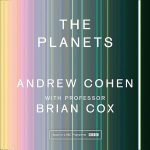
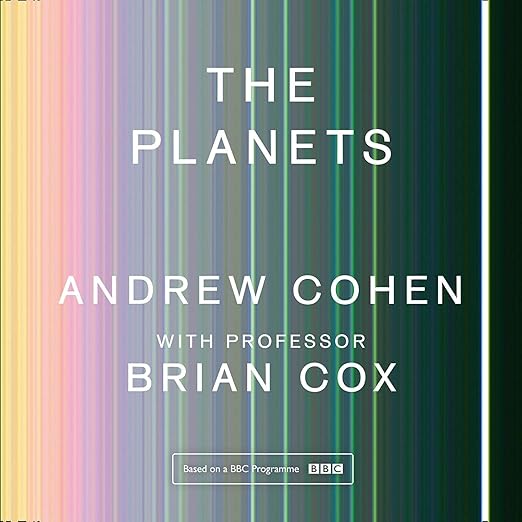
There is a particular kind of Saturday morning that suits Brian Cox. You are still in your dressing gown, coffee going cold on the side table, and suddenly an hour has vanished while you have been staring at an image of Saturn’s rings and wondering quite how you ended up feeling so small and so grateful simultaneously. That is what listening to The Planets does. Narrated with composed intelligence by Samuel West, this companion to the BBC television series is one of those audiobooks that reminds you science writing can also be literature.
Cox and co-author Andrew Cohen do not condescend. They pitch this at curious adults who want rigour alongside wonder, and they mostly deliver it. At just under eight hours, it is the right length for the ambition: enough time to travel properly through each world without overstaying its welcome. I finished the bulk of it on a train journey back from Edinburgh, and the audiobook made the grey Scottish countryside entirely irrelevant.
About the Audiobook
The conceit of The Planets is simple but effective: each of the eight major bodies of our solar system (plus the demoted Pluto) gets its own chapter, and each is treated not merely as a scientific object but as a character with a story. Mercury is the tragedy, a world scorched into submission by a star it orbited too closely. Venus is the cautionary tale, a planet that greenhouse-gassed itself into a hellish four-hundred-and-sixty-degree existence that ought to alarm anyone even slightly worried about climate change. Mars is the great might-have-been, a world that once had flowing water and perhaps the conditions for life, now a rust-coloured monument to atmospheric loss.
Then there is the outer solar system, which is where the book really opens out. Jupiter, with its Great Red Spot, a storm that has been raging for at least four centuries, and its moon Europa, whose subsurface ocean is one of the most compelling candidates in our search for extraterrestrial life. Saturn, whose rings are so visually extraordinary that even describing them feels inadequate. Cox and Cohen are honest about what we do not yet know, which is much of it, and that scientific humility sits alongside the genuine wonder without contradiction. The inclusion of recent NASA photography in the print companion is referenced throughout, which does create the odd moment where you wish you had the book in hand alongside the audio, but West navigates the descriptive passages with enough precision that you can form a picture clearly enough.
Pluto receives a particularly touching treatment, its reclassification to dwarf planet status mourned with gentle affection. The section on the Kuiper Belt and the wider reaches of our system serves as a reminder that what we think of as the solar system is almost comically small relative to the void beyond it. This is the kind of information that should probably induce existential dread but, in Cox and Cohen’s hands, produces something closer to exhilaration. The book was published in 2019 as a companion to the BBC series, and some discoveries in planetary science have moved on since then, particularly regarding Mars and the oceanic moons. This is worth knowing going in, but it does not meaningfully diminish the experience.
Samuel West and the Art of Science Narration
Samuel West is an excellent choice. Best known as an actor of considerable stage and screen pedigree, he brings a calm, measured authority that never tips into the hectoring enthusiasm that can make popular science audiobooks feel like a lecture. He handles the more technical passages, discussions of axial tilt, gravitational dynamics, and atmospheric composition, with the same clear-eyed composure as the lyrical descriptive sections, and crucially he never sounds as though he is performing wonder. The wonder comes through because it is in the material, and West trusts that. His voice has a warmth that suits Cox’s particular brand of accessible scientific optimism, and he gives each planet a slightly different emotional colouring without forcing it.
What Readers Say
The audience response has been notably warm, and a 4.7 rating from the available reviews is a reliable positive signal. One UK listener described it as "absolutely superb, brilliantly written in a manner that covered all depths of knowledge," comparing it favourably to the authors’ work on black holes. Another offered particular praise for the companion book’s physical production quality. A dissenting voice raised a legitimate point: the print edition’s photography can be confusing in digital format, with captions and picture ordering sometimes becoming muddled on Kindle, and the occasional proof-reading lapse. This is primarily a criticism of the print edition rather than the audio. West’s narration irons out such concerns entirely.
Who Should Listen?
Ideal for anyone who watches BBC science documentaries and wants to go slightly deeper; for listeners who found A Brief History of Time compelling but found Hawking’s prose occasionally impenetrable; for those with an interest in planetary science who are not trained scientists. It also works beautifully as commuting company. The chapter structure means you can finish a planet per journey without feeling you have broken anything. Those who want cutting-edge post-2019 research will want to supplement with more recent sources, but as a grounding in the solar system’s personalities, this remains the most enjoyable audio treatment available.